Early Retirement in Swiss Construction: FAR Pension 2026

In one minute
The FAR pension lets you stop working at 60 in the main construction trades. It runs until you reach AHV age and pays 65% of your last agreed annual wage plus CHF 6,000 a year, capped at CHF 6,006 a month in 2026. Since July 2025 you need 20 contribution years in the last 25, with the last seven unbroken.
Plenty of pages still talk about "70% of your wage" and 15 contribution years. The first is a rule of thumb; the second stopped applying on 1 July 2025. And hardly anyone mentions what the FAR pension doesn't cover: your AHV contributions until 65, and saving in your pension fund. We've pulled everything together from the collective labour agreement (GAV FAR), the FAR regulations and the FAR foundation's information sheets, as of October 2026, and checked the sums with examples. The foundation publishes in German, French and Italian only, so most of the links below lead to German pages.
What FAR is and who it covers
FAR stands for "flexibler Altersrücktritt", flexible retirement in the main construction sector. The Swiss Builders' Association (Schweizerischer Baumeisterverband, SBV) and the unions GBI (now Unia) and Syna agreed it in 2002. It has applied since July 2003, and Baukader Schweiz joined later that year. It rests on the GAV FAR, which the Federal Council has declared generally binding. That means it applies to every company in its scope, even if the boss belongs to no association.
The companies covered work in building construction, civil engineering, road building and tunnelling, excavation and demolition, stonemasonry and paving, facade construction (except building envelope work), waterproofing and insulation, concrete repair, asphalt and screed floors, and track construction. According to the FAR foundation, concrete drilling and cutting only counts if the company is a member of the builders' association, because that part was never declared generally binding. You're covered as a person if you work for such a company on site or in a support unit such as the yard or workshop: as a site foreman (Polier), foreman, bricklayer, road builder, construction worker with or without a certificate, machine operator, driver or warehouse worker. Site managers and other management staff, technical and office staff, and canteen and cleaning staff are not covered. Many companies in Valais and Vaud have their own funds, as long as these pay at least equivalent benefits.
Temporary work in construction
Time when a staffing agency sent you to a FAR employer counts towards your contribution years, provided your role falls under the agreement and contributions were paid for you. So check that the FAR deduction appears on your payslips. Without the contributions, the time doesn't count. That also applies to assignments before April 2006: until then, staffing agencies didn't have to pay FAR contributions yet. The next question is whether you have enough years.
Who gets the FAR pension?
You get the full pension if you're 60, haven't yet reached AHV age, have worked and paid contributions with a FAR employer for at least 20 of the last 25 years, the last seven without a break, and then stop working for good. That's what Art. 13 of the FAR regulations says, and it applies to every pension starting on or after 1 July 2025.
You'll often read that you need "20 years in a row". That's wrong. The 20 years can fall anywhere in the 25-year window. Only the last seven before your pension starts have to be unbroken. That's exactly where the expensive mistakes happen: someone who moves at 56 to a company outside the FAR agreement for a year gets no pension at 60, even with 30 years in construction before that. They have to wait until they have seven years in a row again, in this case until 64.
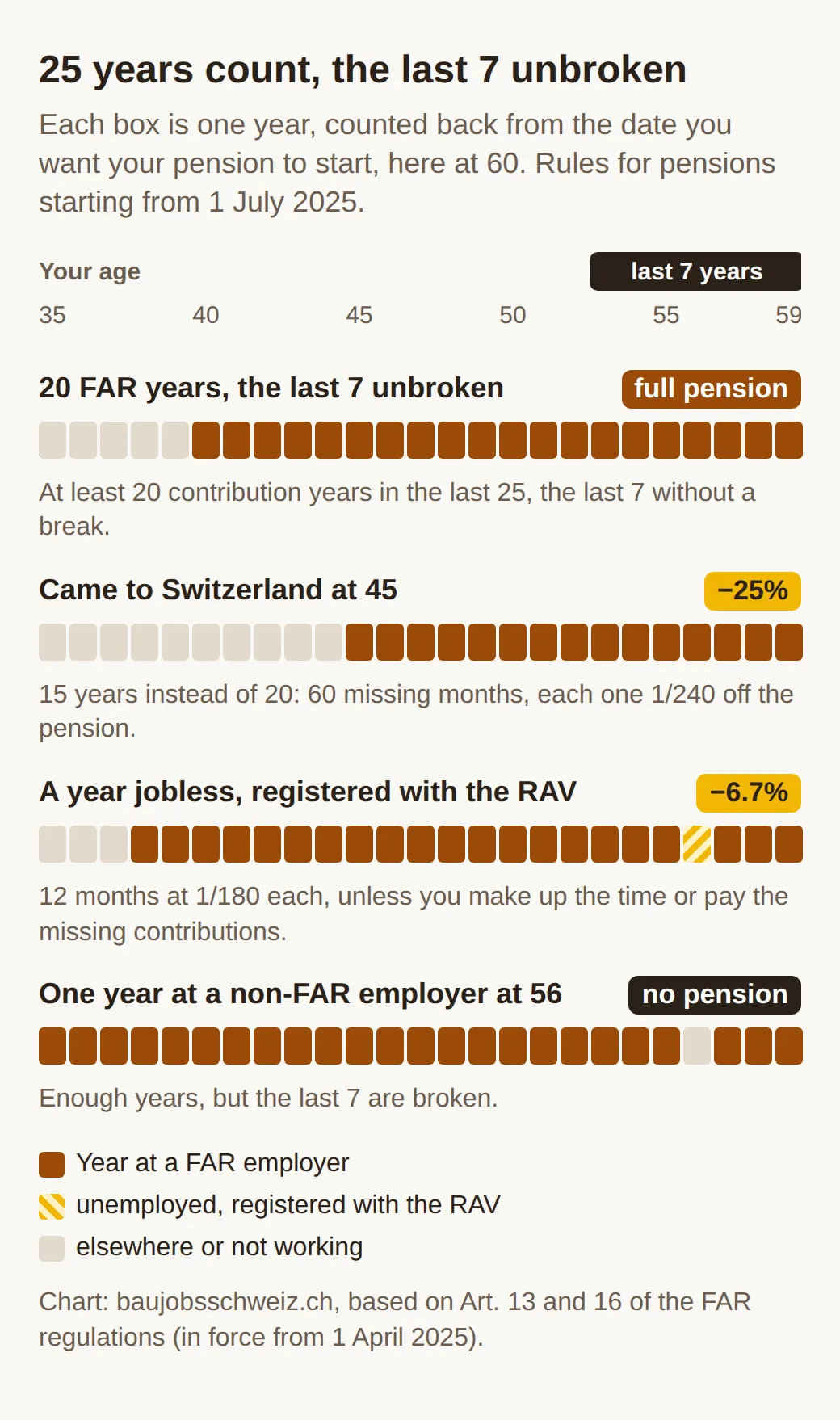
A few exceptions soften the rule. If you became unemployed in the last seven years and registered with the regional employment centre (RAV), the gap can be two years at most. You can make up the missing time by working, or pay the employer's and employee's contributions for it. Otherwise the pension is cut by 1/180 for each missing month, so one year costs 6.7%. Unpaid leave of up to six months doesn't usually break the seven years, provided it isn't in the last year before your pension, you go back to the same employer afterwards and you earn nothing during that time. The pension is then cut for the length of the leave.
If you worked part-time, seasonally or only partly because of a partial disability (IV) pension, a year counts in full as long as you worked at least 50% for a FAR employer. With a disability, that only applies up to a half IV pension. The pension itself is still reduced pro rata for part-time years.
If you're only a little short, the foundation's board can still grant a pension in individual cases, as long as you worked mainly in the main construction sector. It then asks for the missing contributions and may reduce the pension.
How much does the FAR pension pay?
The full pension is 65% of your pension base wage plus CHF 6,000 a year, divided by twelve. The pension base wage is the agreed annual wage for your last year of work, without allowances and overtime. If your agreed monthly wage went up or down by more than five percent from one year to the next during the last three years, the foundation takes the average of those 36 months.
There are two upper limits. The pension can't be more than 80% of the pension base wage, and it can't be more than 2.2 times the maximum AHV old-age pension. That's why the FAR foundation gives a maximum pension of CHF 6,006 a month for 2026. The figure works out once you include the new 13th AHV pension: 13 times CHF 2,520, times 2.2, divided by twelve. Until the end of 2025 the limit was 2.4 times twelve AHV pensions, which came to CHF 6,048. The lower factor offsets the 13th AHV pension, so the limit in francs stays about the same.
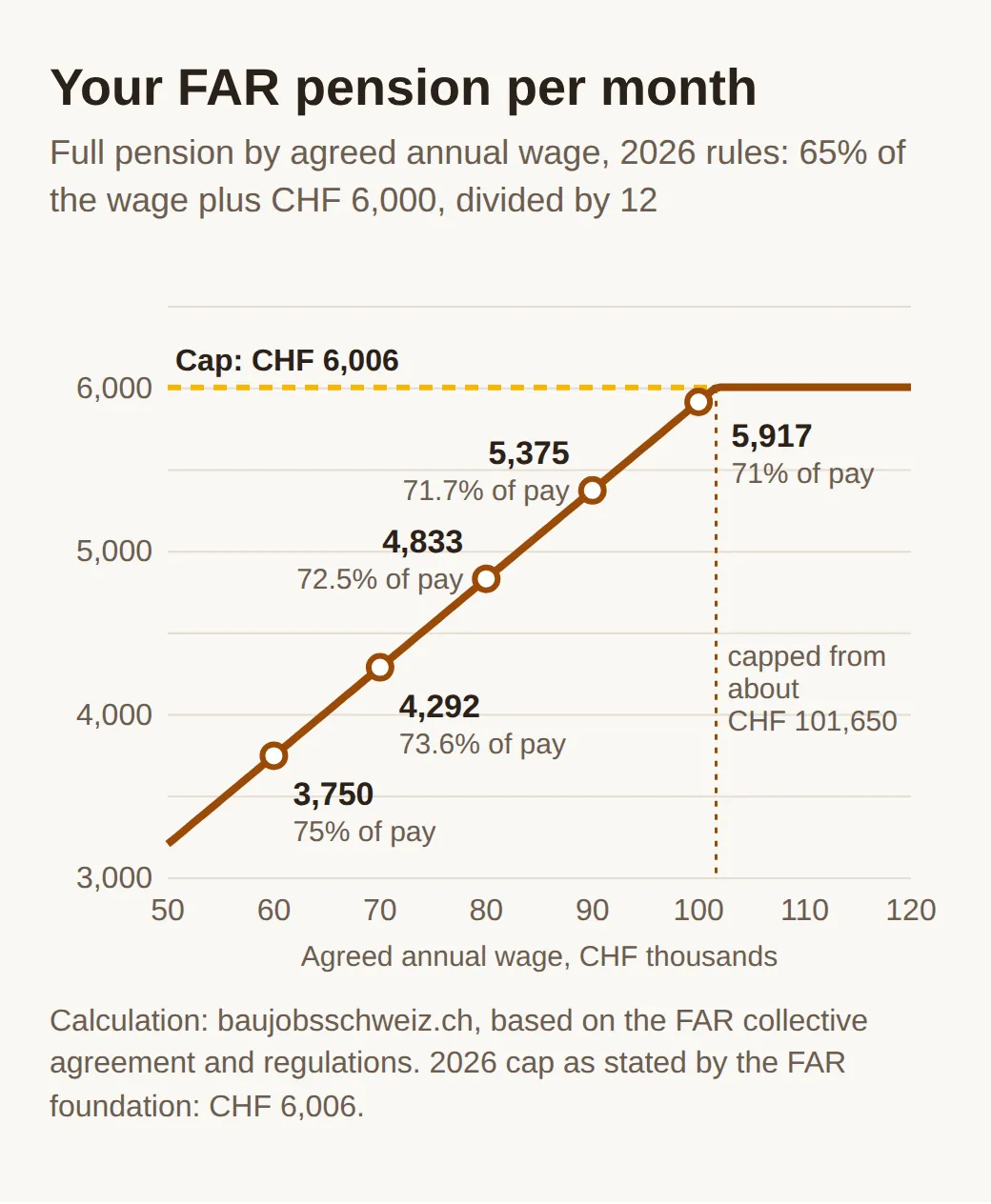
An example: on an agreed annual wage of CHF 80,000 you take 65% of it, which is CHF 52,000, and add CHF 6,000. That's CHF 58,000 a year or CHF 4,833 a month, just over 72% of the wage. On CHF 60,000 it's CHF 3,750, or 75%; on CHF 100,000 it's CHF 5,917, or 71%. That's where the 70% rule of thumb comes from: lower earners end up above it thanks to the fixed base of CHF 6,000. The 80% limit only applies below an annual wage of CHF 40,000, so it hardly ever affects a full-time construction job. You reach the maximum pension from about CHF 101,650.
There's one trap with your working hours: if you cut back in the last year before your pension, the pension can't be more than 90% of your last monthly wage adjusted to your new hours, including the 13th-month salary.
What missing years cost
If you have at least ten but fewer than 20 contribution years in the last 25, you get a reduced pension. Each missing month takes off 1/240, so each missing year costs a twentieth. That hits mainly people who only came to Switzerland or into construction in their mid-40s. With 15 years, 60 months are missing and the pension drops by 25%: CHF 4,833 becomes CHF 3,625. With twelve years, 96 months are missing, which is 40% less, or CHF 2,900.
How hard that hits is clear from a case Swiss public broadcaster SRF reported in July 2025 (in German). A driver for a construction company wanted to take early retirement at the end of July 2025. Under the new rules he gets about CHF 3,500 instead of around CHF 5,000. What bothered him most was that there was no transition rule for him. Before 1 July 2025, 15 years within 20 were enough for the full pension, and the cut was 1/180 per month.
For anyone who just missed the cut-off date, the foundation's information sheet on the 2025 recovery measures draws a line. If you could already have retired before 1 July 2025, the old conditions apply to the number of years, even if you go later. The new rules on deferral and the pension fund, on the other hand, apply to every pension that actually starts from that date.
Does it pay to retire later?
If you defer your pension, you get more each month: 5% after six months, 10% after one year, 15% after a year and a half and 20% after two years, counted from the day you would first have been entitled. Under the regulations the supplement is added after the caps are applied. So if you already get the maximum pension, two years' deferral takes you to CHF 7,207 a month.
To show what that means in francs, we've worked it out for a constant annual wage of CHF 80,000, with the earliest start in the month after your 60th birthday and 60 months until AHV at 65:
| Pension starts | Supplement | Monthly pension | Total FAR pension until 65 |
|---|---|---|---|
| at 60 | none | CHF 4,833 | CHF 290,000 |
| at 60½ | 5% | CHF 5,075 | CHF 274,050 |
| at 61 | 10% | CHF 5,317 | CHF 255,200 |
| at 61½ | 15% | CHF 5,558 | CHF 233,450 |
| at 62 | 20% | CHF 5,800 | CHF 208,800 |
So the total you get in FAR pensions shrinks with every deferral. In return, you earn your full wage during that time, keep paying into your pension fund and have fewer years of AHV contributions to pay as a non-employed person. If your wage still goes up, the new one counts: what matters is your last income before the pension actually starts. The number of contribution years and any reduction, by contrast, are fixed by the foundation at the point you were first entitled. If working longer would fill missing years, you get either that improvement or the supplement, whichever is better for you.
What you pay in and how safe the money is
You pay 2.25% of your wage to the FAR foundation, and your employer adds 6%. It's calculated on your AHV-liable wage up to the maximum insured wage for accident insurance. On an annual wage of CHF 80,000 that's CHF 1,800 a year for you, or CHF 150 a month, and CHF 4,800 for your employer. The employer's contribution rose from 5.5% to 6% on 1 April 2025.
According to the foundation's note on its funding shortfall from September 2026, the funding ratio was 101.4% at the end of 2015 and only 62.9% at the end of 2025. Since 2006, many baby boomers have been reaching retirement age, while the total wage bill that contributions are levied on has barely grown. In 2025 the foundation paid out about CHF 520 million in benefits and took in about CHF 494 million in contributions.
For you as a future pensioner, one thing matters most: the foundation funds each new pension in full for its whole term when it starts, and sets the money aside. By its own account, that means it could pay the pensions it has granted in full even if it had to wind up. The foundation's actuarial expert expects the 2025 measures to bring the ratio back above 100% by 2036 and currently recommends no further steps.
What's less certain is which rules will apply if you go in a few years' time. The amount of your pension follows the rules in force when it starts. Changes by the associations take effect six months after they're decided at the earliest. If the funding ratio strays from the October 2024 forecast by 20% or more, the agreement says only lower benefits or higher employee contributions can be considered. The associations can terminate the GAV FAR itself at the end of 2034 at the earliest, with ten years' notice.
How to apply for the FAR pension
Your application must reach the FAR foundation at least six full months before the date you want your pension to start. The earliest pension starts in the month after your 60th birthday, so for that date the application must arrive six months before your birthday. If it's late, your pension start moves back by exactly the delay. Here's how it works, according to the application page and the guide to the form:
- Get advice if you want. The contact points of Unia, Syna and Baukader Schweiz help with the form for free. They don't decide on your application.
- Talk to your employer and agree a leaving date in case your application is approved. Don't hand in your notice yet, and don't agree to end your contract.
- Gather copies of the documents the guide lists, including a statement of your AHV account, payslips and salary certificates, employment contracts or references covering the last 25 years, and your latest pension fund statement.
- Send the printed and signed form by registered post to Stiftung FAR, Obstgartenstrasse 19, 8006 Zürich. The foundation doesn't accept email or online forms.
- Within three months of receiving your complete documents, the foundation sends its benefit decision with your pension and what you're allowed to earn, with a copy to your employer. If you disagree, you can ask in writing for a review within 30 days.
- Return the "Definitive Anmeldung" (final registration) form no later than one month before your pension starts, with your employer's or the RAV's confirmation that you've left. Until then the foundation pays nothing.
The pension then arrives every month around the 25th in a bank or PostFinance account in Switzerland. Before that, keep an eye on your holidays and overtime: if more than one month's wage of them is paid out to you in the last six months, your pension start is pushed back one month for each full month paid out. The foundation recommends leaving no more than 21 days of holiday or 176 hours outstanding. And after your last working day you're no longer insured against accidents. Tell your health insurer, so it adds accident cover to your basic insurance.
The AHV gap
Once your job ends, nobody pays AHV contributions for you any more. AHV is the state old-age pension (old-age and survivors' insurance, OASI). Until you reach AHV age (65; for women born 1961 to 1963, three to nine months earlier), you have to pay AHV contributions yourself as a non-employed person, as the FAR foundation stresses in its brochure for FAR pensioners. If you take early retirement in the year you turn 58 or later, you stay with your existing compensation office. Otherwise you register with the compensation office of the canton you live in.
How much you pay depends on your assets and your pension income, according to AHV leaflet 2.03. The compensation office adds your assets to 20 times your annual pension income and reads the contribution off a table. Pension income includes "pensions of all types", so the FAR pension counts too. For married couples, the office takes half of the couple's assets and pension income for each spouse. The minimum contribution in 2026 is CHF 530 a year. Our example for a single person: a FAR pension of CHF 4,833 is CHF 58,000 a year, and 20 times that is CHF 1,160,000. With CHF 50,000 in savings that's CHF 1,210,000, which the table puts at CHF 2,438 a year, plus administration costs of up to 5%. Over five years that's just over CHF 12,000. What you have in your pension fund or a vested benefits account doesn't count as assets. But if you take it out as a lump sum, it's then sitting in your account.
If your wife or husband works and pays at least CHF 1,060 a year in AHV contributions, you don't have to pay anything yourself. Otherwise, if you don't pay, you'll be missing contribution years, and each missing year normally cuts your AHV pension by at least 1/44, according to leaflet 3.01, for the rest of your life. A five-year gap would mean more than 11% less AHV.
The pension fund gap
The second gap is quieter. The FAR foundation used to pay retirement credits into your pension fund during early retirement, already cut from 18% to 6% in 2019. For pensions starting on or after 1 July 2025, these credits have been dropped altogether, according to the information sheet on continued insurance. So between 60 and 65, nobody pays into your retirement savings any more. Your pension fund statement shows how big the gap is for you: compare the balance it projects at 65 with what you would have at 60.
What happens to your savings depends on your fund. If its rules let you stay, you either keep only the savings part going or savings and risk cover together. The FAR foundation then deducts the fund's administration and risk costs from your pension each month. At the SBV pension fund (Pensionskasse SBV), FAR pensioners pay neither risk premiums nor administration costs, according to the FAR foundation. If you can't stay, you have four options: take your retirement savings early as a lump sum, take them as a pension, transfer them to a vested benefits account, or a mix. From a vested benefits account you can later only take the money as a lump sum. And if you take an early pension from your pension fund that isn't reduced for life, the foundation deducts it from your FAR pension. A reduced pension, on the other hand, you may keep, and the same goes for an AHV pension drawn early and reduced for that reason.
So ask your pension fund before you apply whether you can stay, what it costs and what each option would give you at 65. As a rule you can no longer pay into pillar 3a once you've taken early retirement, unless you still have some earned income on the side.
How much you can earn on a FAR pension
You don't have to stop completely, but the limits are tight. What counts is the pension fund entry threshold, which according to the Federal Social Insurance Office (in German) is CHF 22,680 in 2026, the same as in 2025. With a FAR employer you can earn up to that amount a year without any deduction from your pension. Up to 30% more, so up to CHF 29,484, is still allowed, but half of what you earn above CHF 22,680 is deducted from your pension. Outside the main construction sector, or self-employed, the limit is half that: CHF 11,340. If you work in both, the total can't go over the construction limit. The amounts come from the information sheet on permitted earnings, and they're calculated on your gross wage including the 13th-month salary and holiday pay.
If you already had a side income more than three years before your pension, you may keep it on top, at the same level. With a full-time main job, the regulations cap it at half your main wage and at CHF 50,000 a year in any case. The foundation checks the previous year at the start of each year. If you earn too much, the first time you pay back the excess, the second time half a month's pension on top, and from the third time a whole one. If you work undeclared, you lose your entitlement altogether, and the foundation claims back pensions already paid.
What you can do now
In your mid-50s it's worth taking a look at your years. Order a statement of your AHV account and count how many of the last 25 years you worked for FAR employers. Check that your current employer really is covered. And above all: in the last seven years, don't move to a company outside the FAR agreement.
If you have to change jobs
Search specifically for construction companies, for example in the canton of Zurich or in the canton of Bern, and ask at the interview whether the company pays FAR contributions.
At 59 it's all about deadlines
For a pension from 60, your application has to reach the foundation by the time you're 59½. Before that, ask your pension fund whether you can stay, and your compensation office what AHV contributions you'll face. With those two figures and the benefit decision, you can work out whether working another six months or a year adds up for you.
Common questions
- Can I move abroad and keep my FAR pension?
- Yes. The FAR foundation then needs a deregistration certificate from your commune and your full address abroad. The pension is normally paid into a bank or PostFinance account in Switzerland, though exceptions are possible under certain conditions. If you move to a country that has no double taxation agreement with Switzerland, the foundation deducts withholding tax straight from the pension.
- What happens to my FAR pension when I die?
- The FAR foundation tops up the survivors' pensions your family gets from other insurance. For a widow or widower it tops them up to 60% of your FAR pension, plus another 20% for each child with an AHV orphan's pension, up to 100% in total. The top-up ends on the day you would have reached AHV age.
- Can a site manager get a FAR pension?
- No. Site managers (Bauführer) count as management staff, whom the FAR agreement excludes. The same goes for anyone listed in the commercial register as authorised signatory, managing director, board member or similar, or holding more than 20% of the company, even if they also work on site. Technical and office staff are not covered either.
- What do I get if I lose my construction job at 55?
- If you find another job with a FAR employer within two years and are registered with the RAV in between, the FAR pension stays within reach, with a reduction you can avoid by making up the time or paying in the missing contributions. If instead you're forced out of construction for good between 50 and 60, after 20 years with FAR employers and the last seven without a break, there is a hardship payment: usually CHF 1,000 per year in construction, paid into your pension fund. You must claim it within four years, and once you've received it you have no further claim to FAR benefits.
- What if I'm off sick when my FAR pension is due to start?
- As long as you receive daily sickness benefits, don't resign, or you put your claim against the insurer at risk. If you can't work at all, the FAR pension only starts once it is higher than the daily benefit, once you are granted an IV disability pension, or once the daily benefit runs out. You still send in the application six months before the planned start.