Swiss Construction Working Hours 2026: Overtime, Travel Time

At a glance
In the main construction sector you work 2,112 hours a year under the national collective agreement (Landesmantelvertrag, LMV), an average of 40.5 a week. Your company's working time calendar spreads them over weeks of 37.5 to 45 hours. Extra hours go into an account. You get a 25% supplement for Saturday work, for every hour over 50 in a week including travel time, and for overtime you have paid out at the end of the year.
A driver from Aargau shows what these rules are worth. He drove for a construction company whose annual calendars wrongly planned more than 2,112 hours. Going by those calendars, the company said, he had minus hours year after year. In June 2023 the Aargau High Court upheld the calculation based on the LMV's 2,112 hours: 824 overtime hours for 2015 to 2019, worth CHF 26,035 net. Because the company had dismissed him a few weeks after a letter from his lawyer, it also had to pay him four months' wages, CHF 24,786.60. A new LMV took effect in 2026, and a lot has shifted on working hours: the overtime account is bigger, the end-of-April cut-off date is gone, and travel time is paid better in stages. Here is what applies to you and how to check your hours yourself. The agreement, the calendars and most of our sources are not published in English, so several links below lead to German pages.
Where the 2,112 hours come from
The figure is simple arithmetic: 365 days divided by 7 makes 52.14 weeks, times 40.5 hours makes 2,112. That is what Art. 26 of the LMV 2026–2031 says, the agreement the Swiss Builders' Association signed with the unions Unia and Syna. The Federal Council has declared its working time rules generally binding, so they also apply if your boss belongs to no association.
The 2,112 hours are a gross figure. Public holidays, annual leave, sickness and accidents are already included. For each such day, your employer credits you with as many hours as your calendar plans for that day. That has a consequence many people miss: on a calendar with 9-hour days, a day of holiday in July counts 9 hours, while a day in December might count only 8.
Working time is any time in which you have to be available to the company. It doesn't include the trip from home to your place of work, or the morning break (Znüni) if it is a fixed break. The trip from the meeting point to the site is a case of its own, covered further down. How the 2,112 hours are spread over the year is up to the calendar.
The working time calendar: what your year looks like
Every company must draw up a calendar for the following year by mid-November and send it to the joint trade committee for its region, the body where builders and unions sit together. The calendar sets the target hours for every working day. As a rule, 37.5 to 45 hours a week are allowed, so 7.5 to 9 hours a day. On top of that come up to five compensation days, on which nobody works and whose hours are worked in advance on other days. Some regions allow more. Your employer must tell you the public holidays, compensation days and company holidays in the last quarter of the previous year at the latest.
If your company doesn't make its own calendar, the committee's calendar for its location applies automatically. Two examples for 2026 show how different these look. The Zurich committee's calendar plans 8 hours a day in winter and 9 hours from the end of March to mid-October. To make up for it, it has 15 compensation days, almost all of them in the weeks around Christmas and New Year.
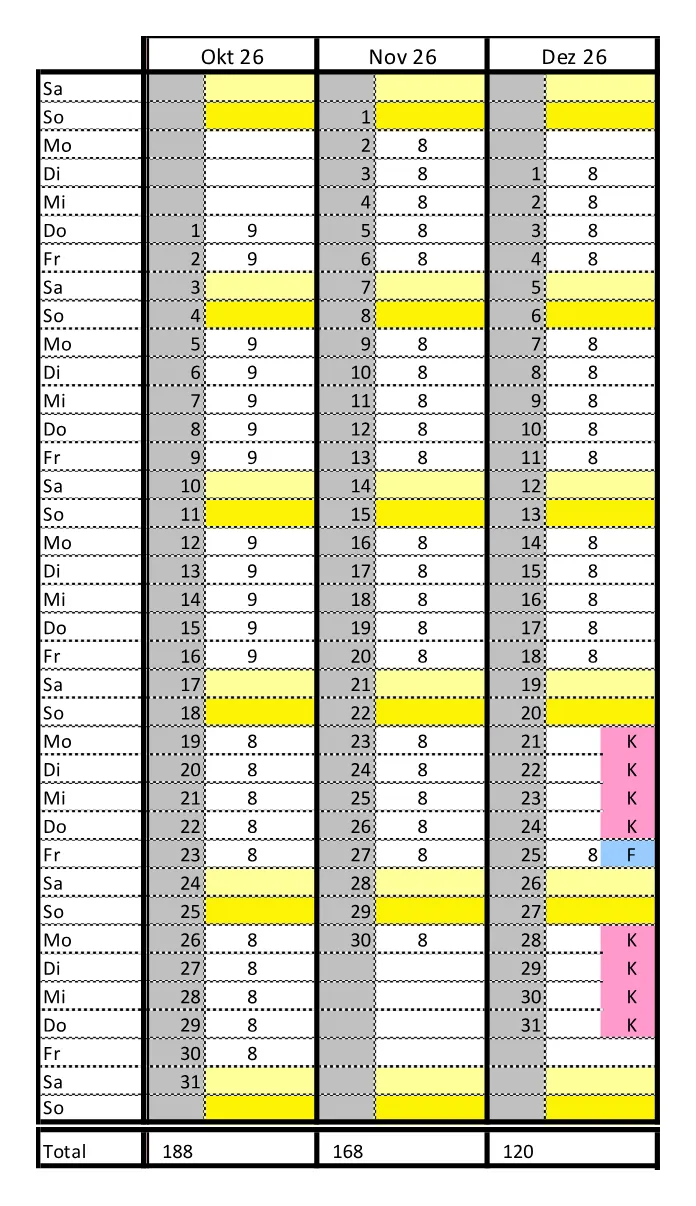
The Aargau committee's calendar works differently: 8.5 hours in summer, 8 in winter and only six compensation days. In July, Zurich has 207 target hours and Aargau 195.5. In December it's 120 in Zurich and 139 in Aargau. By the end of the year both come to exactly 2,112 hours. So don't just ask how long you work in summer, ask when the days off fall too.
When the weather upsets the calendar
If work runs short, the weather is bad or there are technical breakdowns, your employer may change the calendar afterwards, but only for the time ahead. First the company must consult you and, if it doesn't follow your objections, give reasons for its decision. That is what the right to be consulted under the Employment Act requires. To make up lost hours it may plan weeks of up to 48 hours, but only where that is directly linked to the loss. If less extra work turns out to be needed than expected, the difference is at the company's expense, and it may not deduct anything from your wage for it. What else applies in snow and rain is in our post on bad weather compensation in construction.
From 2027: constant working hours as an alternative
Until now the planning year ran from May to April. 2026 is a transition year, and from 2027 the calendar year applies. Also new: from 1 January 2027 a company may plan the same hours every day instead of using a calendar, 8.1 hours, or 8.25 hours if it builds in five compensation days. Whatever you work above or below that goes into your hours account. The condition is a fixed monthly wage. If you are paid by the hour, your employer calculates your hourly wage times 2,112 divided by 12. At CHF 35 an hour that makes CHF 6,160 every month. According to the Swiss Builders' Association's overview of how the new agreement is being introduced, your company must tell the committee by 15 November 2026 whether it is switching in 2027.
When does an hour count as overtime?
Every hour above your calendar is an overtime hour, every hour below it a minus hour. Both go into one account, which is carried forward at the end of each month. Since 1 January 2026 it may range from minus 20 to plus 120 hours. Before that there were two models, 0 to 100 or −20 to 80, and at most 25 overtime hours a month could go into the account. Both rules have been scrapped.
On minus hours, the agreement protects you. If your account drops below −20, the additional minus hours are written off at the company's expense, unless it proves they were your own fault. With constant working hours from 2027, that limit is −50. Conversely, your employer may require you to reduce overtime by taking time off of equal length. It should take your wishes into account and order whole days where possible. In extreme heat or bad weather it may also order the time off by the hour.
Important for 2026: the whole balance used to be paid out with the supplement on 30 April. That cut-off date no longer exists. Under the transitional provision, all overtime in the account at the end of April 2026 was carried forward. What happens to it is decided for the first time on 31 December 2026.
When do you get the 25% supplement?
An overtime hour in your account earns no supplement for now. The 25% only kicks in when it leaves the account in certain ways, or when your week goes over 50 hours. The chart shows every route under Art. 28 LMV.
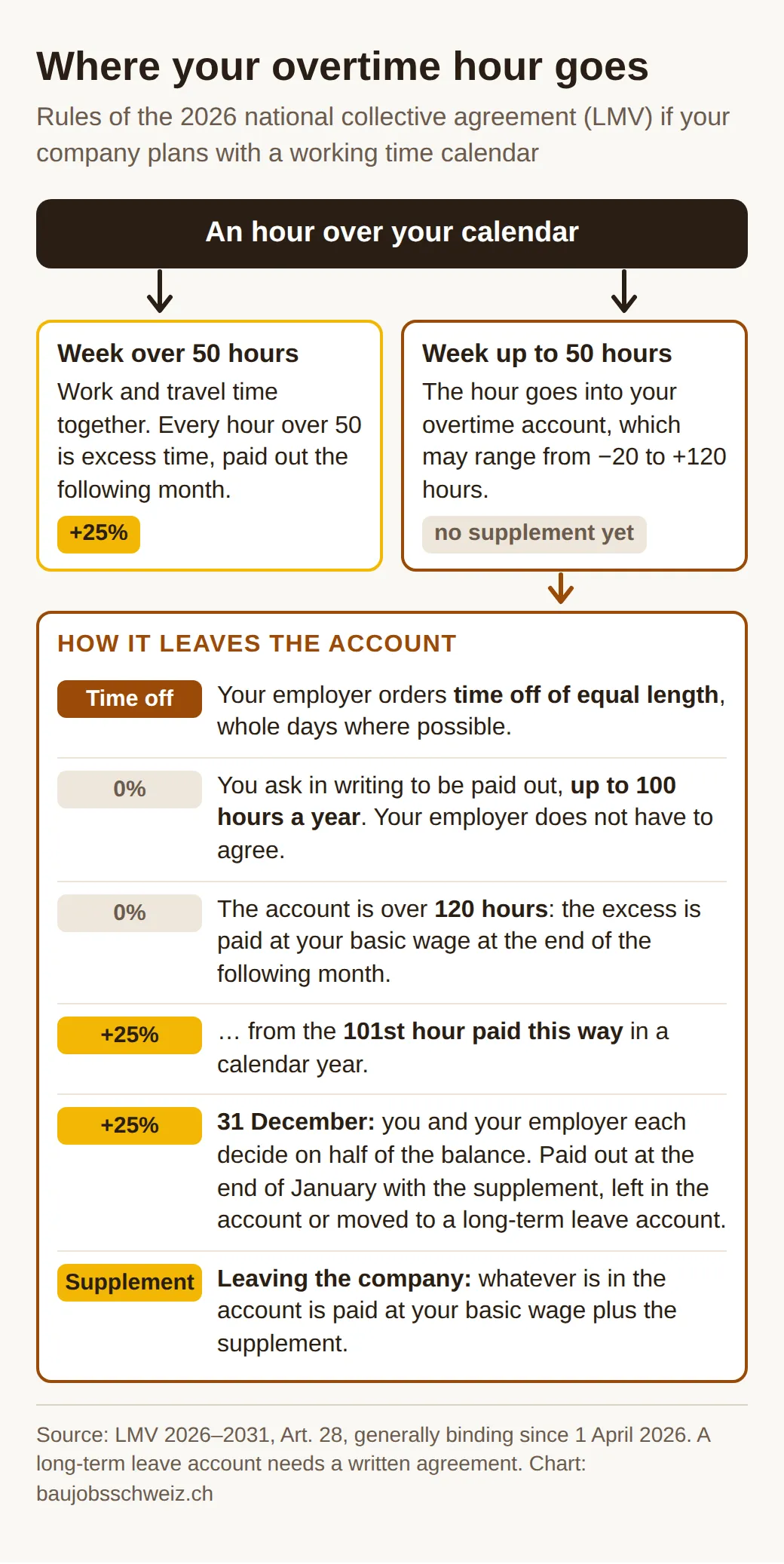
The 50-hour limit replaces an old rule. Until the end of 2025, the 25% applied from the 48th hour of the week. Now work and travel time count together, and every hour over 50 is excess time (Überzeit). Your employer pays it out the following month with a 25% supplement; it doesn't go into the account. This follows the Employment Act, which allows construction workers at most 50 hours a week. Going beyond that is only allowed as an exception, with at most two hours of excess time a day and 140 a year (Art. 12 of the Employment Act).
An example with the Zurich calendar: in summer it plans 9 hours a day, so 45 a week. If the trip from the meeting point to the site and back takes 80 minutes every day, that adds 6 hours 40 minutes of travel time. That makes 51 hours 40 minutes. 1 hour 40 minutes of it counts as excess time and earns the supplement, even though you didn't spend a minute longer on site than the calendar plans.
If your account gets too full, your employer pays out everything over 120 hours at the end of the following month at your normal basic wage. Only once more than 100 hours have been paid out this way in a calendar year does every further hour earn the supplement. You can also ask in writing to be paid up to 100 hours during the year, but then without the supplement. Your employer doesn't have to agree. If you need the money, you get it sooner that way. If you wait until New Year's Eve, you get more for your half.
31 December: your half
At the end of the year your balance is split. Your employer decides on one half, you decide on the other. Each of you has three options for your half: leave the hours in the account, have them paid out at the end of January with a 25% supplement, or move them to a long-term leave account if you have agreed one.
A worked example with 80 overtime hours on 31 December and a basic wage of CHF 35: your half is 40 hours. If you have them paid out at the end of January, you get 40 times CHF 35 times 1.25, which is CHF 1,750 gross. Had you drawn the same hours in summer on request without the supplement, it would have been CHF 1,400. If you leave them, you take them into the new year. Then they count towards the 120-hour limit, and anything above it is paid out without the supplement.
If you decide to have them paid out, tell your employer in writing before the turn of the year. A short note is enough:
Regarding my half of the overtime balance as at 31 December 2026 (Art. 28 para. 5 LMV): please pay it out to me at the end of January 2027 with the 25% supplement.
The long-term leave account
The long-term leave account is new and voluntary. Your employer decides whether to offer it, and you have to agree it in writing. As a rule, only a company that has existed for more than a year and has no outstanding breaches of the agreement may run one. At most 200 hours a year may be added. The total balance may not exceed 200 hours either, unless the company secures the credit against its own insolvency with a blocked account or insurance. Then up to 700 hours are allowed. You must arrange to take the time at least three months in advance, for example for a long break, further training or a period of reduced work. If you leave, the rest is paid out at your basic wage including the 13th-month salary. Without that security, we wouldn't put more hours on it than you plan to take in the foreseeable future. Until the end of October 2026, the rule on the long-term leave account binds only member companies of the Swiss Builders' Association. From 1 November 2026, according to the Swiss Builders' Association, it is generally binding for all companies.
Saturday work in construction
As a rule, there is no work on construction sites on Saturdays, nor on Sundays, public holidays or 1 August. If your employer wants work done anyway in a justified case, it must report this to the joint committee at least 24 hours in advance. That is what Art. 29 LMV says.
Every hour you work on a Saturday earns a 25% cash supplement. The hours themselves aren't in your calendar, so like any other extra work they count as overtime. For 6 hours at a basic wage of CHF 35, that's a supplement of CHF 52.50. The supplements for overtime, night work, Saturdays and Sundays aren't added together, though. If a Saturday hour also falls in a week of more than 50 hours, you get 25% once, not twice.
Watch the clock: under the LMV, work from 5 pm on Saturday already counts as Sunday work, and that earns 50%. The other supplements, for night work, work in water or mud, and the site allowance, are in our post on wages under the LMV 2026.
Travel time: what gets paid
The trip from the agreed meeting point (Sammelstelle) to the site and back is not working time in the sense of the 2,112 hours, but it is paid. Until the end of 2028, the first 30 minutes a day are covered by the site allowance as a flat rate. Your employer pays anything beyond that at your basic wage the following month. From 2029 the flat-rate time falls to 25 minutes, and from 2030 to 20 minutes.
New from 1 January 2027 is a cap on the payout. With a working time calendar, travel time over 60 minutes a day is no longer paid in money but goes into your overtime account. With constant working hours the limit is 90 minutes. The chart shows what that means at 80 minutes a day.
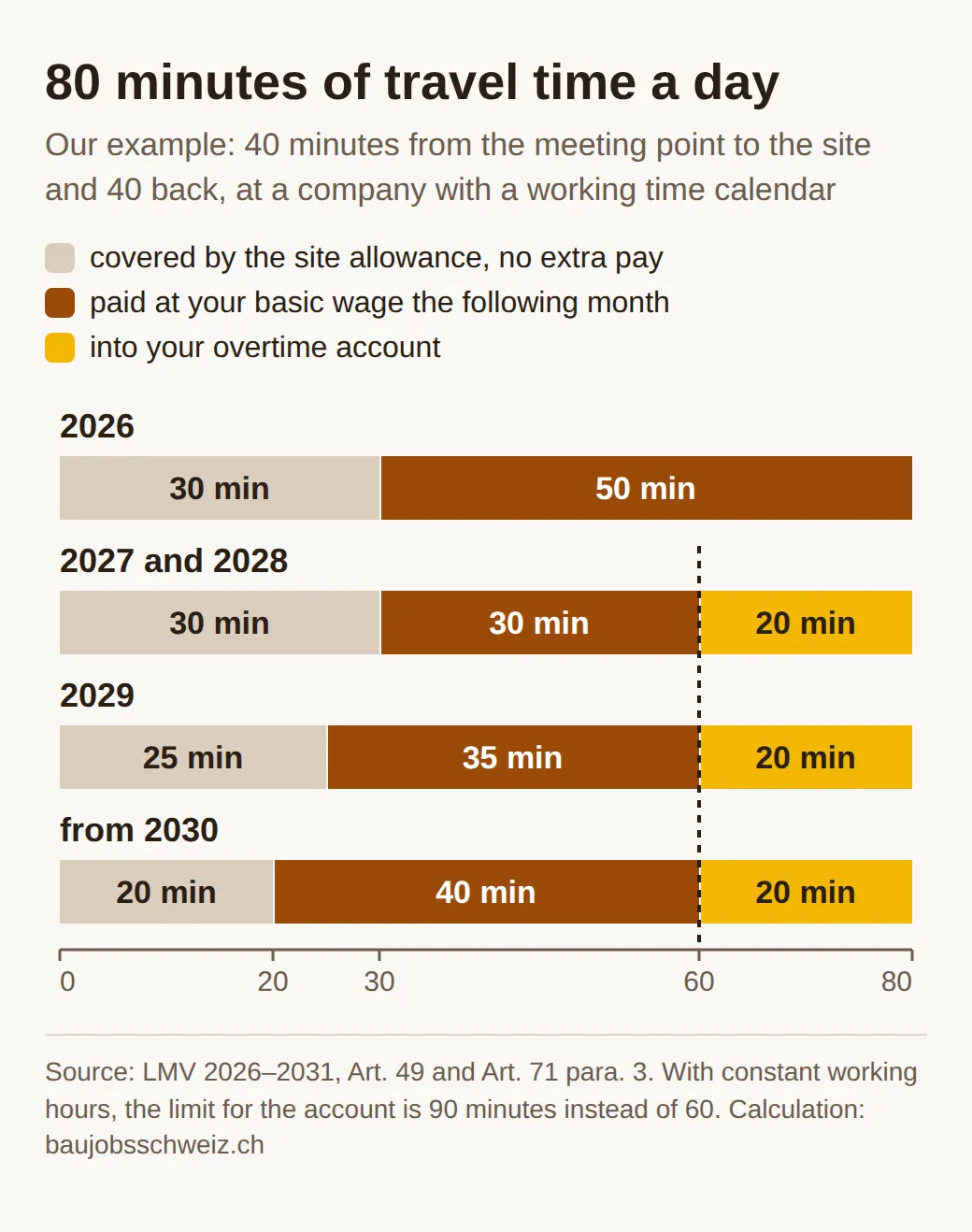
Long weeks are an exception. If work and travel time together come to more than 50 hours, the part above that is paid out as excess time with a 25% supplement and not booked to the account. That is how the Swiss Builders' Association's information on the new agreement describes it.
Who is bound by the travel time rules changes on 1 November 2026. In the special edition of the LMV as at 1 April 2026, Art. 49 on travel time is not marked as generally binding, unlike the rules on working hours, overtime and Saturdays. Until the end of October, the travel time rules therefore bind only firms in the Swiss Builders' Association. From 1 November 2026 a second declaration of general applicability takes effect, which according to the association covers mainly travel time and the long-term leave account. That makes the travel time rules apply to firms outside the association for the first time, in time for the new 60-minute limit. The 50-hour limit including travel time already applied to everyone, because it is in the generally binding Art. 28.
How to check your hours
Your employer must record your working time accurately by day, week and month. You are entitled to a monthly payslip showing the hours worked as well as your wage. The company must make the calendar and every change to it available to everyone affected. That gives you three documents: the calendar, the payslip and your own notes.
Write down every day when you started and finished, how long the trip from the meeting point took and whether you worked on Saturday. Compare that with your payslip every month. At the end of the year, add up all your hours, with holidays, public holidays and sick days counted as the calendar plans them, and subtract 2,112. That is exactly how the Aargau court worked out the driver's 824 hours. If your company's calendar adds up to more than 2,112 for the year, it's wrong. The joint committee can reject a calendar that breaches the LMV or the law.
Don't wait too long with claims. Wage claims from an employment relationship become time-barred after five years. And dismissing you just because you assert claims in good faith counts as abusive dismissal. The court expressly ruled that way in the Aargau case and stressed that a claim you could honestly believe in is enough.
What you can do before the turn of the year
By mid-November your company decides whether it will plan 2027 with a calendar or with constant working hours. Ask your site foreman (Polier), because your limit for minus hours and the travel time limit depend on it. Ask to see the 2027 calendar as soon as it's ready. Check on your November payslip how many overtime hours are in your account, and think about what you'll do with your half on 31 December.
And if you notice that your company has been counting the wrong hours for years, it's a good time to think about changing jobs. In a job interview, ask whether the new company plans with a calendar or with constant working hours, where the meeting point is and how it pays for travel time.
Construction sites in the canton of Zurich
Construction sites in Aargau
Common questions
- Do the LMV working hours apply to temporary workers in construction?
- Yes. If you work through a staffing agency at a company covered by the generally binding LMV, the Recruitment Act requires the agency to apply the LMV's rules on wages and working hours. For travel time, the LMV also requires the company you are placed with to use the same meeting point for you as for its own staff.
- How does part-time employment work in Swiss construction?
- A part-time contract must be in writing and state your exact share of the 2,112 annual hours. The hours credited to you for public holidays, annual leave or sickness fall in the same proportion, and so does the limit up to which a week carries no supplement. If the company plans a regular four or four-and-a-half-day week, a calendar week may also have only 32 hours instead of 37.5.
- Can apprentices in construction work overtime?
- Only with restraint. The LMV requires the company to take the apprentice's age and vocational school into account. For young people under 18, the Employment Act also applies: at most 9 hours a day, overtime and school included, and no overtime at all under 16.
- What happens to my overtime hours when I quit?
- Whatever is in your overtime account is paid out when you leave, at your basic wage plus the supplement. Your employer may only deduct minus hours from your final pay if they are your own fault and the deduction is reasonable. If you are paid monthly and worked more than your pro rata share of the 2,112 hours in the year you leave, you are paid the difference on top.
More posts
All posts
Bricklayer Salary in Switzerland 2026: LMV Minimum Wages
The minimum a bricklayer earns in Switzerland in 2026: LMV wages by wage class and zone, the 13th month's salary and allowances, with worked examples.

Early Retirement in Swiss Construction: FAR Pension 2026
Early retirement at 60 in Swiss construction: who gets the FAR pension, how much it pays in 2026, what changed in July 2025 and the AHV and pension fund gaps.

Temp work in Swiss construction: pay, expenses, notice 2026
Temping on a Swiss building site: the 2026 minimum wage, holiday pay, 13th month and site allowance, how quickly you can be let go and what happens to FAR.