Temp work in Swiss construction: pay, expenses, notice 2026

The short answer
If you work as a temp on a Swiss building site, your pay is set by the construction company's collective agreement, the LMV, not by the temp sector's agreement. In 2026 that means at least CHF 26.95 to 38.10 an hour, depending on wage class and region, plus at least 10.6% holiday pay, 8.3% for the 13th month and the same expenses as permanent staff.
Many pages on the subject quote the minimum wages of the GAV Personalverleih, the collective agreement for temporary staff. On a site in the main construction sector, those simply don't apply. Others work with old LMV figures or leave out what matters most to temps: how quickly an assignment can end, when FAR contributions count towards early retirement, and what is allowed when you move into a permanent job. We went through the LMV 2026–2031, the GAV Personalverleih, the Recruitment Act and the social partners' collective agreement database, as of October 2026.
Who your employer is and which agreement counts
Your employment contract is with the temp agency, but you work at the construction company. The agency pays your wage; the construction company tells you what to do on site. The law calls this the hiring out of staff (Personalverleih): the temp agency hires you out, and the construction company is the hirer.
Which rules apply to you depends mainly on the construction company. If it is bound by a collective labour agreement that has been declared generally binding, the temp agency must respect that agreement's rules on pay and working hours. That is what Art. 20 of the Recruitment Act (AVG) says. In the main construction sector, the agreement is the LMV 2026–2031, the national collective agreement (Landesmantelvertrag), whose minimum wages have been binding on every company in the sector since 1 April 2026. Art. 48a of the Recruitment Ordinance (AVV) lists what that covers: minimum wage, expenses, supplements, holiday pay, 13th month's pay, paid public holidays, continued pay, for example in bad weather, as well as working hours, breaks, and travel and waiting time. Both texts are published in German, French and Italian only.
The GAV Personalverleih still applies to you, but only for the rest. Its Art. 3 takes over the LMV's rules on pay and working hours and the rules on flexible retirement (FAR). It sets probation and notice periods itself, along with daily sickness benefits, the pension fund and the contributions for inspections and training, as long as its own solution is at least as good. Its own minimum wages, though, don't count in construction.
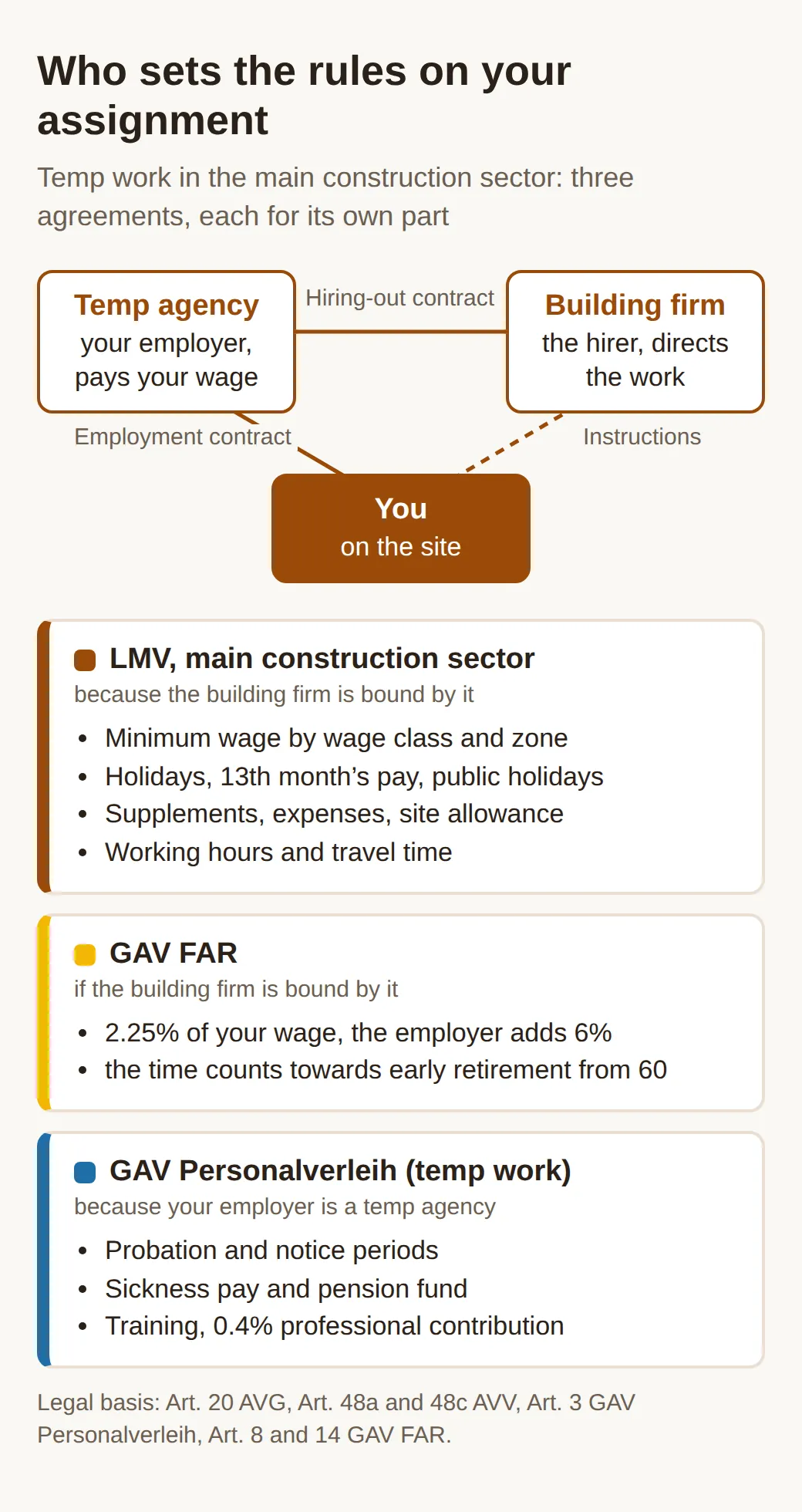
There is one catch: the LMV applies only if the construction company really belongs to the main construction sector. That mainly means building construction, civil engineering, road building and tunnelling, excavation and demolition, scaffolding, and concrete drilling and cutting. And it covers the people on site, not site foremen (Poliere), works foremen or office staff. If the temp agency sends you to a painter, an electrician or a timber builder, their own sector agreements apply. Let's stay with the main construction sector and look at pay.
What hourly wage applies in 2026?
The LMV has five wage classes and three wage zones. Class C is a construction worker without specialist skills, B a construction worker with specialist skills, A a skilled construction worker without a professional certificate, Q a qualified construction worker with a Federal VET Diploma (EFZ) and at least three years on building sites, and V a foreman (Vorarbeiter). The zones are red, blue and green and roughly follow the wage level of the cantons. Under Art. 37 LMV, the hourly wage is the monthly wage divided by 176 hours.
The social partners, the employers' and workers' organisations behind the agreement, keep the figures in their collective agreement database, tempdata, under “Personalverleih LMV Bauhauptgewerbe”. Every temp agency sees the same table there as you do.
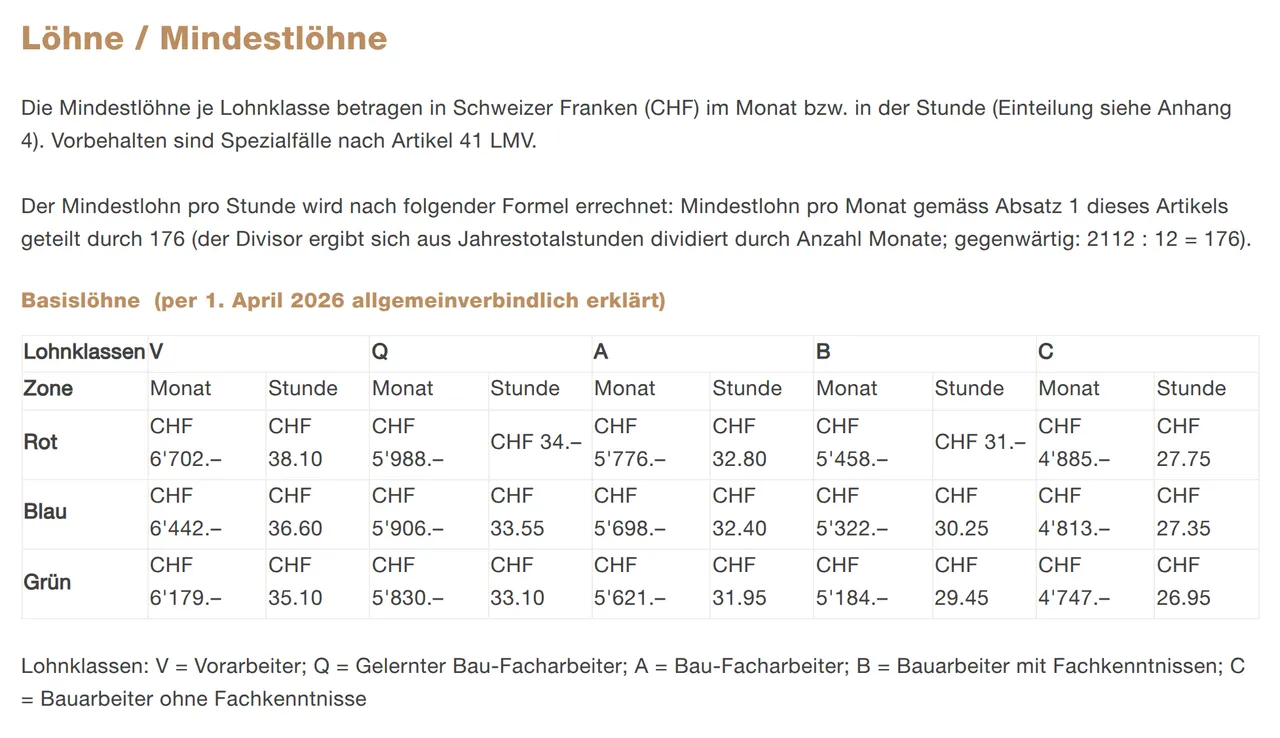
The zone map holds a trap. It isn't the same for hourly and monthly wages, and temps are almost always paid by the hour. For class C hourly wages, the canton of Zurich is in the red zone, so CHF 27.75, but for monthly wages it is in the blue zone, at CHF 4,813. As for which location counts, the GAV Personalverleih says it is generally where the hirer is based, not where the temp agency has its office.
Your wage class must be written in your assignment contract. The temp agency may correct it once during probation, under Art. 19 GAV Personalverleih. The LMV also requires it on every payslip. Art. 38 LMV matters especially for temps: a class C construction worker is normally promoted to class B after 36 months at the latest, and assignments through a staffing agency explicitly count towards that. Once you've been promoted to class B, you keep it when you move to another construction company. The LMV allows the reductions for people who have just finished an apprenticeship, up to 15% in the first year, only for open-ended permanent jobs.
From 1 January 2027, minimum wages rise by at least the inflation measured up to the end of September 2026. According to the Swiss Contractors' Association's timetable, the social partners announce the new amounts in mid-October 2026, after which they also appear in tempdata. How wages develop for permanent staff is covered in our post on wages under the LMV 2026. For you as a temp, the next step is what else has to be included in the hourly wage on your payslip.
Holidays, public holidays and 13th month's pay
On an hourly wage, your holiday pay and 13th month's pay are calculated as percentage supplements. The LMV gives you 25 days of holiday a year; under 20 and from 50 you get 30. On an hourly wage, Art. 31 LMV turns that into 10.6% or 13.0% on top of your pay. That's more than the GAV Personalverleih, which gives only 20 days, or 8.33%, between 20 and 50. On a building site, the LMV's better rule applies.
The 13th month's pay is 8.3% (Art. 46 LMV). Under Appendix 6 of the LMV, it is also calculated on holiday and public holiday pay, but not on expenses such as the lunch allowance. For a class C construction worker in the canton of Zurich, it looks like this:
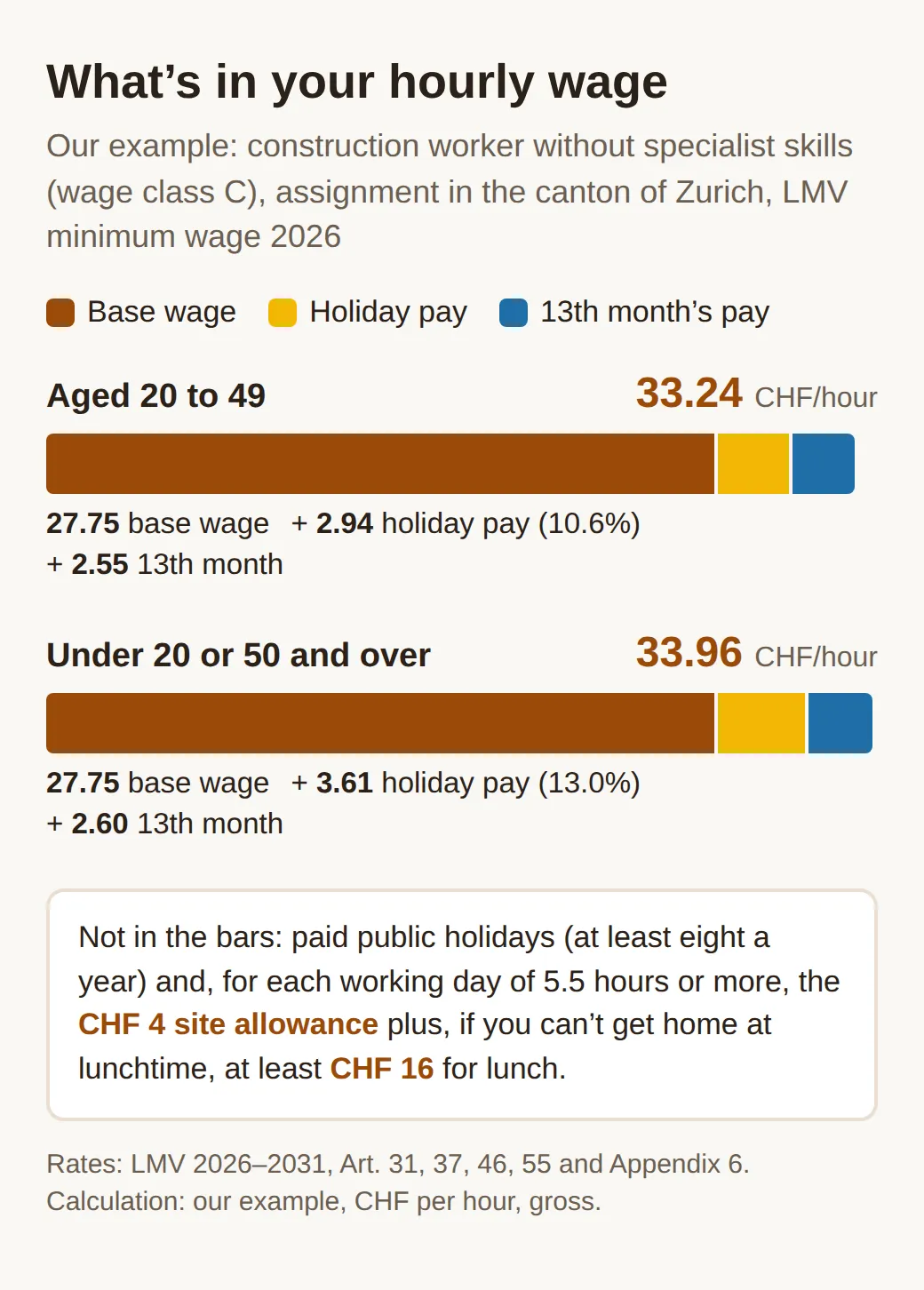
Public holidays come on top. The LMV pays at least eight public holidays a year, as long as they fall on a working day. Which ones they are is decided by the joint committee of employers and unions in your region (the paritätische Berufskommission). You're entitled if you worked for the company for at least a week before the holiday. Instead of paying each public holiday separately, the employer may agree in writing on a percentage supplement, which the joint committee sets every year.
Check that your payslip shows holiday pay and 13th month's pay as separate lines. The GAV Personalverleih allows holiday pay to be paid out with the hourly wage only on one-off assignments of three months or less. On every other assignment it is credited to you, your balance is shown on every payslip, and it is paid out when you take holiday or the assignment ends. An “all-inclusive hourly wage” with no breakdown is therefore a reason to ask questions. Besides the wage itself, there is also money that isn't in the hourly rate at all.
Expenses, site allowance and supplements
You get expenses just like permanent staff, and besides the law, Art. 27 GAV Personalverleih makes this clear for lunch. If no meals are provided at work or you can't get home at lunchtime, Art. 55 LMV says you are owed a lunch allowance of at least CHF 16. Local collective agreements can provide more. If you're told to drive your own car, it's at least 70 centimes per kilometre.
The site allowance is new: CHF 4 for every working day of five and a half hours or more, rising to CHF 6.50 in 2027 and CHF 9 in 2028. It is meant to cover the extra cost of food during breaks, and it has been generally binding since 1 April 2026, so it applies to temps too. Over 20 working days a month, that's already CHF 80 in 2026.
Work outside normal hours earns supplements. Saturday work costs the company 25% more, Sunday work 50%. Short-term night work is paid at 50% extra if it lasts a week at most, otherwise at 25%. The supplements aren't added together; the higher one applies.
One rule concerns only temps: under Art. 49 LMV, the construction company must set the same meeting point for you as for its own permanent staff. Travel time to the site counts from there, and how it's paid is explained in our post on working hours in construction. What ends up in your bank account, though, also depends on the deductions.
What is deducted from your pay
Besides AHV (old-age insurance), unemployment insurance and accident insurance, your payslip shows two deductions that only come in this combination. The first is the FAR contribution of 2.25% for early retirement from 60, to which the employer adds 6% (Art. 8 GAV FAR). The second is the 0.4% professional contribution under the GAV Personalverleih. It funds inspections, training and the social fund, and it replaces the contributions to the construction sector's joint fund (Parifonds Bau). For daily sickness benefits, the agency may deduct at most half the premium, and no more than 3.5% of your wage.
You pay the FAR contribution from your first working day, under Art. 48c AVV. The only people exempt are those who are under 28, in training outside the main construction sector and on an assignment limited to three months, all at once. All three conditions must be met together, as the Federal Supreme Court confirmed in its ruling 9C_339/2023 of 28 February 2024. For almost every temp in construction, the deduction applies.
The same ruling shows what everything hinges on. The FAR foundation claimed just under CHF 29,300 in contributions from a staffing agency for workers it had hired out between 2015 and 2017 to a company doing fire protection and hazardous material removal. That company had since been struck off the commercial register, and it could no longer be proven that it had mainly renovated buildings and so fell under the GAV FAR. The claim failed before the Aargau insurance court and before the Federal Supreme Court.
For you, that means your assignments count as years towards a FAR pension only if the construction company itself is bound by the GAV FAR and your role is covered by it (Art. 14 para. 5 GAV FAR). The deduction on your payslip isn't enough on its own, as the FAR foundation stresses in a leaflet for staffing agencies. An assignment from age 53 at a company outside the GAV FAR can cost you the pension, because the last seven years before it starts have to be unbroken. How the pension works in detail is explained in our post on early retirement in construction. Before the money, though, comes the question of how long an assignment lasts at all.
Probation and notice: how fast an assignment can end
An open-ended temp assignment can be ended with two working days' notice in the first three months, by either side. That's the biggest difference from a permanent job. The minimum periods are in Art. 19 AVG, the exact ones in the GAV Personalverleih (Art. 10 and 11):
| When | Temp (GAV PV) | Permanent (LMV) |
|---|---|---|
| Probation | 3 months | 2 months, can be extended by 1 |
| Notice during probation | 2 working days | 5 working days |
| Months 4 to 6 | 7 days | 1 month, to the end of a month |
| From month 7 | 1 month, to the same date | 1 month, 2 months from the 2nd year of service, each to the end of a month |
On a fixed-term assignment, two thirds of its length count as probation, up to three months. During that time the two working days' notice applies too; after that, the assignment ends on the agreed date. The leaflet for temporary workers from the canton of Basel-Stadt (in German) points out some details that are often missed. A fixed term needs a date or a deadline that can be clearly determined. An assignment “bis Ende Arbeitsüberlastung” (until the workload eases) counts as open-ended. Notice given on a Friday with two working days' notice that would only run over the weekend is invalid. Every new assignment starts with a new probation period, unless you keep working at the same company in the same role. And the canton's labour office treats a chain of three-month contracts at the same hirer in the same role as one single open-ended contract.
One point matters especially in construction. If work stops because of bad weather or short-time working, the temp agency gets no compensation from unemployment insurance for it. According to the leaflet, you're still entitled to your wage until the end of your notice period. How this works for permanent staff is in our post on bad weather in construction. Short notice doesn't mean short protection, and that holds for illness and accidents too.
Sick, injured, insured
You're insured against illness from the first agreed working day. Daily sickness benefits pay at least 80% of your wage after no more than two waiting days. Because the construction company is bound by a generally binding collective agreement, the long benefit period of 720 days within 900 days applies to you (Art. 28 GAV Personalverleih). If you fall ill, tell the temp agency straight away, not just the foreman on site.
You're insured against occupational accidents with Suva, from the agreed start of work to your last working day. What to do after an accident is explained in our post on accidents on a building site.
You join the pension fund from day one if your assignment is open-ended, is meant to last more than three months, or you have children to support. From the 14th week of work you are always insured. Assignments with the same temp agency within twelve months are added together for this, and for the other benefits that depend on length of service (Art. 5 and 31 GAV Personalverleih).
There's also a fund many people don't know about. After 88 hours of temp work, you can apply to the temptraining training fund, which according to tempservice pays for language courses, occupational safety or specialist courses up to CHF 5,000. The GAV Personalverleih also opens up the sector's own training programmes to you. If you want to move up in construction, our post on becoming a Polier shows the way. Often, though, that starts with a permanent job.
From temp to permanent
If the construction company wants to hire you permanently, nobody may stop you. Clauses in your employment contract that ban or hinder a move to the hirer are void (Art. 19 para. 5 AVG). The same goes for clauses in the contract between the temp agency and the construction company (Art. 22 para. 2 AVG). The only thing allowed is a fee paid by the construction company to the temp agency, and only if your assignment lasted less than three months and you move over less than three months after it ends. It is capped at what the company would have paid for three months of administration and profit. The agency may not ask you for anything.
A move means a new employment relationship, and a new probation period is allowed. Under the LMV it lasts two months, with five working days' notice. After that, you have much more security: one month to the end of a month in the first year of service, two months from the second to the ninth year, three from the tenth. From age 55 it's four months after the first year of service and six from the tenth (Art. 21 LMV). Your months on assignment in wage class C count towards promotion to class B. And if the construction company is bound by the GAV FAR, your contribution years carry on without a gap.
Before you switch, ask about the monthly wage rather than the hourly one. On a monthly wage, holidays and public holidays are paid days off, and the 13th month's pay comes as a full extra wage at the end of the year. So never compare the hourly wage on your temp payslip with the monthly wage divided by 176; work both out for a whole year.
Before you sign your next assignment contract
First check that the temp agency has a licence. SECO, the State Secretariat for Economic Affairs, keeps a directory of licensed staffing agencies. Without a licence, your employment contract is invalid and your wages aren't protected by a deposit, because the canton only requires one for the licence.
Then the assignment contract. Under Art. 19 AVG, it has to state the work, the place, the start date, the length or notice period, working hours, the wage with expenses and allowances, and the benefits for illness, accidents and holidays. If anything is missing, the usual terms for the place and the trade apply. Look closely at three lines: your wage class and zone, the holiday supplement of 10.6% or 13.0%, and the FAR deduction. On every new assignment, ask whether the construction company is bound by the GAV FAR, especially if you're over 50.
If something isn't right, contact tempcontrol, the inspection body of the GAV Personalverleih, or a trade union. In construction, the regional joint committee also checks that the LMV is respected, including at temp agencies.
If you're looking for your next assignment, you'll find current jobs in the canton of Zurich or the canton of Bern, for example. With the figures in this post, you know what has to be on your first payslip.
Common questions
- What happens to my wages if the temp agency goes bankrupt?
- Every temp agency needs a licence, and to get one it must lodge a security deposit, at least CHF 50,000 according to Basel-Stadt's Office of Economy and Labour. The deposit covers unpaid wages owed to the agency's temporary staff if it goes bankrupt. It is held by the canton where the agency has its registered office. That canton's labour office can tell you how to file your claim.
- Can a temp agency charge me fees in Switzerland?
- No. Under the Swiss Recruitment Act, any agreement that makes the worker pay fees, pay anything up front or accept wage retentions is void. That covers every fee, whether for placing you, for paperwork or for moving into a permanent job. If an agency asks you for money anyway, you can report it to the cantonal labour office that supervises temp agencies.
- Do I have to give the same short notice if I quit a temp job?
- Yes. The notice periods apply to both sides: two working days in the first three months of an open-ended assignment, seven days from the fourth to the sixth month, then one month. If your assignment is fixed-term, the two working days apply only during probation, which is the first two thirds of the assignment and three months at most. After that, the assignment ends on the agreed date.
- I'm a cross-border commuter. Which location sets my pay?
- Under the collective agreement for temp work, it is generally the location of the company where you work, not where you live and not where the temp agency is based. For the LMV wage zone, what counts is the location of the construction company you are placed with. A Swiss temp agency may only hire you if you have permission to work in Switzerland and are allowed to change jobs.
- When does a temp agency have to pay my wages?
- At least once a month, and no later than the 5th day of the following month, as the collective agreement for temp work sets out. Under the LMV, if your assignment lasts less than a year, you get your 13th month's pay pro rata with your last wage payment. If you pay withholding tax, it can also be agreed monthly, but it then has to be shown as a separate line on your payslip.
More posts
All posts
Early Retirement in Swiss Construction: FAR Pension 2026
Early retirement at 60 in Swiss construction: who gets the FAR pension, how much it pays in 2026, what changed in July 2025 and the AHV and pension fund gaps.

Accident on a Construction Site: What Suva Pays in 2026
Hurt on a construction site? Who pays the first three days, how Suva works out the 80% daily allowance, and the rules on treatment, pensions and free time.

Site Foreman (Polier) Training 2026: Path, Cost and Pay
How to become a site foreman (Polier) in Switzerland: from bricklayer to foreman to federal diploma. Duration, cost, federal subsidies and 2026 pay.