Site Foreman (Polier) Training 2026: Path, Cost and Pay
The path in brief
You become a site foreman (Polier) by passing a federal exam. To sit it, you need a Federal VET Diploma (EFZ) as a bricklayer, road builder or concrete cutter and five years in construction, two of them in a leadership role, usually as a foreman. Preparation courses cost around CHF 9,700 to 15,000, and the Confederation refunds half after the exam. Site foremen earn CHF 8,260 a month on average.
Most pages on this topic list schools and stop there. What matters more is what happens in between: the foreman's diploma isn't compulsory, a course invoice in the wrong name costs you the federal subsidy, cross-border commuters get nothing from the Confederation, and as a site foreman you move to a different collective agreement. We read the exam regulations, the federal rules, the national collective agreement (Landesmantelvertrag, LMV), the collective agreement for construction supervisors (Baukadervertrag) and the rules of the Parifonds Bau as they stood in October 2026, and worked through the costs with an example. Nearly all of these sources are published in German, French and Italian only, so most links below lead to German pages.
Three levels from bricklayer to site foreman
The usual path has three levels: an apprenticeship as a bricklayer (Maurer EFZ), then foreman (Bauvorarbeiter), then site foreman (Baupolier). Foreman and site foreman are each a federal professional exam leading to a Federal Diploma of Higher Education. Both are run by the Swiss Builders' Association, Infra Suisse, the Swiss association of concrete drilling and cutting companies, Baukader Schweiz, Unia and Syna, as set out in the guidelines for the site foreman exam.
The difference is responsibility. A foreman leads a small group and makes sure jobs are carried out correctly. A site foreman plans the work across the whole site, coordinates who works where, writes the reports and leads a team of up to 20 people. They're responsible for deadlines, budget and safety. Road construction, foundation engineering and track construction have their own site foreman exams. If you want to go further after that, the next steps are site manager (Bauführer) and master builder (Baumeister), both advanced federal exams.
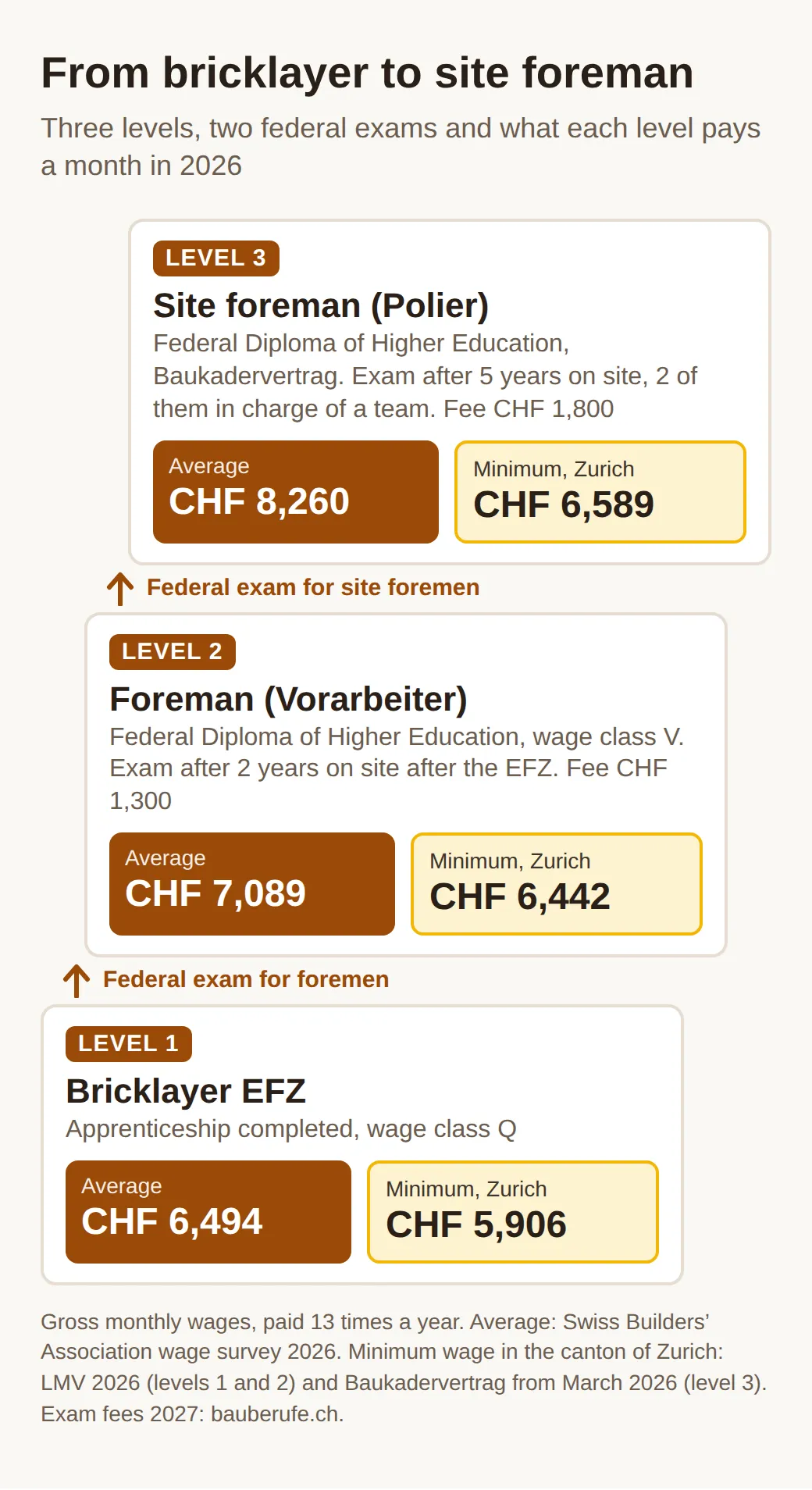
An exam isn't the only way to the title. Under Art. 38 of the LMV, you go into wage class V if you've passed the federal foreman's exam or your employer appoints you foreman. It's the same for site foremen: the Baukadervertrag counts you as a site foreman if you hold the federal diploma or the company has expressly appointed you. The diploma has one advantage an appointment doesn't, though: it counts with every employer. So before you register, check whether you'll be admitted.
Who is admitted to the site foreman exam
There are three routes to the exam, all with at least two years in a leadership role on sites in the main construction sector:
- EFZ in construction: bricklayer, concrete cutter, road builder, track builder, foundation builder, paver, or industrial and screed floor layer, then at least five years on construction sites.
- Another EFZ or an academic baccalaureate: then at least six years on construction sites.
- Professional exam, advanced federal exam, college of higher education or university degree: then two years in a leadership role on construction sites.
According to the guidelines, you'll gain the leadership experience "as a rule" as a foreman or site foreman. But the admission rules don't require the foreman's diploma, and taking a preparation course isn't a condition either. A few details matter when you count the years: preparation courses count as work experience, and a second apprenticeship in the main construction sector counts as one year. If you work less than 80%, the time only counts pro rata, and you generally have to prove the experience in Switzerland, with signed employment certificates from your employers.
Some schools are stricter. According to its course page, the site foreman school at Campus Sursee takes foremen with an average grade of 4.7 and a practical certificate; everyone else sits an entrance exam. If you're unsure, send your file to the Swiss Builders' Association's exam office in advance. According to bauberufe.ch, this pre-admission check usually takes four to five working days.
How long does site foreman training take?
The preparation course for the site foreman exam takes between ten months and two years alongside your job, depending on the school. Campus Sursee puts the whole path through its foreman and site foreman schools at two and a half years. On the classic route, though, you can't sit the exam earlier than five years after your EFZ.
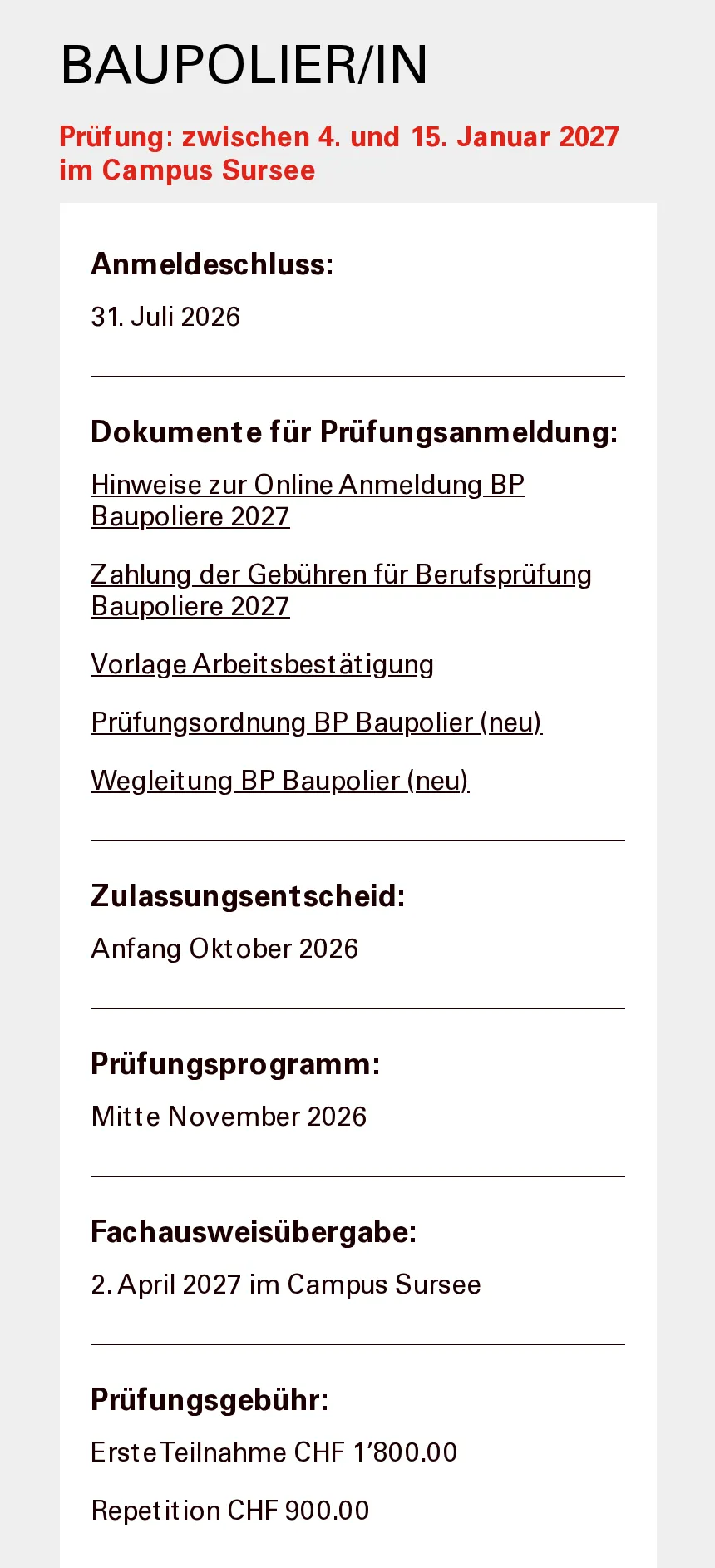
The exam sets the pace, because it's held only once a year, in January at Campus Sursee. For the exam from 4 to 15 January 2027, registration closed on 31 July 2026. The admission decision came at the start of October 2026, the exam schedule follows in mid-November, and diplomas are awarded on 2 April 2027. Registration for this round is closed, so if you're just starting out, plan for a later one. The Swiss Builders' Association publishes the dates on bauberufe.ch.
You can withdraw your registration up to eight weeks before the exam starts; after that, only for a valid reason such as illness, an accident or a death in your close family.
What the site foreman exam involves
The exam takes 765 minutes in total and has five parts. The heaviest is the guided case study: 390 minutes in which you plan and document a construction project. On top of that come a mixed question paper of 60 minutes, an in-tray exercise and short case descriptions taking 120 minutes together, a 105-minute oral exam with a simulated staff interview, and a 90-minute practical exam. No aids are allowed in the oral exam.
You pass if the overall grade and every single part of the exam reach at least 4.0. So a strong part doesn't make up for a weak one. The fee for 2027 is CHF 1,800, or CHF 900 for a resit. For the foreman's exam it's CHF 1,300.
On the same page you'll find sample tasks and the complete 2025 exam to download, the best way to get to know the format. The list of successful candidates from German-speaking Switzerland for the January 2026 exam has 109 names. The organisations behind the exam don't publish a pass rate. In its own overview of the new exam, Campus Sursee reports that 71% of its students passed in 2025 and 79% in 2026, against an average of 68% and 72% at the other schools in German-speaking Switzerland. Under the old exam the figures were mostly higher. So expect roughly one candidate in four to fail.
What site foreman training costs
The biggest item is the preparation course. Site foreman courses cost between just under CHF 9,700 and CHF 15,000, depending on the school and format:
| School | Format | Duration | Price in CHF |
|---|---|---|---|
| Campus Sursee | block courses | 37 course days | 9,685 (excl. VAT) |
| Baukaderschule Burgdorf | Wednesday evenings and Saturday mornings | 10 months | 9,900 |
| ibW Chur | Fridays, 9 modules | 2 blocks | 10,500 |
| GBS St. Gallen | block teaching Mon to Fri | 1 year | 11,800 |
| Baugewerbliche Berufsschule Zürich | alongside work | 4 semesters | 14,970 incl. internal exam |
The prices come from the course pages on berufsberatung.ch and from Campus Sursee. In Zurich they're made up of four semesters at CHF 3,250 and an internal final exam at CHF 1,970. At Campus Sursee, an "AVV surcharge" of the same amount appears next to the course price. On its accommodation prices, the campus uses the same term for a surcharge on non-members of the Swiss Builders' Association. So ask before you register whether it applies to your company, because it would double the course price. Courses in French are run by the Ecole de la Construction in Tolochenaz, and courses in Italian by the Centro di formazione professionale SSIC in Gordola.
Then there are the extra costs. In Sursee a room with breakfast costs CHF 66 in a twin room or CHF 81 in a single, and a lunch or dinner CHF 16.65. In Burgdorf the school expects three to four hours of self-study a week. And if you come through the foreman school, you've already paid for that too: at Campus Sursee it costs CHF 13,765 for ten weeks. A large part of it comes back if you know the federal rules.
Federal subsidies: half back, if the invoice is right
The Confederation refunds 50% of the eligible course fees, up to CHF 9,500 per professional exam. That's set out in the FAQs from the State Secretariat for Education, Research and Innovation (SERI). It's paid after the exam, whether or not you pass. You apply on the Confederation's online portal, no later than two years after the exam decision. Processing usually takes up to three months.
Three conditions decide whether you get the money:
- The course is on the federal list of eligible courses in the year it starts. Ask the school before you register.
- The invoice is in your name and you paid it yourself. If your employer pays the school directly, that amount doesn't count.
- Your tax residence is in Switzerland when the exam decision is issued. Cross-border commuters are excluded.
Point two is the most common trap when the company pays part of the cost. That's why the Swiss Builders' Association advises employers in its fact sheet on training agreements to give the money to you, not to the school. Your claim with the Confederation stays the same. Whether you then pass the federal subsidy on to the company is something you settle in the agreement, for example as a loan.
The same fact sheet states that the foreman school counts as part of the preparation for the site foreman exam and is eligible if you then sit the site foreman exam. If you only take the site foreman exam, you claim both courses there, but together only up to CHF 9,500, and the foreman school can't have started more than seven years before the exam. If you take both exams, each course is claimed against its own exam. That's how we read the cap that SERI sets "per professional exam". Before the course starts, get this confirmed by the office that processes federal subsidies at the SDBB (the Swiss service centre for vocational education and career guidance), because more than CHF 2,000 is at stake.
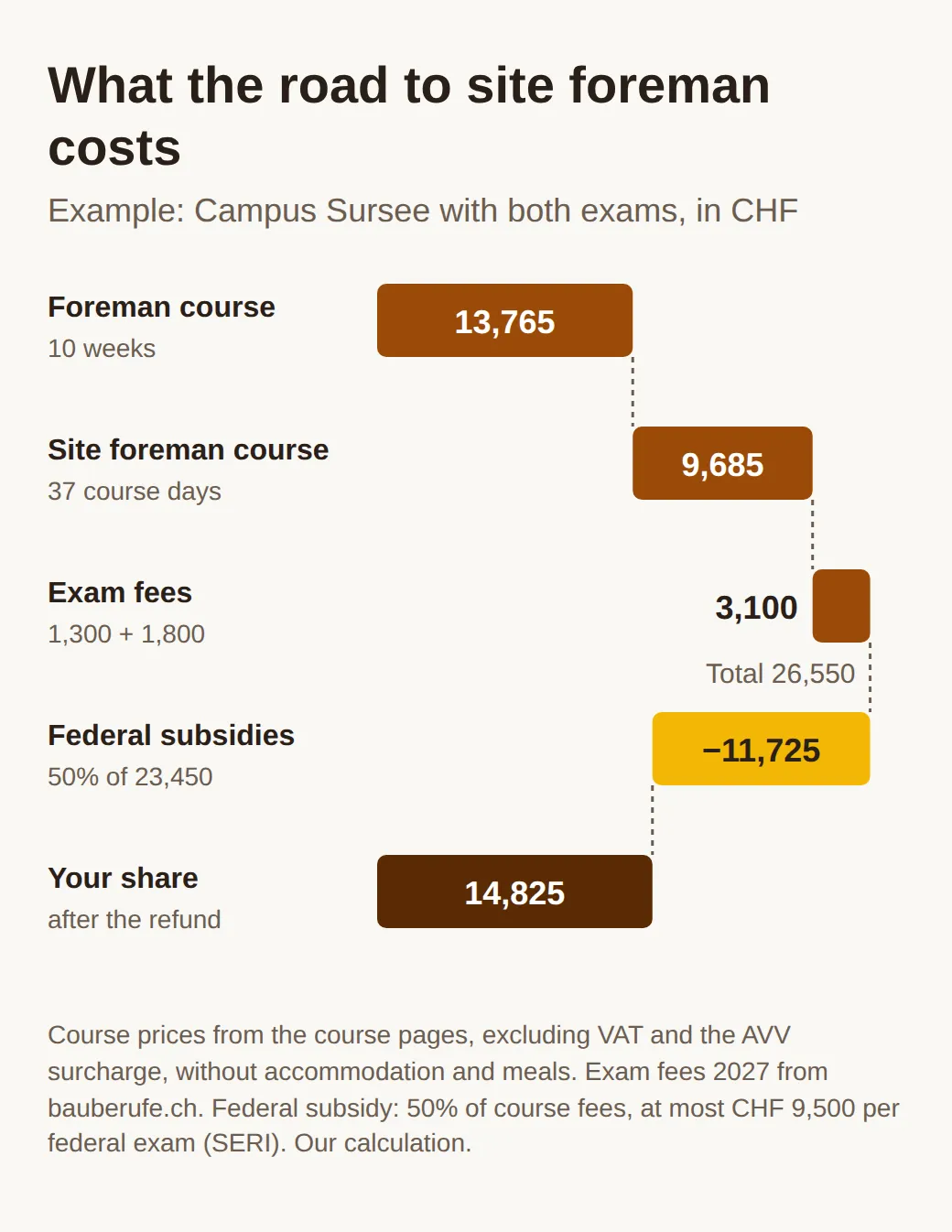
In our example, CHF 14,825 of the CHF 26,550 stays with you after the federal subsidies, not counting accommodation, meals and lost wages. If you can't pay the money up front, you can apply for partial payments before the exam. But that's only possible if your direct federal tax in your last assessment was below CHF 88 and you've paid at least CHF 3,500 in course fees. You declare the federal subsidy in your tax return as other income, and course costs and subsidy from the same tax period are offset against each other. For the days you spend on the course, there's a second source of money.
Parifonds Bau: money for course days
The Parifonds Bau pays a flat rate of CHF 250 per course day for the site foreman school and the foreman school. With the 37 course days in Sursee, that's CHF 9,250. The money is meant to cushion lost wages. Under the 2026 regulations, it's usually paid to the company as long as you're employed there, even though the entitlement is yours.
To be entitled, you must have paid contributions to the Parifonds for at least nine months in the 24 months before the course starts, six of them in the last twelve months. Under the LMV, your employer deducts 0.7% of your wage for this. The course must be recognised by the Parifonds, which Campus Sursee states for its site foreman school, and you must attend at least 70% of the course days. You can claim the flat rate up to one year after the course ends. In Geneva, Neuchâtel, Ticino, Vaud and Valais, cantonal funds with their own rules apply to member companies.
Important for your talk with the boss: the LMV entitles you to at most five days off work a year for training, but without pay and without course fees. Anything beyond that has to be agreed, and before the course starts. The Swiss Builders' Association recommends that the agreement sets out who pays for the course, wages and expenses, and what you pay back if you leave the company. According to the fact sheet, such a repayment doesn't apply if the company dismisses you for economic reasons.
How much more does a site foreman earn?
On average, site foremen earn CHF 8,260 a month in 2026, according to the Swiss Builders' Association wage survey. Foremen get CHF 7,089, and trained construction workers in wage class Q CHF 6,494. That puts CHF 1,766 a month between Q and site foreman, or just under CHF 23,000 a year with 13 monthly salaries. The association itself calculates that further training brings in CHF 600 more a month on average.
These are averages, not a promise. Many site foremen have long experience, and according to the association the best-paid 20% earn around 20% more than the lowest-paid 20%. How much you get is up to you to negotiate. But the comparison shows the order of magnitude: compared with the average foreman, a site foreman earns CHF 1,171 more a month, a good CHF 15,000 a year. On paper, your own share of CHF 14,825 is back after about a year, before tax and without the lost wages during course days.
The minimum wages are closer together. Since March 2026, the Baukadervertrag sets minimums for site foremen of CHF 6,847 in the red zone (the Basel region and Geneva), CHF 6,589 in the blue zone (including Zurich, Bern, Aargau, Lucerne and St. Gallen) and CHF 6,333 in the green zone (Glarus, Ticino and parts of Graubünden). In the canton of Zurich, that puts a site foreman only CHF 147 above a foreman's minimum wage. How the LMV wage classes work is explained in our post on wages under the LMV 2026.
There's one clause you should know about: the Baukadervertrag allows a wage below the minimum if you both agree it in writing. If you don't agree with it, you can turn to the joint supervisory committee within six months. So don't sign in a hurry.
What changes under the site foreman agreement
As a site foreman you're no longer covered by the LMV, because Art. 5 expressly excludes site foremen and works foremen. Instead, the Baukadervertrag between the Swiss Builders' Association, Baukader Schweiz, Unia and Syna applies to you, provided your company applies it. Your employment contract will say so.
Some things get better. Instead of five unpaid days for training, you're entitled to up to five paid working days a year. From the second year of service the notice period is three months. If you're ill or have an accident, the company pays your full wage for one to six months depending on your years of service, and it pays at least 6% of your wage into your pension fund, 7% over the age of 45 and 7.5% over 55.
Other changes are worth knowing about. The probation period is three months instead of two. And ten hours a month for preparation, checks and reports count as included in your monthly wage unless you agree otherwise. You keep early retirement: site foremen are still covered by the FAR scheme. We've written separately about how the FAR pension works. If you later become a site manager, though, you drop out of the FAR, because the FAR collective agreement counts site managers as management staff.
Your next step
If you want to become a site foreman, start with the paperwork, not the school:
- Count your years on construction sites and your time as group leader or foreman. Get employment certificates stating your role, dates and workload; the template is on bauberufe.ch.
- Send your file to the exam office for pre-admission.
- Choose a school and ask whether the course is on the federal list and recognised by the Parifonds.
- Sign a training agreement with your company before the course starts, and have the course invoice made out in your name.
- After the exam, apply to the Confederation for the subsidy within two years.
Construction jobs in the canton of Lucerne
If you change jobs for your training, ask directly in the interview about course contributions, pay during course days and a training agreement.
Construction jobs in the city of Zurich
You'll also find construction jobs in the canton of Bern. In job ads for site foremen, check whether the company applies the Baukadervertrag, because the minimum wage, paid training days and notice periods depend on it.
Common questions
- Can I become a site foreman without a bricklayer apprenticeship?
- Yes. With a different Federal VET Diploma or an academic baccalaureate, you need six years of experience on sites in the main construction sector instead of five, two of them in a leadership role. For foreign qualifications, the examination board decides. It can ask for an assessment by the State Secretariat for Education, Research and Innovation first.
- Do cross-border commuters get federal subsidies for the Polier course?
- No. The Confederation only pays people whose tax residence is in Switzerland when the exam decision is issued. Cross-border commuters and international weekly residents are expressly excluded. The daily allowance from the Parifonds Bau, on the other hand, depends on your contributions, not on where you live. So budget for the full course fees and find out early what your employer will cover.
- What does it cost if I fail the Polier exam?
- You still get the federal subsidy, because it only depends on you having sat the exam. For a resit you pay a reduced fee, which according to the exam guidelines depends on how many parts of the exam you have to retake. For the 2027 exam, the Swiss Builders' Association quotes CHF 900. Courses you take for the second attempt can be added to your earlier course fees, up to the cap.
- Does my experience count if I work part-time?
- Yes, but not always in full. If you work at least 80%, a year counts as a full year; below that it counts pro rata. Longer absences of more than 20% of the annual workload also cut the time that is credited. With the Parifonds Bau, a workload below 70% means a correspondingly reduced daily allowance.
- Can I take the Polier exam in French or Italian?
- Yes. The exam is offered in all three official languages, and you choose your exam language when you register. Preparation courses are held in French in Tolochenaz and in Italian in Gordola.
More posts
All posts
Temp work in Swiss construction: pay, expenses, notice 2026
Temping on a Swiss building site: the 2026 minimum wage, holiday pay, 13th month and site allowance, how quickly you can be let go and what happens to FAR.
Accident on a Construction Site: What Suva Pays in 2026
Hurt on a construction site? Who pays the first three days, how Suva works out the 80% daily allowance, and the rules on treatment, pensions and free time.

Swiss Construction Working Hours 2026: Overtime, Travel Time
Working hours in construction under the LMV 2026: 2,112 hours a year, working time calendar, overtime account, 25% supplement, Saturday work and travel time.