Accident on a Construction Site: What Suva Pays in 2026
The short answer
If you have an accident on a construction site, Suva pays for your treatment in full, with no deductible and no co-payment, and from the third day after the day of the accident a daily allowance of 80% of your wage, for every calendar day. Your employer pays at least 80% for the day of the accident and the two days after it. If lasting damage remains, a pension and a one-off compensation payment come on top.
Search for Suva and accidents on construction sites and you mostly find news reports about disasters and general Suva pages that read the same for every industry. What they leave out is what construction adds: the protection against dismissal in the national collective agreement, what happens to your 13th-month salary and public holidays, why the figures are so high in construction in particular, and where your cover has gaps. We worked from the law, the 2026 national collective agreement and Suva's own documents, as they stood in October 2026, and checked the sums. Most of the laws and our sources aren't published in English, so many links below lead to German pages.
In construction, Suva almost always covers you
If you work for a construction company, you're insured with Suva, whether you like it or not. The Federal Accident Insurance Act (UVG) assigns building and installation firms and pipeline construction to Suva by law, along with quarries, gravel works and forestry businesses. Your company can't choose another insurer. Your employer pays the whole premium for occupational accidents, and may deduct the premium for leisure accidents from your wage. On your payslip it shows up as a deduction labelled NBU or NBUV.
The statistics show how much this cover matters. The UVG-Statistik 2026, published jointly by all accident insurers, counts 140.1 occupational accidents per 1,000 full-time jobs in building and civil engineering in 2024, and as many as 145.3 in the other construction trades (finishing work, installations, roofing, painting). Across all industries the figure is 58.2, and only arts, entertainment and recreation is higher, at 162.1. In building and civil engineering, that works out at one occupational accident a year for every seven full-time jobs.
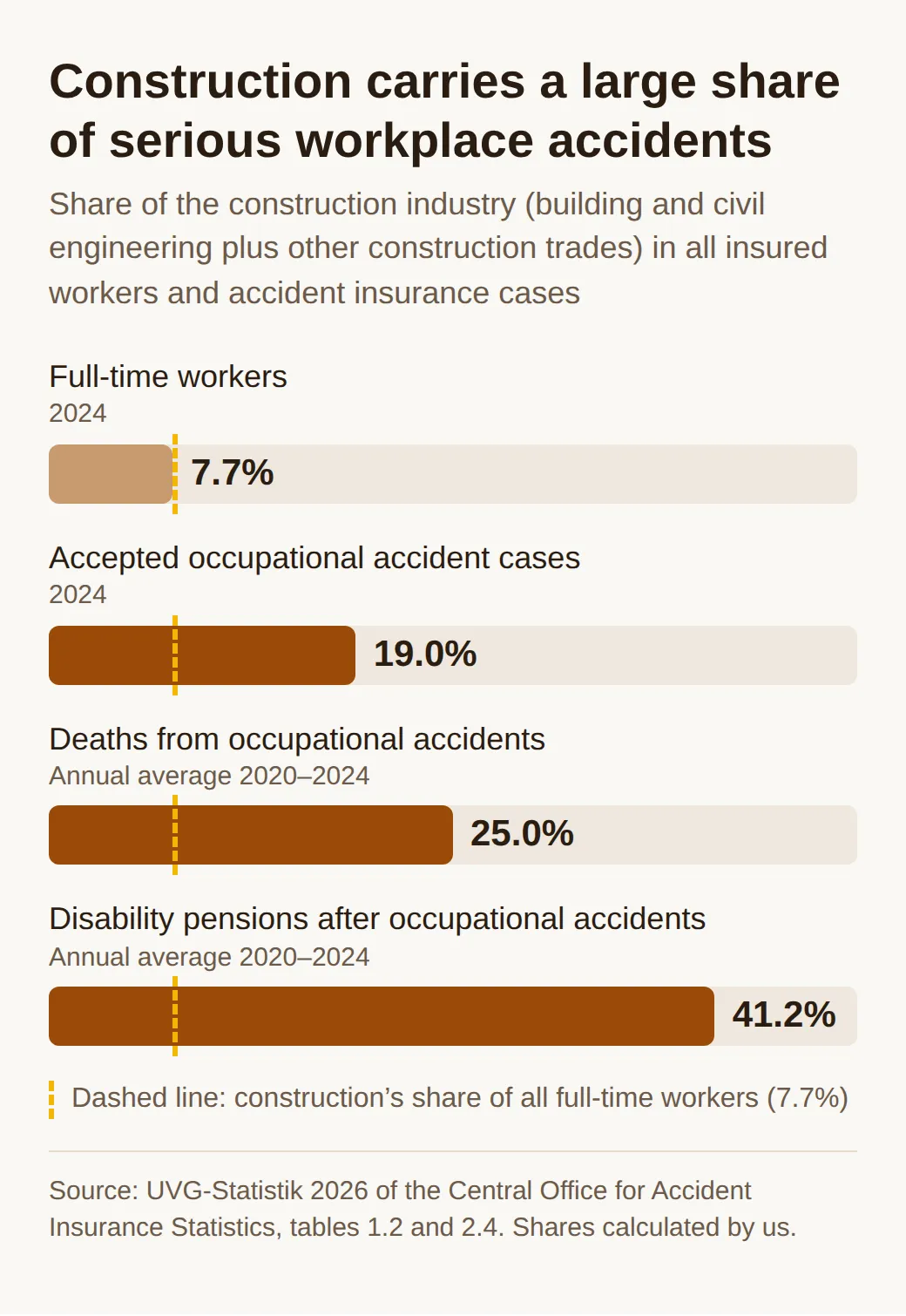
The serious cases make it even clearer. Construction accounts for 7.7% of all full-time workers but 19% of accepted cases in occupational accident insurance: 49,641 of them in 2024. On average over 2020 to 2024, 16 people a year died in construction from an occupational accident, a quarter of all such deaths. And 236 disability pensions a year went to people injured in construction, 41% of all pensions after occupational accidents. So if you work in construction, it isn't enough to know you're insured. You should know what exactly the insurance pays. That starts with a question many people skip.
Is it actually an accident?
Suva only pays for accidents and occupational diseases. Under the Federal Act on the General Part of Social Insurance Law (ATSG), an accident is the sudden, unintended effect of an unusual external factor on the body. If any one of these is missing, it's an illness, and then your health insurer is responsible, with its deductible and co-payment.
Suva explains the difference in its brochure for employees with two examples from construction. If you cut your hand with a jigsaw, that's an accident. If you lift a box and feel a sharp pain in your back, it isn't, because nothing unusual happened from outside. This is especially harsh for back injuries, since heavy lifting is part of every day on a construction site.
It isn't quite that narrow, though. For a list of injuries, Suva pays even without a clear accident, as long as they aren't mainly due to wear and tear or illness: broken bones, dislocated joints, torn menisci, torn and strained muscles, torn tendons, ligament injuries and perforated eardrums (Art. 6 para. 2 UVG). So if a tendon tears while you're unloading reinforcing bars, Suva can only refuse if wear and tear is mainly to blame.
Then there are occupational diseases. They're treated like an occupational accident from the moment you first have to see a doctor or can no longer work. Suva gives skin cancer after years in the sun on building sites and hearing damage from noise as examples. The UVG statistics show how much they weigh: from 2020 to 2024, an average of 59 people a year in construction died of an occupational disease, almost four times as many as from an occupational accident. Whether it's an accident, an injury from the list or an occupational disease, Suva first has to hear about it before it can look at your case.
Report it the same day
You have to report an accident that needs treatment or leaves you unable to work to your employer or to Suva without delay. Suva advises reporting accidents even when you can keep working. The twisted ankle that only really swells up three days later is the typical case where an early report saves an argument later.
What goes into the report is set out in the Accident Insurance Ordinance (UVV): the time, place, course and consequences of the accident, the doctor or hospital, and anyone who may be liable or any other insurance involved. For your site foreman, a short message is often enough, as long as it covers these points:
Accident today at 10:30 on the Bahnhofstrasse site, second scaffold level. Slipped climbing down, twisted my right ankle. Marco saw it. I'm going to the walk-in clinic at the station now and need an accident form.
Your employer must then pass the report on to Suva immediately and, for an occupational accident, look into how it happened. Except for trivial cases, you get an accident form (Unfallschein), which you show at the doctor's and the pharmacy and hand back at the end of treatment. If you report late without a good excuse and that causes Suva a lot of extra work, it can cut the cash benefits for the period in between by up to half (Art. 46 UVG). If it still hasn't heard anything after three months, it may halve every benefit. If it's your employer who fails to report, on the other hand, the employer is liable for the resulting costs. Once the report is on its way, the next question is the money for the first few days.
Your employer pays the first three days
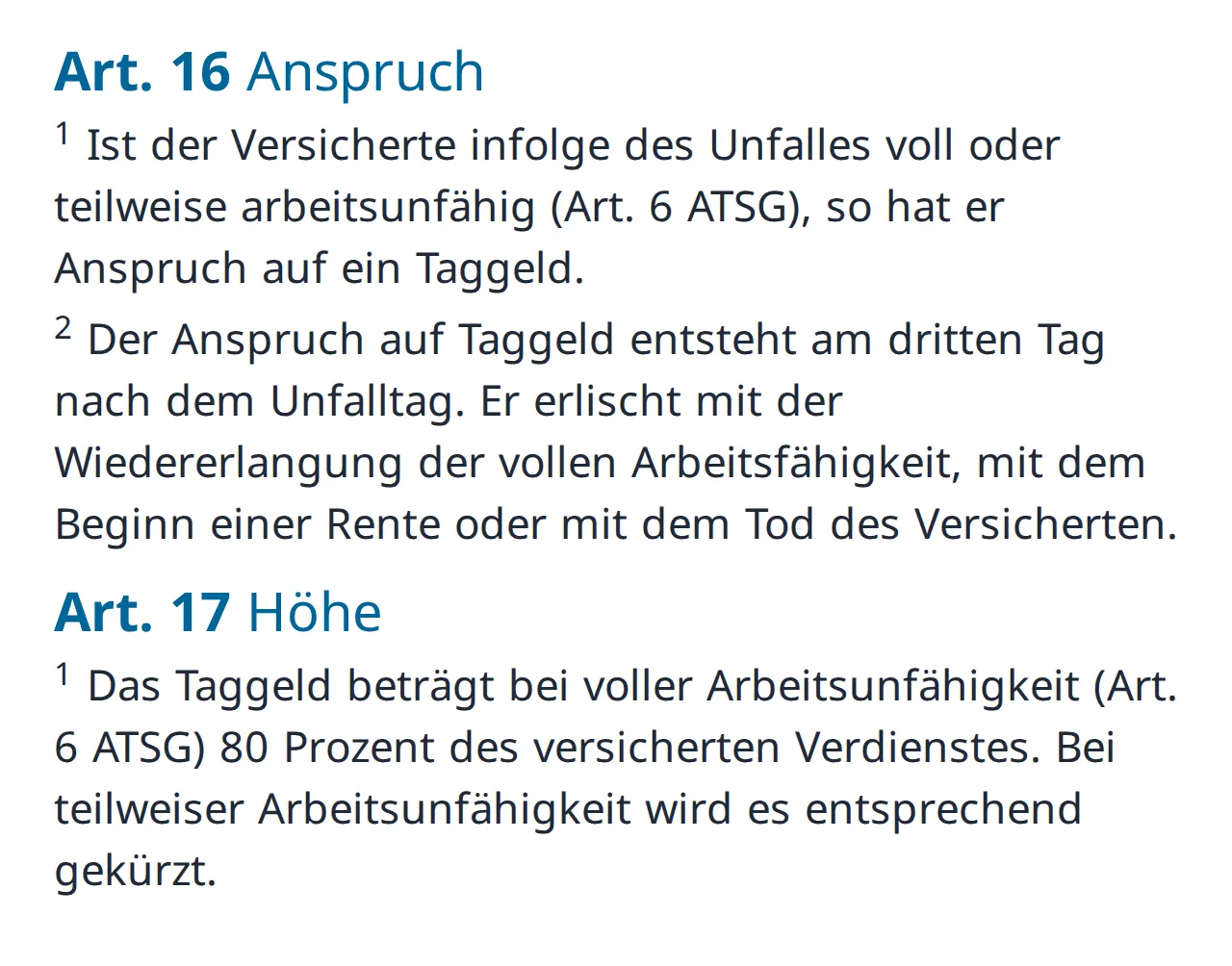
Suva's daily allowance only starts on the third day after the day of the accident. If you have an accident on a Monday, you get the daily allowance from Thursday. For the day of the accident and the two waiting days in between, your employer has to pay at least four-fifths of your wage, so 80% (Art. 324b para. 3 CO). The national collective agreement for the main construction sector (Landesmantelvertrag, LMV) expressly counts these Suva waiting days as paid wages, on which holiday pay and the 13th-month salary are due.
Illness works differently. In the main construction sector there's one unpaid waiting day per illness, at your expense, and only after that does the daily sickness benefits insurance pay 80% (LMV 2026, Art. 56). After an accident there's no such day without pay.
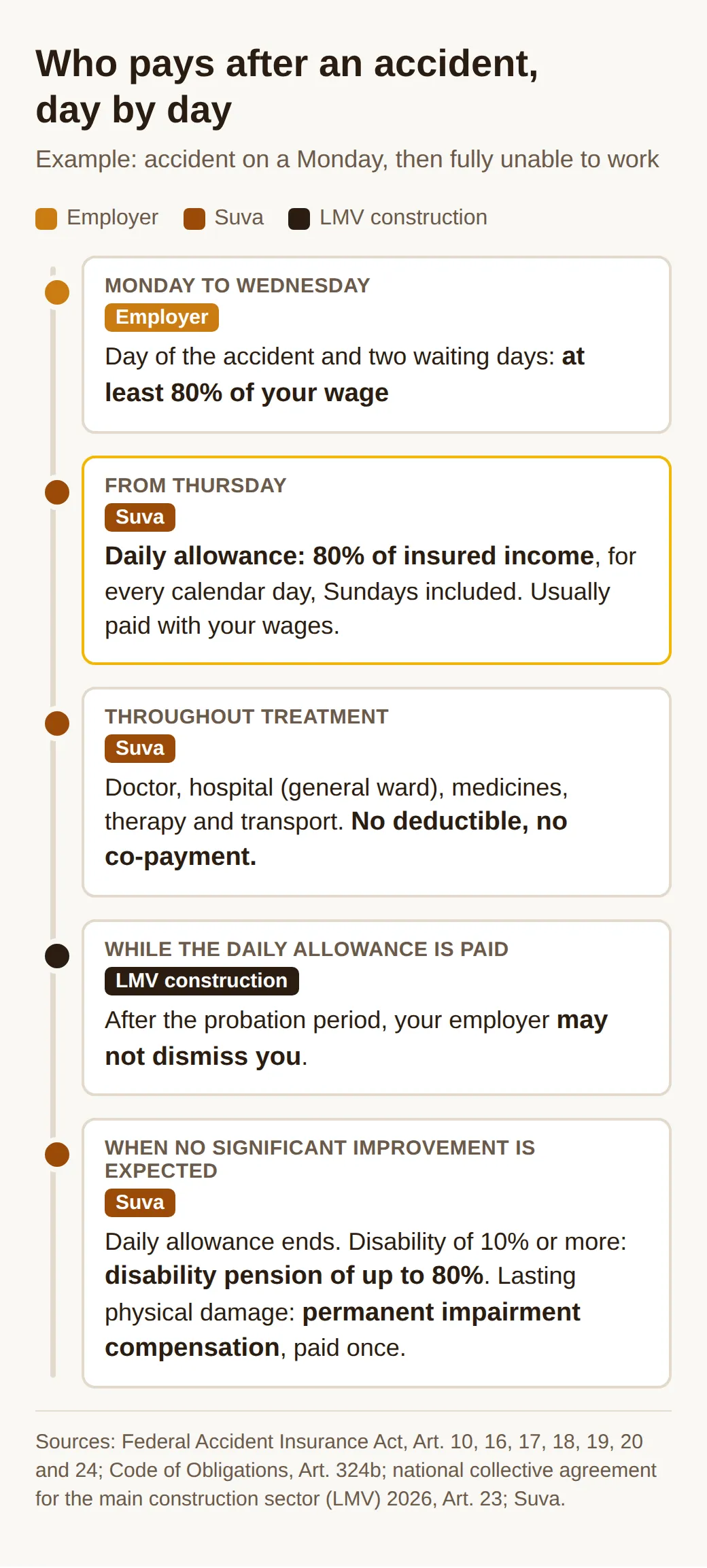
From Thursday, Suva takes over. How much then lands in your account comes down to a simple formula.
The daily allowance: 80%, Sundays included
If you're fully unable to work, the daily allowance is 80% of your insured income; if you're partly unable to work, it's reduced accordingly. What counts is your last wage before the accident, extrapolated to a full year, including the 13th-month salary and allowances.
Suva calculates it like this: annual wage divided by 365, and 80% of that. The result applies to every calendar day, Saturdays, Sundays and public holidays included. Suva's own example is a bricklayer earning CHF 78,000 gross a year, 13th-month salary included. His daily allowance is 78,000 ÷ 365 × 80% = CHF 170.95. If he is able to work 50% again after the accident, he gets half of that, CHF 85.50 a day. Fully unable to work, he receives CHF 5,128.50 in a 30-day month and CHF 5,299.45 in a 31-day month. Over a year that adds up to CHF 62,397, 80% of his annual wage. Where your own wage sits under the LMV is covered in our post on wages in construction.
The calculation has a ceiling. Insured income is capped at CHF 148,200 a year or CHF 406 a day (Art. 22 UVV), so the highest daily allowance is CHF 324.80. The cap only matters if you earn more than CHF 148,200 a year.
Three things make the gap to your usual pay smaller or bigger than the 80% suggests:
- No social security deductions. Accident insurance benefits don't count as earned income (Art. 6 AHV Ordinance). If your company pays out the daily allowance, it may not deduct social security contributions from it, according to Suva's information sheet on the daily allowance; you get the full amount. So net, you lose less than the 80% on paper suggests.
- The 13th-month salary and holidays are already included. Annex 6 of the national collective agreement states that holiday entitlement and the share of the 13th-month salary are included in Suva's benefits. So no extra 13th-month salary is added on top of the daily allowance.
- No public holiday pay. If a public holiday falls while you're receiving Suva's daily allowance, Art. 34 LMV says you don't get public holiday pay for it. You don't lose anything, because the daily allowance is paid for that day too.
The daily allowance is usually paid through your employer with your normal payslip: Suva transfers it to the company, which passes it on to you. If your company doesn't pay it out itself, Suva pays it straight into your account. If less arrives than the formula gives, ask the payroll office first and then Suva. The daily allowance runs until you can work fully again. And while it runs, construction gives you a protection that other industries don't have in this form.
Your boss can't fire you during this time
Under the Code of Obligations, if you can't work after an accident through no fault of your own, your employer is barred from dismissing you only for a limited time: 30 days in your first year of service, 90 days from the second to the fifth, and 180 days from the sixth year on (Art. 336c CO). In the main construction sector the LMV goes much further. Under Art. 23 LMV, after the probation period your employer may not dismiss you as long as compulsory accident insurance is paying a daily allowance, however long that takes.
The limit only comes when Suva announces it will stop the daily allowance and it's clear that for health reasons you can't go back to your old job. Then you and your employer can agree that the employment ends with the last daily allowance payment. And an agreement needs your signature. If you have the accident after you've already been given notice, the notice period stops running while Suva pays the daily allowance and then resumes.
The LMV applies to companies in the main construction sector: building and civil engineering, road building, tunnelling and related work. If you work as a painter, electrician or plumber, your own collective employment agreement applies, and you'll have to check there whether it has a similar protection. More on how the LMV rules work day to day is in our post on working hours in construction. Beyond the money for lost wages, though, what Suva mainly pays for is your treatment.
Medical costs: doctor and hospital with no deductible
Suva covers appropriate treatment of the consequences of the accident (Art. 10 UVG): outpatient care from a doctor, dentist or chiropractor, prescribed medicines and therapies, hospital in the general ward, prescribed spa treatment and aids such as crutches, prostheses or orthopaedic shoes. Necessary rescue, transport and travel costs are covered too. You choose your own doctor and hospital.
Unlike with health insurance, there's no deductible and no co-payment, as Suva expressly points out on its page on interim accident insurance. Doctors, hospitals and pharmacies bill Suva directly; you show them your accident form. If you want a semi-private or private room, Suva doesn't cover the extra cost. For rehabilitation, Suva runs its own clinics in Bellikon and Sion.
The cover comes with a duty: you have to cooperate, which means keeping appointments, doing your therapy and giving Suva the information it needs. Most of the time, the story ends with you going back to the site in good health. Sometimes something remains.
If there is lasting damage: pension and permanent impairment compensation
At some point, further treatment no longer brings any significant improvement. Then the daily allowance ends and Suva checks whether you're entitled to a pension (Art. 19 UVG). Any integration measures from the disability insurance (IV), such as retraining, must be completed first.
You get a disability pension from a degree of disability of 10%. The degree measures how much your earning capacity is reduced by the damage to your health. For full disability, the pension is 80% of your insured income, and correspondingly less for partial disability (Art. 20 UVG). Here the basis is your wage in the last year before the accident. If you also receive an IV pension, Suva pays a complementary pension: the two together may reach 90% of your insured income, but no more.
One point hardly anyone knows about affects older construction workers. If you were over 45 at the time of the accident, Suva reduces the pension once you reach the AHV reference age (the state pension age). For a degree of disability of 40% or more, it's 2 percentage points for every full year over 45, at most 40%. Below that, it's 1 percentage point a year, at most 20%. So someone who has an accident at 55 and stays 50% disabled gets the full Suva pension until AHV age and then 20 percentage points less. If you're in your mid-fifties and thinking about early retirement, look at this together with the FAR pension plan.
Permanent impairment compensation is a one-off payment for permanent, significant damage to your body or mind, a kind of damages for pain and suffering. You get it even if you can work fully again. The amount follows a scale in Annex 3 of the Accident Insurance Ordinance and is a percentage of the maximum insured income of CHF 148,200:
| Permanent damage | Scale | Amount |
|---|---|---|
| Loss of two segments of a finger | 5% | CHF 7,410 |
| Loss of an entire thumb | 20% | CHF 29,640 |
| Loss of a hand | 40% | CHF 59,280 |
| Loss of a leg above the knee | 50% | CHF 74,100 |
Damage below 5% gives no entitlement. We worked out the amounts from the scale. In each case, Suva sets the percentage according to how severe the damage is, including for damage not on the list.
If an accident is fatal, the surviving family receives a pension: a widow or widower 40% of the insured income, a child who has lost one parent 15% and one who has lost both 25%, together at most 70%. So much for the benefits after an accident on a construction site. An accident on a Saturday looks different in some ways.
Leisure accidents: same Suva, stricter rules
If you work at least eight hours a week for the same employer, Suva also insures you against accidents in your free time (Art. 13 UVV). That includes your commute. The daily allowance, medical costs and pensions are the same as after an occupational accident. The figures show that in construction, work is still the bigger risk:
| Accidents per 1,000 full-time jobs, 2024 | Work | Leisure |
|---|---|---|
| Building and civil engineering | 140.1 | 106.9 |
| Other construction trades | 145.3 | 130.8 |
| All industries | 58.2 | 131.5 |
In most industries, more happens in people's free time than at work. Across everyone it insures, Suva counted around 296,000 leisure accidents and 166,000 occupational accidents and occupational diseases in 2025, as it reports in its annual results. In construction it's the other way round.
The most important difference is in the reductions. If you caused a leisure accident through gross negligence, such as driving drunk, Suva cuts the daily allowance for the first two years (Art. 37 UVG), by at most half if you have family to support. For hazardous activities, meaning particularly dangerous undertakings without reasonable precautions, it halves the cash benefits or refuses them altogether (Art. 50 UVV). Suva's examples include BASE jumping, motocross racing and skiing off-piste despite an avalanche warning. If you take part in a brawl, you lose at least half of the cash benefits.
For an occupational accident there's no reduction for gross negligence; the law only provides for it in leisure accidents. According to Suva, it reduces benefits after occupational accidents only in extremely rare cases, for instance if someone is injured while committing a misdemeanour or a felony. Standing on scaffolding without a helmet is still a bad idea: it breaks the safety rules you have to follow under Suva's brochure, and no pension ever replaces what a fall destroys. A gap between two jobs, however, can cost you more than any reduction.
Between jobs: 31 days, then you're unprotected
If your job ends or you take unpaid leave, you stay insured against leisure accidents for only 31 days (Art. 3 UVG). They're counted from the last day on which you were entitled to at least half your wage. After that, all you have is the accident cover of your health insurer, with deductible and co-payment and without Suva's benefits. That hits a lot of people in construction: anyone taking a break in winter, changing jobs after a season, or going back to their home country for a few months.
The answer is interim accident insurance (Abredeversicherung). It extends Suva's cover against leisure accidents by up to six months. According to Suva, it costs CHF 65 a month, so CHF 390 for six months. You take it out online and must arrange it and pay for it within the 31 days. If you miss the deadline, you can't make up for it later. It can't be cancelled and there are no refunds, so only take as many months as you're sure you'll need. If you receive unemployment benefits, Suva says you're also insured against leisure accidents during that time. The 31 days then only start when your entitlement ends.
When Suva says no
Not every case goes smoothly. If Suva rejects an accident, reduces benefits or stops the daily allowance, you get a written decision. You can lodge an objection with Suva within 30 days, free of charge (Art. 52 ATSG). Say briefly what you disagree with and why, and enclose medical reports that support your view. If the objection is rejected, you can appeal to your canton's social insurance court within 30 days (Art. 57 and 60 ATSG).
You can also try to talk things through earlier. As long as Suva hasn't issued a decision yet, the Ombudsman of Private Insurance and of Suva, a foundation, mediates, free of charge for people insured with Suva, according to Suva's page on its benefits. It doesn't stop any deadlines from running, though.
If the dispute is about the question from the start, accident or wear and tear, what counts is what you did on the first day. A prompt report with what happened and who saw it, and a visit to the doctor soon after, are the best evidence later on.
What you can do now
Look at your next payslip. If it shows an NBU deduction, you're insured in your free time too. Save the number of Suva's customer service, 058 411 12 12, and for emergencies abroad the Assistance number, +41 848 724 144. And when you change jobs, write down your last day of pay: 31 days later, your cover for leisure accidents ends.
If you have to work differently after an accident
If an accident leaves you with only part of your capacity to work, a part-time job or less physically demanding work can be the way back. Suva supports people in returning to work. On our site you'll find part-time positions and construction jobs in your region, for example in the canton of Zurich.
Common questions
- Am I covered by Suva on my way to work?
- Yes. Your cover starts the moment you set off for work. If you work at least eight hours a week for the same employer, an accident on the way to work counts as a non-occupational accident. If you work fewer than eight hours, it counts as an occupational accident, because you aren't insured against leisure accidents at all then.
- Does Suva pay for glasses broken at work?
- Only if you were injured as well and the injury needs treatment. That is what the Accident Insurance Act says for glasses, hearing aids and dentures. If your glasses simply fall off the scaffolding and nothing happens to you, Suva pays nothing.
- Does Suva cover accidents on holiday abroad?
- If you are insured against non-occupational accidents, Suva covers you worldwide. For treatment abroad it pays at most twice what the same treatment would have cost in Switzerland. In an emergency abroad, Suva's Assistance helpline is open around the clock on +41 848 724 144.
- Does Suva still pay if an old injury flares up months later?
- Yes, benefits also cover relapses and late effects. Report the relapse to your employer or to Suva straight away, and tell your doctor it's about the consequences of an earlier accident. If you already receive a Suva disability pension, treatment and daily allowance are paid only under stricter conditions.
More posts
All posts
Temp work in Swiss construction: pay, expenses, notice 2026
Temping on a Swiss building site: the 2026 minimum wage, holiday pay, 13th month and site allowance, how quickly you can be let go and what happens to FAR.

Site Foreman (Polier) Training 2026: Path, Cost and Pay
How to become a site foreman (Polier) in Switzerland: from bricklayer to foreman to federal diploma. Duration, cost, federal subsidies and 2026 pay.
Swiss Construction Working Hours 2026: Overtime, Travel Time
Working hours in construction under the LMV 2026: 2,112 hours a year, working time calendar, overtime account, 25% supplement, Saturday work and travel time.