Bricklayer Salary in Switzerland 2026: LMV Minimum Wages
The figures first
A trained bricklayer with a Federal VET Diploma (EFZ) and three years in construction earns at least CHF 5,830 to 5,988 gross a month in 2026, depending on the region, paid 13 times a year. By the hour it's at least CHF 33.10 to 34.00. From 1 January 2027 the monthly minimum rises to CHF 5,888 to 6,048. On average, trained construction workers such as bricklayers earn CHF 6,494 a month in 2026, according to the Swiss Builders' Association's wage survey.
The minimum wages don't come from wage statistics. They're written into the national collective agreement for the main construction sector (Landesmantelvertrag, LMV). The new agreement runs from 2026 to the end of 2031, and since 1 April 2026 it has been generally binding, which makes it compulsory for every company it covers. Which amount applies to you depends on your wage class, your zone, the surcharges and a quirk of the agreement that hardly anyone knows about: in many cantons, monthly pay falls in a different zone from hourly pay. We read the agreement and the wage tables and did the sums. The agreement and most of our sources are published in German, French and Italian only, so most links below lead to German pages.
Minimum wages 2026 by wage class and zone
The LMV has five wage classes and three wage zones: red, blue and green. Red has the highest minimum wages, green the lowest. For each combination the agreement sets a monthly and an hourly wage, both gross, so before deductions for AHV and the rest. According to the Syna union, the rates from 1 January 2026 went up in line with inflation, by 0.2%:
| Wage class | Red zone | Blue zone | Green zone |
|---|---|---|---|
| V foreman | 6,702 / 38.10 | 6,442 / 36.60 | 6,179 / 35.10 |
| Q trained skilled worker | 5,988 / 34.00 | 5,906 / 33.55 | 5,830 / 33.10 |
| A skilled construction worker | 5,776 / 32.80 | 5,698 / 32.40 | 5,621 / 31.95 |
| B with specialist knowledge | 5,458 / 31.00 | 5,322 / 30.25 | 5,184 / 29.45 |
| C no specialist knowledge | 4,885 / 27.75 | 4,813 / 27.35 | 4,747 / 26.95 |
The first figure is the monthly wage in francs, the second the hourly wage. The hourly wage is the monthly wage divided by 176. That divisor comes from the annual working time: 2,112 hours a year, divided by twelve months (Art. 26 and 37 LMV). For a trained bricklayer, the red and green zones are only CHF 158 a month apart. Your wage class matters far more: from C to Q it's around CHF 1,100. So check your class first.
What wage class are you in as a bricklayer?
As a trained bricklayer with an EFZ, you belong in class Q once you've worked at least three years on building sites. Your apprenticeship counts towards that, so after a three-year apprenticeship you go straight into Q. That's set out in Art. 38 LMV together with Annex 5, which also lists the other recognised trades, from road builder to stonemason.
The other classes work like this:
- C is the entry level for construction workers without specialist knowledge.
- B normally follows after at most three years in C, counted on a full-time basis. Assignments through a staffing agency count too. Your employer can only refuse the promotion on the grounds of a poor assessment, and must report that to the joint trade committee (paritätische Berufskommission).
- A applies to bricklayers with a Federal VET Certificate (EBA), to skilled construction workers with a recognised course certificate, for example after 300 hours of further training, and to anyone your employer expressly recognises as a skilled worker.
- V applies to foremen who have passed the foreman's exam, or if your employer appoints you foreman.
If you trained abroad, the Swiss joint enforcement commission (SVK) decides whether your qualification is equivalent. Some cases are already settled in the agreement. A bricklayer from Austria goes into Q, and apprenticeship trades from Germany into A or Q. If you bring the French certificat d’aptitude professionnelle (CAP), you go into A with one year of site experience, and with a brevet professionnel or baccalauréat professionnel into Q. From Italy, a Scuola tecnica diploma plus one year of experience counts for Q. Your class must appear on every payslip (Art. 39 LMV), so check what yours says.
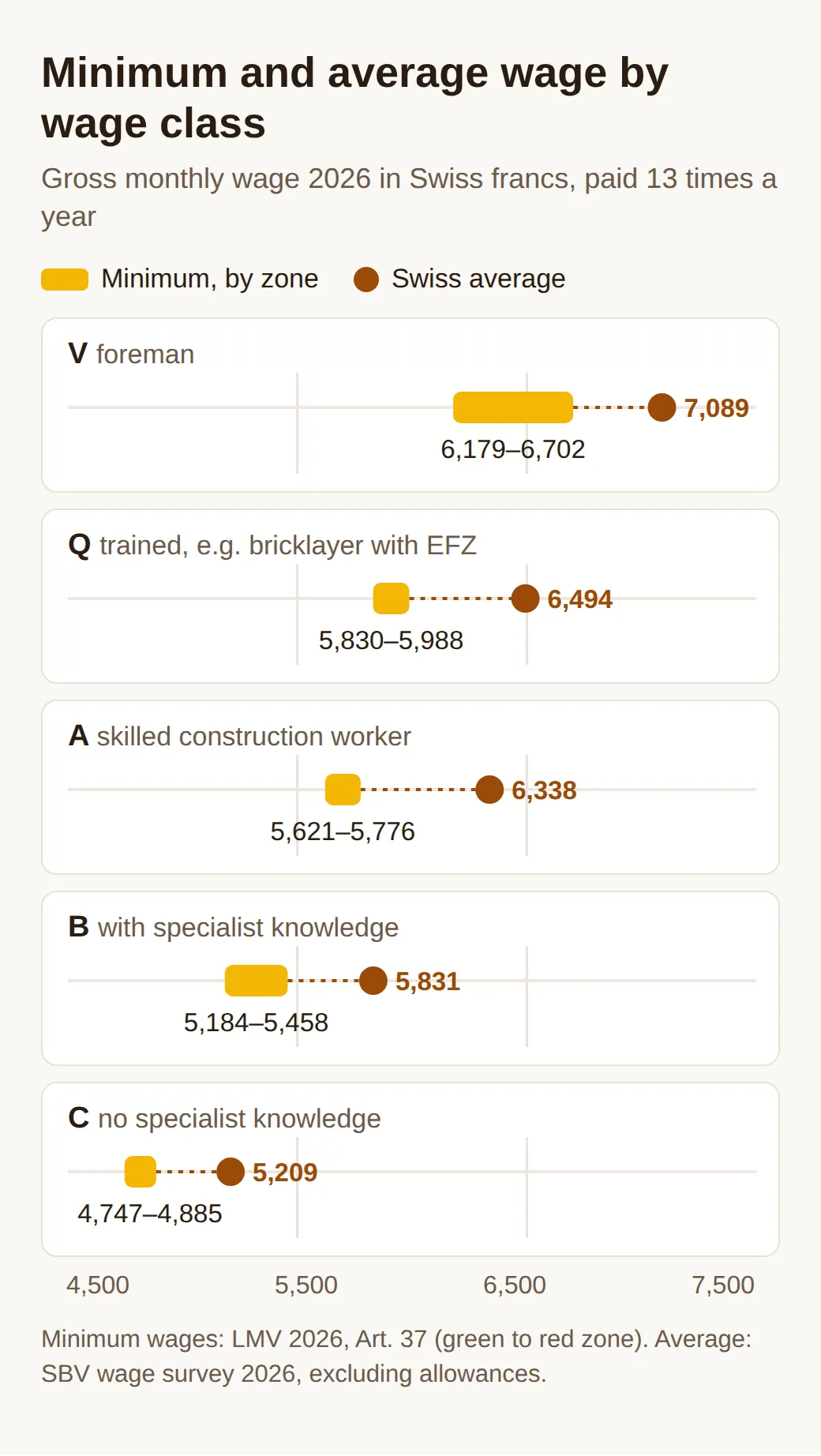
The chart shows how far actual pay sits above the minimum. According to the Swiss Builders' Association's wage survey, trained construction workers in class Q, such as bricklayers with an EFZ, earn CHF 6,494 a month on average in 2026, just under 10% more than the minimum in the blue zone. Surcharges aren't included in these figures. For 2026, the social partners (the employers and the unions) did not raise actual wages across the board. Anything above the minimum is yours to negotiate.
Straight out of your apprenticeship
Right after your apprenticeship, your pay may sit below the minimum, but only within limits and only on a permanent contract. For class Q it may be at most 15% lower in the first year, 10% in the second and 5% in the third. In the blue zone that means at least CHF 5,020.10 in the first year, 5,315.40 in the second and 5,610.70 in the third. After an EBA apprenticeship, your pay may drop to the class C minimum in the first year, and in years two to four it may be at most 15%, 10% and 5% below class A. After that, the full table applies. Which column of the table is yours depends on where you work, though.
Red, blue, green: your zone depends on the canton
Annex 4 of the LMV sets which zone applies, separately for each wage class and separately for monthly and hourly pay. That sounds like red tape, but it has real consequences. In the canton of Zurich, trained bricklayers paid by the hour fall in the red zone: CHF 34.00. For monthly pay, though, it's the blue zone, with CHF 5,906. Jura and Neuchâtel work the same way. In Lucerne, Zug and Schwyz it's the other way round: hourly pay in blue, monthly pay in green.
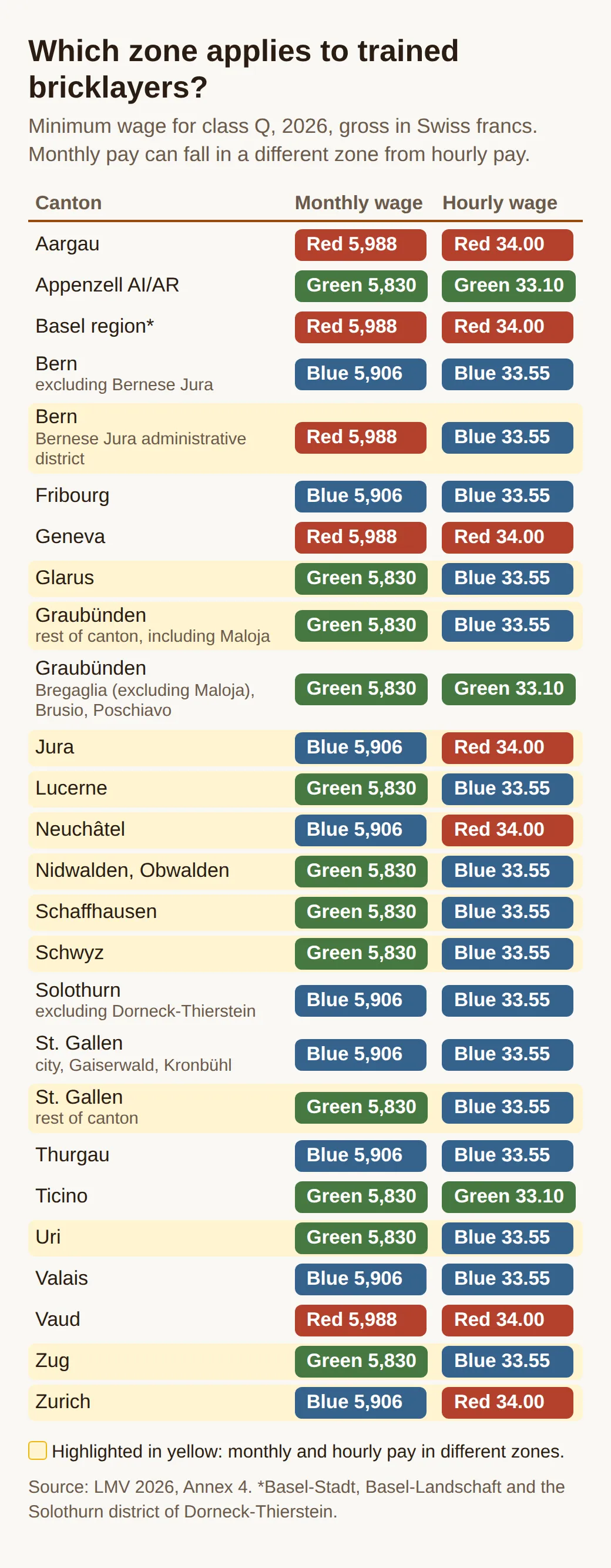
For class Q, only the Basel region, Geneva, Vaud and Aargau are entirely in the red zone. Entirely green are Appenzell, Ticino and the Graubünden districts of Bregaglia (excluding the municipality of Maloja), Brusio and Poschiavo. What's new since 2026 is the canton of Bern: according to the Swiss Builders' Association's page on social partnership, its zones were merged and blue now applies to all classes. The only exception is monthly pay in class Q in the Bernese Jura administrative district, which stays red.
Geneva and Neuchâtel also have a cantonal minimum wage. Under the LMV, the agreement's wage applies there as long as it's higher. Whether the monthly or the hourly wage counts for you in the end depends on your contract.
Monthly or hourly pay?
Both are common in construction, and either way a similar amount lands in your account each month. If your employment lasts longer than seven months, the company must pay an hourly wage as a steady monthly wage too: the hourly wage times 2,112 hours, divided by twelve (Art. 43 LMV). How many hours you actually worked in a given month then makes no difference to the monthly amount.
Take Bern, where both wages are in the blue zone: CHF 33.55 times 176 makes CHF 5,904.80 a month, practically the same as the monthly wage of CHF 5,906. Zurich is different. On the minimum hourly wage of CHF 34.00 you get CHF 5,984 a month, CHF 78 more than on the minimum monthly wage. Over a year with the 13th month's salary, that's CHF 1,014. If you earn more than the minimum anyway, the difference doesn't matter.
One difference remains, and it's about holidays. You get 25 working days of holiday a year, or 30 days up to your 20th birthday and from the age of 50. On monthly pay, your wage simply carries on while you're on holiday. Only if holiday pay is exceptionally calculated on the hours worked is it added as a supplement of 10.6% (for five weeks) or 13% (for six weeks), paid out when you take the holiday (Art. 31 LMV). Swapping holiday for money is not allowed while you're employed. On top of the pay for twelve months, there's a thirteenth.
How the 13th month's salary works
You're entitled to the 13th month's salary from your first working day, not just after the probationary period (Art. 45 LMV). If you work the whole year for the same company, it pays you an extra average monthly wage at the end of the year. On hourly pay, it's 8.3% of all the wages you received in the calendar year. If the job ends during the year, you also get 8.3% of what you earned that year, with your last pay.
A worked example: you start on 1 August as a trained bricklayer in Zurich on the minimum monthly wage of CHF 5,906. By the end of December you've earned CHF 29,530, and 8.3% of that is CHF 2,450.99 as your pro rata 13th month's salary for 2026. A full year brings 13 times 5,906, or CHF 76,778 gross.
With a written agreement, the company may pay the 13th month's salary twice a year. If you pay withholding tax, it may even be paid monthly. Either way, it must be shown separately on your payslip (Art. 46 LMV). Annex 6 sets what goes into the calculation: base wage, holiday and public holiday pay, bad weather compensation, and surcharges for night and Sunday work all count. Lunch allowances and expenses don't. How bad weather compensation itself works is explained in our post on bad weather in construction. Beyond the base wage, you earn more mainly through surcharges.
What surcharges are you entitled to?
Surcharges are paid for work at times or in conditions the agreement treats as a burden, as a percentage of your base wage. The main ones in the LMV:
| When | Surcharge | Article |
|---|---|---|
| Saturday, every hour | 25% | Art. 29 |
| Night, assignment of up to one week | 50% | Art. 50 |
| Night, assignment of more than one week | 25% | Art. 50 |
| Sundays and recognised public holidays | 50% | Art. 51 |
| Overtime above 50 hours a week | 25% | Art. 28 |
| Water or mud, high boots | 30% | Art. 52 |
| Water or mud, waders | 50% | Art. 52 |
| Permanent night shift | CHF 2 an hour | Art. 54 |
From April to September, night means 8 pm to 5 am; from October to March, 8 pm to 6 am. For the surcharge, Sunday starts at 5 pm on Saturday. The rule in Art. 48 is the one to know: surcharges for overtime, night, Saturday and Sunday aren't added together, and the higher one applies. So if you work on a Sunday night, you get 50%, not 100%.
On Zurich's minimum hourly wage of CHF 34.00, that means CHF 42.50 for an hour on a Saturday and CHF 51.00 for an hour on a Sunday. An ordinary extra hour below 50 hours a week, on the other hand, usually goes into your hours account without a surcharge. How the hours account works under the new agreement is a topic of its own. Underground construction has its own, higher surcharges under Annex 10. Besides the surcharges, there are fixed amounts in francs.
Site allowance, lunch and mileage
Since 2026 you get a site allowance (Baustellenzulage) of CHF 4 for every working day on which you work at least five and a half hours. It rises to CHF 6.50 on 1 January 2027 and to CHF 9 in 2028 (Art. 55 LMV). With 20 working days a month, that's CHF 80 in 2026 and CHF 180 in 2028. The Swiss Builders' Association says the allowance is there to cover the cost of food during breaks. At the same time, under Art. 49 it covers travel time from the meeting point to the site and back, up to a certain length: the first 30 minutes a day until the end of 2028, 25 minutes in 2029 and 20 minutes from 2030. Apprentices get half the allowance.
Lunch works differently. The company should provide meals where it can. If it doesn't, or you can't get home at lunchtime, you're entitled to at least CHF 16. Local collective agreements may provide more. In the canton of Geneva, according to Annex 13, there's a flat CHF 25 a day for travel and lunch, plus a paid morning break worth 2.9% of the monthly wage.
If your boss tells you to drive your own car, you get at least 70 centimes per kilometre. If the company sends you to work away from your usual place, it must pay the expenses that come with it. Lunch money, mileage and expenses are reimbursements and, under Annex 6, count neither towards the 13th month's salary nor towards holiday pay. Which leaves the question of how much of your gross wage actually reaches you.
What's left of your gross wage
Some deductions are almost the same for everyone, others depend on your company. The fixed ones are 5.3% for AHV, IV and EO (old-age, disability and income compensation insurance) according to leaflet 2.01, 1.1% for unemployment insurance according to leaflet 2.08, 2.25% for FAR early retirement according to the FAR foundation and 0.7% for the Parifonds Bau (Art. 10 LMV), which pays for enforcement and training. In Geneva, Neuchâtel, Ticino, Vaud and Valais, a cantonal fund with its own rules may take the place of the Parifonds Bau.
On the minimum wage of CHF 5,906, that comes to CHF 552.21 in total. That leaves CHF 5,353.79 before contributions to the pension fund, non-occupational accident insurance and daily sickness benefits insurance. Those depend on your age and on your company's insurance. Under Art. 56, employer and employee each pay half of the daily sickness benefits premium. If you pay withholding tax, that comes off as well. What the 2.25% for FAR brings you later is explained in our post on early retirement in construction.
What changes in 2027
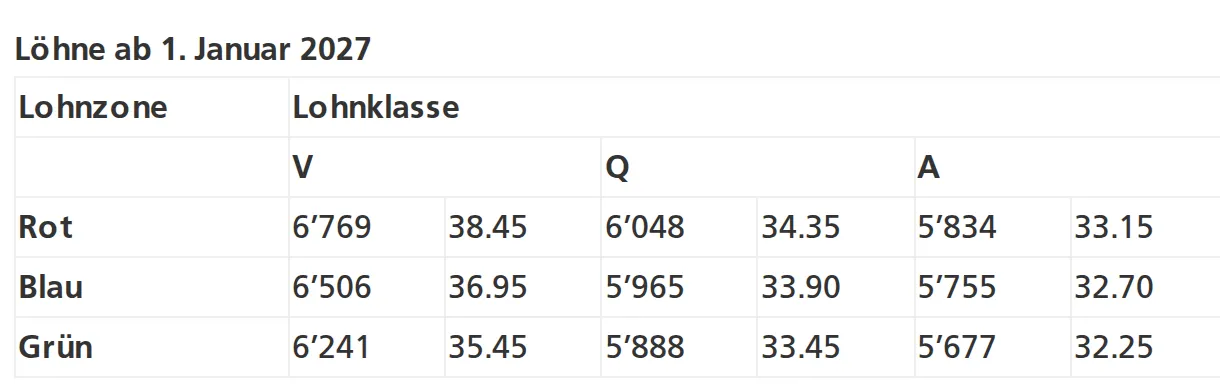
Minimum wages rise by around 1% on 1 January 2027. The new agreement ties them to the Swiss Consumer Price Index for September of the previous year (Art. 71 LMV), and according to the Federal Statistical Office, prices in September 2026 were 1.0% higher than a year earlier. The Swiss Builders' Association has already published the new rates on the same social partnership page. For trained bricklayers they are CHF 6,048 in the red zone, 5,965 in blue and 5,888 in green.
Even if you earn more than the minimum, you get something extra in 2027. According to a Swiss Builders' Association information sheet from August 2026, all actual wages rise by a fixed amount in francs in 2027 and 2028: 80% of inflation, calculated on the class C minimum wage in the blue zone. With inflation of 1.0% and a minimum of CHF 4,861, that comes to around CHF 39 a month by our calculation, the same for everyone. According to the association's timeline, the social partners announce the binding amount in mid-October 2026. On 17 October 2026 it had not yet been published on the association's or Syna's websites. Check it on your January payslip. There will be no more general wage negotiations until 2031, unless inflation rises above 2%. If you want more, you'll have to get it from your own boss.
If your pay is below the minimum
First compare the wage class on your payslip with your training and your years in construction, then compare the amount with the table for your canton. If something's wrong, talk to the company first. If that doesn't help, you can turn to the joint trade committee for your region. It enforces the LMV locally (Art. 62 LMV), and you'll find the addresses on the website of the SVK for the main construction sector. The unions Unia and Syna also advise their members.
Underpaid wages don't become time-barred straight away. Under Art. 128 of the Code of Obligations, you can claim money owed from your employment for five years. So keep your payslips and your records of the hours you worked.
Bricklayer jobs in the canton of Zurich
If you're changing jobs, know the minimum for your class and mention the average when you talk pay. The red zone applies to trained bricklayers on monthly pay in the canton of Aargau and the canton of Vaud, for example. When you get an offer, ask about the wage class, whether it's monthly or hourly pay, and whether the company provides lunch or pays the CHF 16. With those three answers, you can compare two offers fairly.
Common questions
- Does the LMV minimum wage apply if my employer isn't in an association?
- Yes. The Federal Council has declared the 2026 to 2031 national collective agreement generally binding, with effect from 1 April 2026. So the minimum wages apply to every company the agreement covers, even if it isn't a member of the Swiss Builders' Association.
- How much does an apprentice bricklayer earn in Switzerland?
- The LMV sets no fixed minimum wage for apprentices. The regional sections of the Swiss Builders' Association publish recommendations every year, and they vary from region to region. What the agreement does fix is six weeks of holiday, a 13th month's salary and half the site allowance.
- Do I get a 13th month's salary on piecework?
- Yes, unless something else has been agreed in writing. Without a written agreement, the LMV rules on the 13th month's salary, holidays, public holidays and daily sickness benefits insurance also apply to piecework. The same goes if you get a performance bonus on top of a fixed wage.
- Can a new employer put me in a lower wage class when I change jobs?
- As a rule, no. If you were in class B or A, you keep that class when you move to another construction company. An exception is only possible if the new employer agrees it with you in writing and reports it to the joint trade committee.
More posts
All posts
Swiss Construction Working Hours 2026: Overtime, Travel Time
Working hours in construction under the LMV 2026: 2,112 hours a year, working time calendar, overtime account, 25% supplement, Saturday work and travel time.

Early Retirement in Swiss Construction: FAR Pension 2026
Early retirement at 60 in Swiss construction: who gets the FAR pension, how much it pays in 2026, what changed in July 2025 and the AHV and pension fund gaps.

Temp work in Swiss construction: pay, expenses, notice 2026
Temping on a Swiss building site: the 2026 minimum wage, holiday pay, 13th month and site allowance, how quickly you can be let go and what happens to FAR.