Bad Weather Compensation in Swiss Construction 2026
The short answer
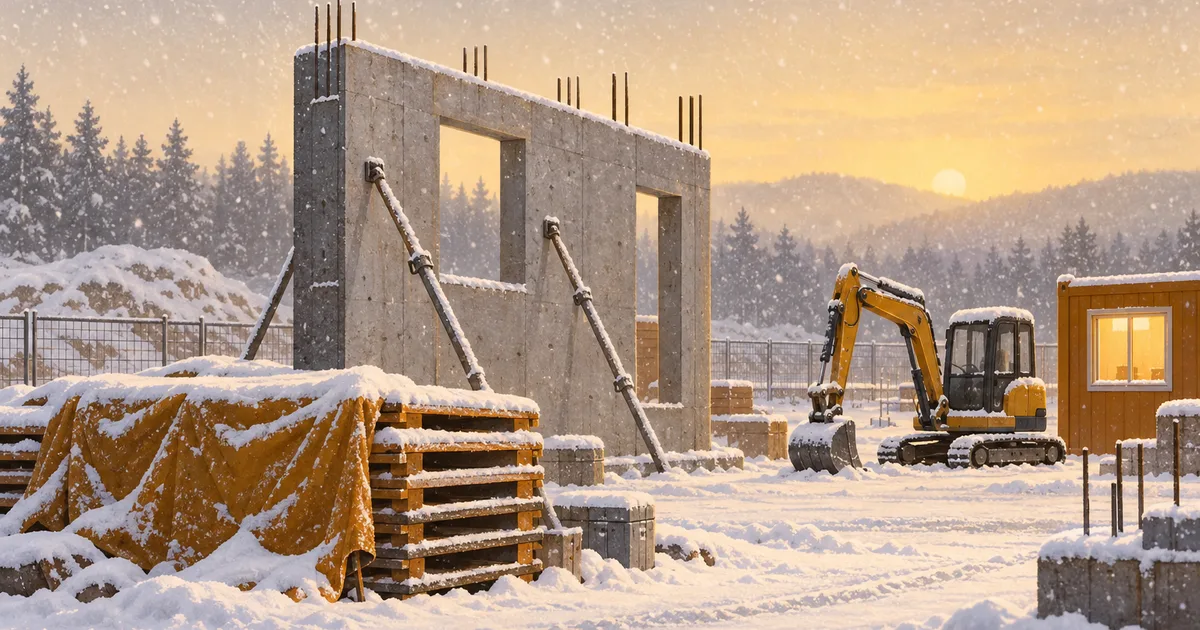
When snow, steady rain or hard frost hit, your company has to stop outdoor work: the national collective agreement for construction (LMV) requires it. For the full and half days you lose, you usually get 80% of your wage, on your normal payday, from your employer. Unemployment insurance pays the company back later, except for the waiting days, usually two a month, which the employer covers. You don't have to apply for anything.
Nearly every page on bad weather compensation agrees on that much. But they're written for employers: forms, deadlines, office addresses. What happens on your payslip, why your overtime goes first and what the new LMV guarantees you on those days hardly gets a mention. We read the Unemployment Insurance Act, its ordinance, SECO's brochure and the LMV 2026 to 2031, and worked through an example. The laws, the brochure and the agreement are published in German, French and Italian only, so most links below lead to German pages.
When work stops on a building site
The rule is in Art. 30 of the Landesmantelvertrag, the national collective agreement for the main construction sector. Its new version has been generally binding since 1 April 2026, so it applies to every company in the sector. If the weather puts your health at risk or makes efficient work impossible, outdoor construction work must stop, as far as that's technically possible. The agreement lists heat, rain, snow, lightning and severe cold.
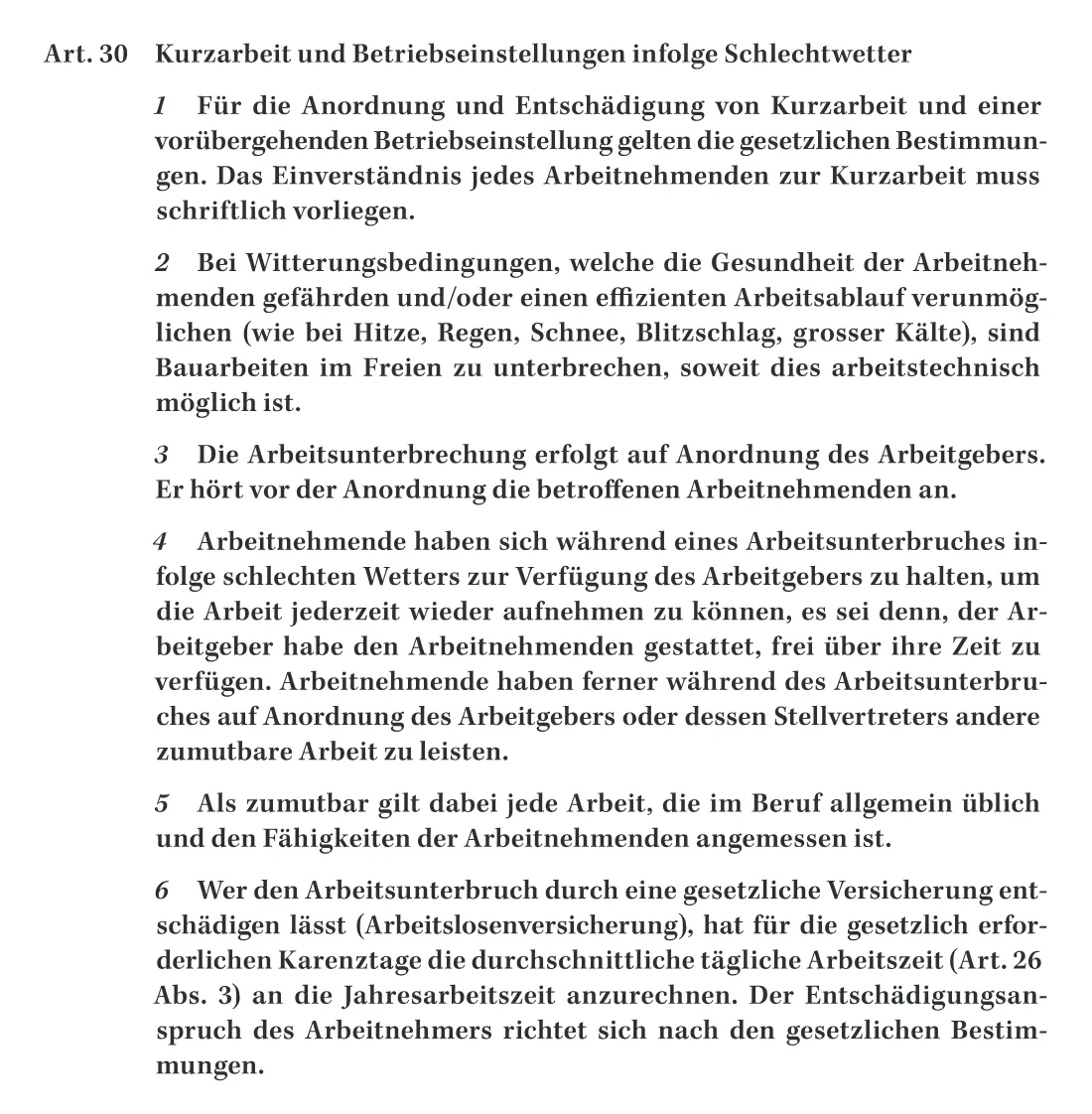
Neither the LMV nor the law names a temperature or an amount of rain at which work ends. Your employer decides, and must hear the workers affected first. So tell your site foreman (Polier) if you think a job is dangerous in ice or a storm. If work is stopped, you don't simply go home. You stay available so work can restart at any time, unless the boss expressly lets you go. In the meantime they can also give you other work, as long as it's normal in your trade and suits your skills, say in the company yard instead of on the scaffolding.
Vaud has fixed thresholds
For building sites in the canton of Vaud, MeteoSwiss produces a report of its own twice a day, the Prévision Construction-Vaud. From October to April, according to the joint committees' information sheet (in French), it flags a feels-like temperature of minus 8 degrees or lower, at least 6 millimetres of rain in six hours, and one centimetre of fresh snow or more. Even there, though, the cantonal office decides afterwards whether money is paid. It checks whether the weather on your lost days really was that bad. What your pay then looks like is set by law.
How much is bad weather compensation?
For every hour lost you get 80% of the wage for that hour. That's in the Unemployment Insurance Act, which applies the short-time work rules to bad weather compensation. According to SECO's brochure for employers, this covers your contractual wage and the regular allowances written into your contract. Under the Act, allowances meant to make up for unpleasant work don't count. The insured wage is capped too: at CHF 12,350 a month including allowances in 2026, according to the canton of Zug.
Only full and half days are paid. A half day is a morning, an afternoon, or at least half your daily working time. So an hour of rain in the morning isn't enough. The brochure works it through: if five hours are planned in the morning and four in the afternoon and 4.3 hours are lost, four count, namely the afternoon. With 4.6 hours lost, 4.5 count, the half day.
There's a catch on your payslip. Your employer must keep paying contributions to AHV, IV and EO (old-age, disability and loss-of-earnings insurance), unemployment insurance, accident insurance, the family allowance fund and the pension fund on your full wage, as if you'd worked normally. Unless something else has been agreed, they may also deduct your full share of those contributions. So net, you're missing a little more than 20%. In return, your AHV and your pension fund count the full wage, just as on a normal working day. What years in construction mean later for retiring early is covered in our post on early retirement. And under Annex 6 of the LMV, bad weather compensation also counts towards your holiday pay and your 13th-month salary.
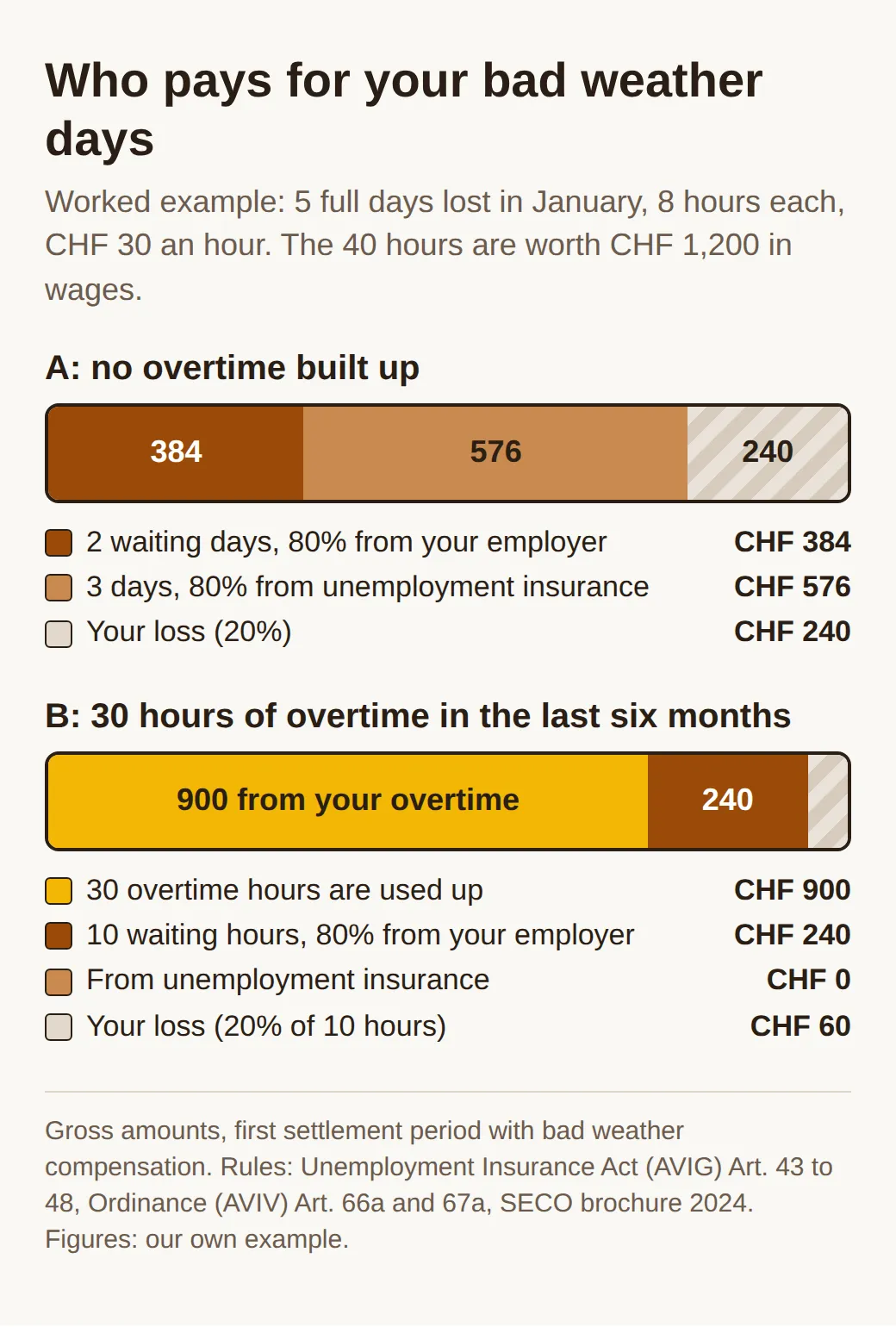
In the example you earn CHF 30 an hour, the working time calendar plans eight hours a day in January, and on five days it snows so hard that nothing can be done. Those 40 hours would be worth CHF 1,200. You get CHF 960, which is 80%, and lose CHF 240 gross. Who pays what depends on the waiting days.
Who pays for the waiting days
Your employer pays for the waiting days, not you. Waiting days, Karenztage on a German payslip, are the first lost days in each settlement period, for which the insurance pays nothing. Under the ordinance, there are two a month in the first six months with compensation, and three from the seventh. The fund counts months of short-time work too. For these days your employer must pay you the compensation themselves, just as for the other days. The canton of Valais states on its page on bad weather compensation that the waiting period may "under no circumstances" be charged to employees.
In the example, the company carries 16 hours, CHF 384, and the unemployment insurance fund the other 24 hours, CHF 576. You won't see the difference on your payslip. The LMV adds one more thing: for the waiting days, the company must credit your average daily working time to your annual working hours. So for your hours account they count as worked.
The upper limit matters too. Within two years, bad weather compensation is paid for at most six settlement periods, usually six months. A snowy winter can use up a large part of that for a company. Before the insurance pays at all, though, there's a rule that surprises many people.
Why your overtime goes first
Before the insurance pays, your overtime is offset. If no two-year benefit period is running for the company yet, the fund deducts all the extra hours you worked in the six months before from your lost hours, under Art. 66a of the ordinance. If the period is already running, it's all extra hours since the last stoppage, from the last twelve months at most. The only exceptions are small flexitime balances of up to 20 hours and hours planned in advance to make up for public holidays.
For you, that means lost hours are balanced against your overtime first. In the example, you built up 30 hours of overtime in the six months before. That leaves only ten of the 40 lost hours, and they all fall within the waiting period. The unemployment insurance fund pays nothing, your company pays CHF 240, and your account is 30 hours lighter. Yet under Art. 28 LMV, you could have decided yourself what happens to half your balance at the end of the year, for instance to have it paid out with a 25% supplement.
The Vaud construction industry's information sheet (in French) shows how this is calculated. It compares the overtime balance in January with the one in August and accepts a difference of up to 20 hours. If someone had 70 hours in August and 80 in January, that's ten, and bad weather compensation is paid. If the balance rose from 10 to 80 hours, the company must first use 50 of those hours for the bad weather days.
What else the LMV lets the company do
Insurance isn't the only way through a wet month. The LMV lets the employer have overtime taken as time off, and in extreme heat or bad weather even by the hour. They may also change the working time calendar because of bad weather: fewer hours now, more later, but no more than 48 a week and only for the future. If fewer make-up hours are needed in the end than planned, the company bears the difference and may not cut your pay.
They may carry negative hours forward only within tight limits: at most 20 hours with a working time calendar, and from 2027 at most 50 under the new constant working time planning. Anything beyond that is written off at the employer's expense, unless it's your own fault. For the bad weather days themselves, your employer has a few more duties.
What your employer has to do
Your employer advances the compensation and settles up with the authorities afterwards. According to SECO and its brochure, the law asks four main things of them. They pay you the 80% on the normal payday, even if the authorities haven't decided yet. They carry the waiting days. They pay social insurance contributions on your full wage. And they keep a record of working time that shows, for every day, who worked how long, who was off because of the weather and who was on holiday or sick.
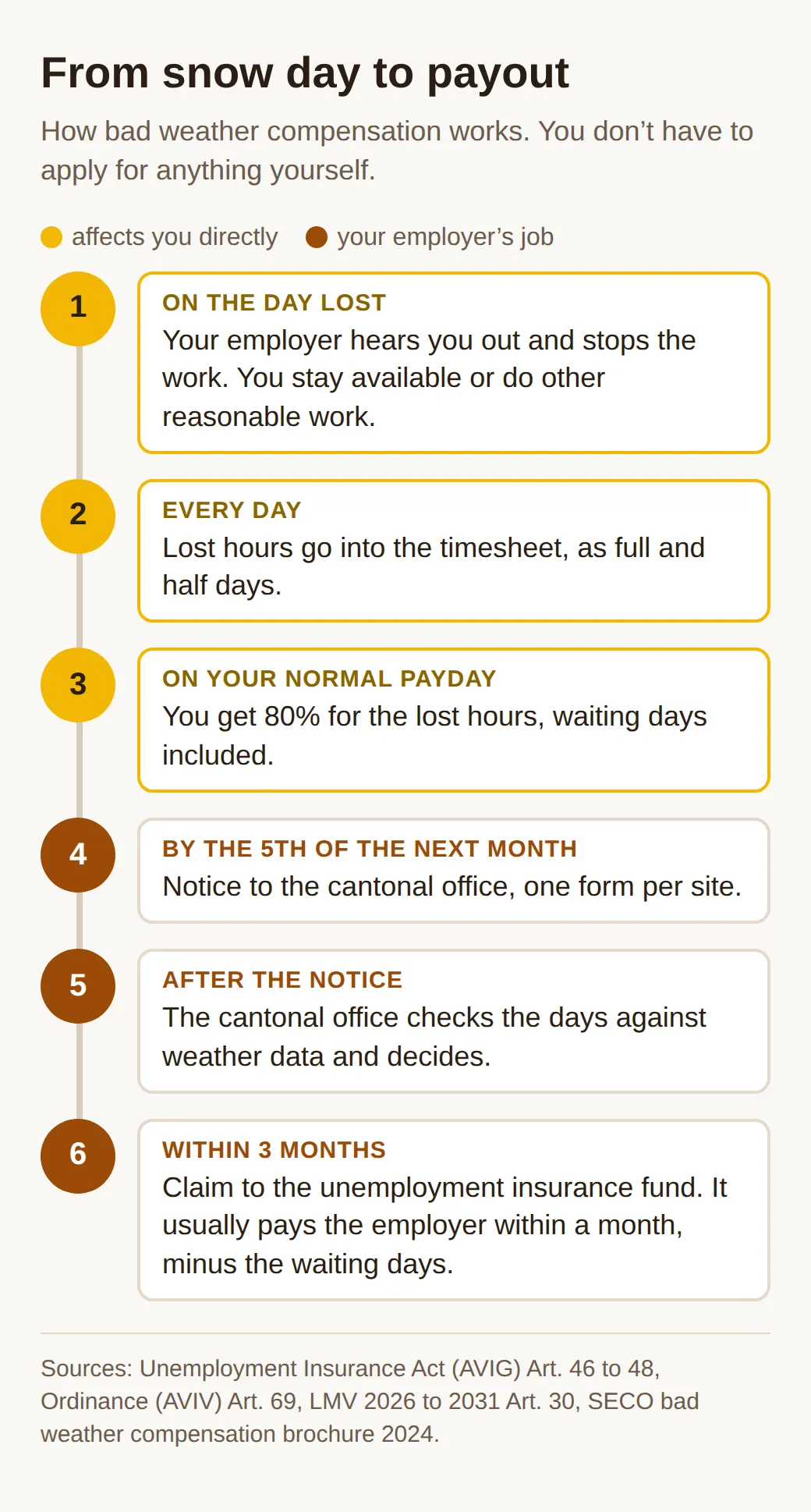
By the 5th of the following month at the latest, they must report the stoppages to the cantonal office, with one form per building site. The form asks, among other things, for the site's altitude and the work that couldn't be done. The office checks the days against a meteorological calendar or other records and decides which days are paid. If the company reports late without good reason, the entitlement starts later by the length of the delay. The company must then submit its claim to the unemployment insurance fund within three months of the end of the month concerned. Anything it submits late, the fund doesn't pay.
Your timesheet counts
A ruling by the Federal Administrative Court from December 2021 shows how closely the authorities look. A construction firm had received around CHF 49,085 in bad weather compensation for January and February 2018 and January to March 2019. SECO checked and found a wage set too high, and lunch allowances paid on days claimed as full days lost. The firm said the workers had waited on call on site until about 2 pm. The court found it more likely that work had been done on those days. In all, the firm had to pay back CHF 11,784.75.
What this means for you: make sure the timesheet says what really happened. If you worked two hours in the morning and then stopped, that's what goes in. Under Art. 44 LMV you're entitled to a monthly payslip that also shows your hours. Compare it with your own notes. Otherwise a mistake that costs you money won't be noticed by anyone.
Holidays instead of bad weather days?
Your employer can't simply book bad weather days as holidays. In 2010 the consumer magazine Beobachter reported on a construction worker at the Sihlpost building site in Zurich whose firm had sent him home for five days because of snow and booked them as holidays. Unia called that "completely impermissible", and even the head of the legal department at the Swiss Builders' Association said holidays could only be taken with the employee's consent or as company holidays.
The LMV is clear on this. Under Art. 32, holidays are agreed between you and your employer in good time, and the company sets company-wide holidays in good time after consultation. A snow day doesn't give advance notice. Even under the Code of Obligations, where the employer decides when holidays are taken, they must take due account of your wishes. So don't sign a holiday request for a day the weather sent you home. For some people in construction, though, the question of compensation doesn't even arise.
Who gets no bad weather compensation
The insurance pays nothing for temporary workers. The Act says so, and according to the SECO brochure neither the temp agency nor the company you're placed with can claim bad weather compensation for you. What you get on those days is set by your contract with the agency. Also excluded are people on loan from another company, spouses working in the business, partners, shareholders and board members with a say in how the company is run, and anyone who has reached AHV retirement age. You have no entitlement either if your working hours can't be checked.
One special case: if you don't agree to the stoppage, you get no compensation, and your employer has to pay you under your employment contract. That's in the SECO brochure. It's no licence to keep working through a storm, because the employer is the one who orders the stoppage. But it shows that the 80% is an exception to your normal wage, not something to take for granted.
New to Switzerland? There's no qualifying period. According to the brochure, newly arrived B permit holders, seasonal workers and cross-border workers are entitled from their first day at work. And bad weather compensation doesn't only apply in the main construction sector: under the ordinance, it also covers carpentry, railway track and overhead line construction, landscape gardening and a few other sectors. Whether the LMV or another collective agreement applies to you there depends on your company.
What you can do before the first snow
Ask your site foreman early how the company handles bad weather days: through the insurance, with overtime or with a changed calendar. On each day lost, note when work stopped and whether you were allowed to go home. Check your payslip at the end of the month: bad weather days should show at 80%, waiting days too, and your overtime balance should match your notes. If something doesn't add up, the unions Unia and Syna can help, and the joint professional committee (paritätische Berufskommission) in your region is responsible for enforcing the LMV.
Where you get the full 100%
In Vaud you can get more. According to the information sheet, companies that pay into the Vaud construction industry's funds can claim the missing 20% back from the Fonds de prévention santé et sécurité if more than two days are lost in a month. In return, they first pay you the 80% and then, once the unemployment insurance fund has decided, the remaining 20%. This has applied all year round since January 2023, heatwaves included. So if you change jobs in Vaud, ask whether the company belongs to this fund.
Common questions
- Do apprentices get bad weather compensation?
- Yes. Everyone who pays unemployment insurance contributions is entitled, and so are young people who have finished compulsory school but are not yet old enough to pay AHV contributions. That includes apprentices in construction. The Vaud construction industry names apprentices explicitly in its information sheet.
- Do I have to register with the RAV on bad weather days?
- No. Only your employer claims bad weather compensation, through the cantonal office and the unemployment insurance fund. You stay employed and get your money with your wages as usual. You only go to the RAV, the regional employment centre, if you lose your job.
- Can I work another job on a bad weather day?
- Only if your employer has released you, because under the LMV you stay on call during the stoppage. If you earn anything in that time from a side job or self-employment, you must tell your employer. They pass it on to the unemployment insurance fund, and the income is taken into account in the compensation.
- Is bad weather compensation also paid in a heatwave?
- The LMV names heat explicitly as a reason to stop outdoor work. Compensation follows the same conditions as for rain or snow: despite protective measures, the work must be impossible, unjustifiable or unreasonable to expect. In Vaud, a heatwave of 34 degrees or more on three days in a row goes through the same reporting process and the same fund.
- How long can bad weather compensation be paid?
- Within two years, bad weather compensation is paid for at most six settlement periods, usually six months. Months of short-time work count towards that. After that, unemployment insurance pays the company no more bad weather compensation until the two years are up.
More posts
All posts
Temp work in Swiss construction: pay, expenses, notice 2026
Temping on a Swiss building site: the 2026 minimum wage, holiday pay, 13th month and site allowance, how quickly you can be let go and what happens to FAR.

Accident on a Construction Site: What Suva Pays in 2026
Hurt on a construction site? Who pays the first three days, how Suva works out the 80% daily allowance, and the rules on treatment, pensions and free time.

Site Foreman (Polier) Training 2026: Path, Cost and Pay
How to become a site foreman (Polier) in Switzerland: from bricklayer to foreman to federal diploma. Duration, cost, federal subsidies and 2026 pay.