Electrician Pay in Switzerland 2026: Minimum Wages to 2029
The pay in brief
As a qualified electrical installer (Elektroinstallateur EFZ), you earn at least CHF 4,500 gross a month in 2026 straight after your apprenticeship, paid 13 times a year. From 1 January after a full year in the trade, it's at least CHF 5,000. For installation electricians (Montage-Elektriker EFZ) the figures are CHF 4,300 and 4,700. On 1 January 2027 all of these minimum wages go up by CHF 100.
Search for "electrician salary Switzerland" and you mostly end up on salary websites. They show averages from their own surveys, sometimes based on fewer than a hundred entries, and annual salaries based sometimes on twelve monthly wages and sometimes on thirteen, without saying which. What you're actually entitled to is set out in a Federal Council decision. On 11 December 2025, the Federal Council declared the collective employment agreement for the Swiss electrical industry (GAV) generally binding until the end of 2029, including the minimum wages for each year. We read the decision, the agreement itself, the fact sheets of the national joint commission (PLK) and the Federal Statistical Office's earnings survey, and did the sums. The agreement and the commission's documents are published in German, French and Italian only, so most links below lead to German pages.
Who the electrical industry GAV covers
The GAV applies to every company in Switzerland that carries out electrical installations under the Low-Voltage Installation Ordinance, installs telecoms, data and building automation systems, or cuts wall chases and lays conduit for them (Art. 3.3.1 GAV). Because it's generally binding, it doesn't matter whether your employer is a member of the industry association EIT.swiss. Temp agencies and foreign companies working here also have to pay the minimum wages.
There are three exceptions you should know about. First, the agreement doesn't apply in Geneva and Valais, which have their own agreements, as SECO's overview confirms. Second, it excludes managers, office staff and anyone who mainly plans, designs projects, works out costings or writes quotes, which usually means electrical planners too. Third, in the canton of Neuchâtel the cantonal minimum wage applies if it's higher than the minimum wage in the GAV.
Figures from the building services agreement don't belong here either. That's a separate contract, listed separately by SECO. The same goes for figures from Liechtenstein, which isn't covered by the Swiss GAV. Mix them up and you'll quickly end up with the wrong amounts. For everyone else, one table with figures for five years applies.
Minimum wages 2026 to 2029
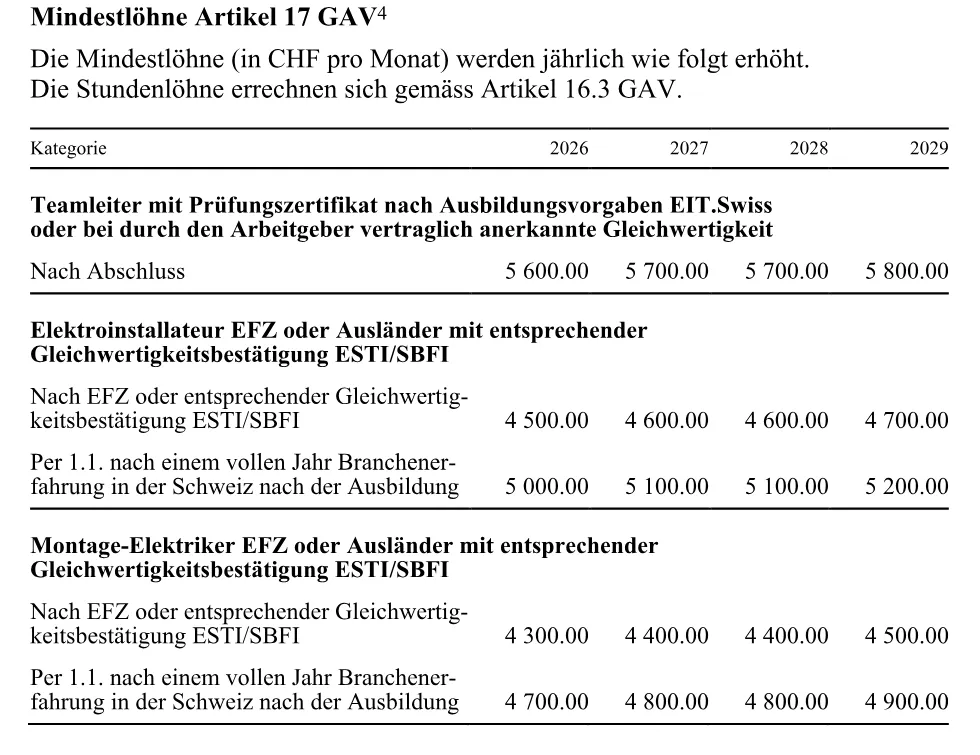
Your minimum wage depends on two things: which qualification you hold, and whether you already have a full year of experience in Switzerland. The amounts are in Annex 5c of the GAV and are monthly wages for a 40-hour week. In 2028 they stay at the 2027 level.
| Level | 2026 | 2027 and 2028 | 2029 |
|---|---|---|---|
| Electrical installer EFZ, after qualifying | 4,500 | 4,600 | 4,700 |
| Electrical installer EFZ, after a full year | 5,000 | 5,100 | 5,200 |
| Installation electrician EFZ, after qualifying | 4,300 | 4,400 | 4,500 |
| Installation electrician EFZ, after a full year | 4,700 | 4,800 | 4,900 |
| Building IT specialist or telematics technician EFZ, after qualifying | 4,770 | 4,870 | 4,970 |
| Building IT specialist or telematics technician EFZ, after a full year | 5,300 | 5,400 | 5,500 |
| Team leader with exam certificate | 5,600 | 5,700 | 5,800 |
Over a year, that means an experienced electrical installer earns at least CHF 65,000 gross in 2026, and an installation electrician CHF 61,100. Straight after the apprenticeship, it's CHF 58,500 and 55,900.
Two levels are missing from the table above, because they rarely matter for trained electricians. With a school-based qualification in the electrical trade, or a foreign electrical qualification that hasn't been recognised, it's at least CHF 4,300 in 2026, and 4,600 after a full year in Switzerland. Without a vocational qualification in the trade, it's CHF 4,200, and 4,500 after two years of experience. For young people without an EFZ, there's no minimum wage at all until the age of 20 (Art. 17.1 GAV). Things get interesting when you move up a level.
Why "after one year" can mean around 17 months
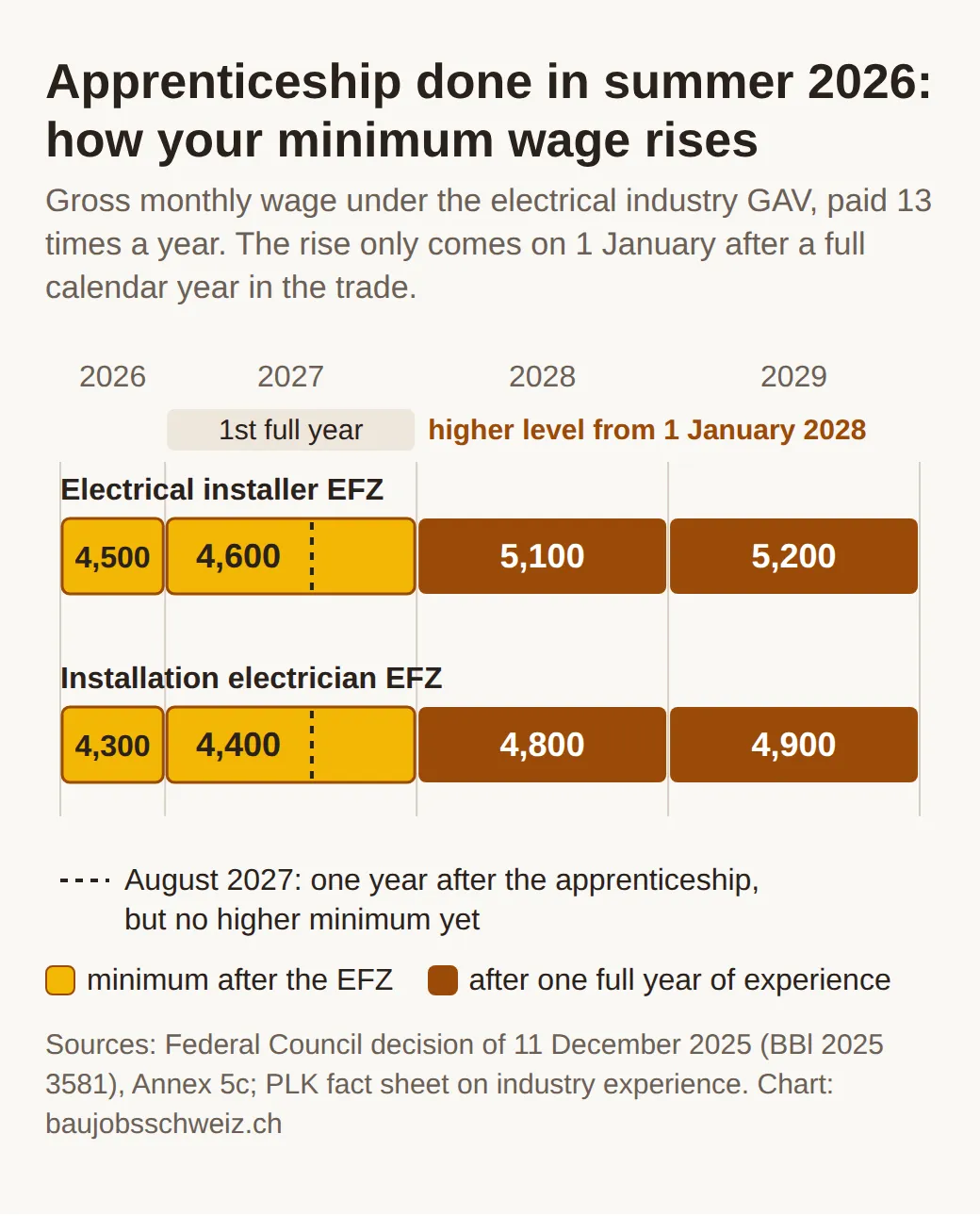
You don't get the higher minimum wage one year after your final apprenticeship exam. You get it on 1 January after a full calendar year in the trade. That's what the PLK fact sheet on industry experience says: your experience counts from 1 January of the year after you qualify. The months between the end of your apprenticeship and New Year don't count.
An example: you finish your apprenticeship in summer 2026. Until the end of 2026, the entry wage of CHF 4,500 applies. 2027 is your first full year in the trade, so you stay on the entry wage, which by then is CHF 4,600. Only from 1 January 2028 are you entitled to the higher level, by then CHF 5,100.
The PLK fact sheet also covers special cases. Basic military training (recruit school) and single-period military service don't count as industry experience, and neither do further training or longer absences. You have to prove your years without gaps, with employment references, payslips or social insurance statements. A CV on its own isn't enough. According to the PLK's FAQ, though, it's mainly your employer's job to get your level right: they have to ask for the documents, and if an inspection finds the wrong level, it's held against them, not you. Which level you're on depends first of all on your qualification.
Electrical installer or installation electrician: what your qualification is worth
Between the two most common qualifications, the minimum wage differs by CHF 200 a month straight after the apprenticeship and by CHF 300 after a full year. The reason is the training: according to berufsberatung.ch, the electrical installer EFZ apprenticeship takes four years, while the one for installation electrician EFZ takes three. With a qualification as a building IT specialist or telematics technician EFZ (Gebäudeinformatiker, Telematiker), the minimum is a little higher still.
If you qualified abroad, your qualification only counts with a certificate of equivalence from the Federal Inspectorate for Heavy Current Installations (ESTI) or the State Secretariat for Education, Research and Innovation (SERI). With one, you're treated as an electrical installer or installation electrician EFZ. Without one, you fall into the lower level for foreign electrical qualifications. For an electrical installer with a year's experience, the gap is CHF 400 a month (5,000 instead of 4,600), or CHF 5,200 over a year. So recognition pays off, and according to the PLK's FAQ, your employer has to tell you it's an option.
If you complete the further training to become an electrical team leader with an exam certificate, you're entitled to at least CHF 5,600. Above that, there are no more GAV levels. Whether you're paid by the month or by the hour doesn't change these amounts, only the arithmetic.
How much does an electrician earn per hour?
You work out the hourly rate from the monthly wage: monthly wage divided by 174 gives the basic hourly wage (Art. 16.3 GAV). If you're employed on an hourly basis, the model employment contract in Annex 6 adds three supplements, because holidays, public holidays and the 13th month's salary would otherwise be missing: 11.59% for 27 days of holiday, 3.59% for nine paid public holidays, and on top of that total another 8.33% for the 13th month. From age 50, it's 13.04% for 30 days of holiday.
| Level 2026 | Basic hourly wage | With all three supplements |
|---|---|---|
| Electrical installer, after qualifying | 25.86 | about 32.27 |
| Electrical installer, after a full year | 28.74 | about 35.86 |
| Installation electrician, after qualifying | 24.71 | about 30.83 |
| Installation electrician, after a full year | 27.01 | about 33.70 |
| Team leader with exam certificate | 32.18 | about 40.15 |
The PLK already listed these basic wages for the same monthly amounts in its 2025 wage annex. We calculated the figures with supplements using Annex 6; depending on how the payroll rounds, they can be one centime out. From 2027, the basic hourly wage for electrical installers goes up to CHF 26.44 after qualifying and CHF 29.31 with experience.
Check whether your payslip shows the supplements separately. An hourly wage of CHF 30 sounds like more than 25.86, but it's too little for an experienced electrical installer if holidays, public holidays and the 13th month are supposed to be included. Which brings us to the 13th month's salary itself.
The 13th month's salary and what else you get
The 13th month's salary is compulsory under the GAV and amounts to 100% of your average monthly wage over the calendar year (Art. 18 GAV). The company pays it in December at the latest or when you leave, or monthly if agreed. If you don't work for the company for the whole year, you get it pro rata. Your employer can only cut it if you're off work for more than two months in total in a year, and then by one twelfth for each further full month. Military refresher courses don't count as time off.
On top of that come supplements for working at unsocial hours (Art. 25 GAV). On Saturdays from 1 pm to 11 pm you get 25%, at night from 11 pm to 6 am 50%, and on Sundays and public holidays 100%. These supplements can only be paid in money, not as time off. Overtime goes into an account over the year: you can carry up to 100 hours into the next year, and anything above that has to be paid out in January with a 25% supplement (Art. 21.3 GAV). Hours ordered beyond 50 a week count as extra overtime and also cost 25% more.
Expenses come with fixed minimum amounts. If the site is more than 15 minutes from the company's base in actual travel time, you get at least CHF 18 a day for lunch (Art. 33.1 GAV); in 2025 it was still CHF 16. If you drive your own car with the company's consent, you get 60 centimes per kilometre. For a motorbike or moped it's a flat CHF 50 a month, and for a bicycle CHF 20 (Art. 34.1 GAV). You get 27 days of holiday a year, 30 from age 50, and up to five paid days for further training if the course is run or recognised by the parties to the agreement.
Besides the usual social security deductions, CHF 21 a month comes off your wage for enforcement and training, even if you work part time; your employer pays the same again. The electrical GAV has no early retirement scheme of its own like the FAR in the main construction sector, which we explain in our article on early retirement in construction. Apprentices are exempt from the deduction, and they have their own rules in other areas too.
How much does an apprentice electrician earn?
There's no GAV minimum wage for apprentices (Art. 17.1 GAV). But the Federal Council has made part of the agreement binding for apprentices as well: working hours, holidays, public holidays, paid leave, expenses and the 13th month's salary. As an apprentice, you also get 13 monthly wages and the CHF 18 for lunch when the site is outside the 15-minute zone.
How much apprentices are paid is set by recommendations. For apprenticeships starting in summer 2026, the regional association EIT.ost, which covers St. Gallen, both Appenzells and Liechtenstein, recommends these monthly wages for electrical installers and installation electricians:
- 1st year: CHF 800
- 2nd year: CHF 1,000
- 3rd year: CHF 1,300
- 4th year: CHF 1,600 (electrical installers only)
For a second apprenticeship, EIT.ost recommends CHF 2,500 in the first year and CHF 3,000 in the second. The official careers guidance portal berufsberatung.ch gives lower figures for Switzerland as a whole: 700, 900, 1,150 and 1,462 francs for electrical installers, and 700, 900 and 1,105 francs for installation electricians. The portal gives no date for them. Both are recommendations, not obligations. What counts is your apprenticeship contract.
Finding an apprenticeship
When you do a trial day, ask straight out about the pay for each year of the apprenticeship and whether the company follows its regional association's recommendation. For trained electricians, the turn of the year into 2027 brings more.
What changes on 1 January 2027
All minimum wages go up by CHF 100 on 1 January 2027, as the Federal Council decision sets out. In 2028 they stay the same, and in 2029 another CHF 100 is added. These amounts are fixed and don't depend on inflation. For team leaders it's CHF 5,700, for experienced electrical installers CHF 5,100.
A second rule applies to your actual wage (Art. 17.6 GAV). If inflation in September is below 1.5%, it's compensated on actual wages, but by at least CHF 50 a month. According to the Federal Statistical Office, inflation in September 2026 was 1.0%. In its FAQ, the PLK works through exactly this case with a hypothetical example: at 1% inflation, a wage of CHF 4,700 goes up by CHF 50 and a wage of CHF 6,000 by CHF 60. Under this rule, your wage would therefore rise by 1% in 2027, and by at least CHF 50. If that still leaves you below the new minimum wage, the minimum applies.
It only becomes binding with the wage agreement for 2027. On the PLK's page listing the wage agreements, only the 2026 agreement had been posted by mid-October 2026. Under the 2026 agreement, the general CHF 50 rise only went to people who had started at the same company before 1 October 2025. So if you're starting a new job now, check whether a cut-off date like that applies again for 2027.
From 2027 there's also a PLK directive on travel time. It makes clear that the journey from the company to the site is always paid working time. If you start directly on site, you're paid for the time that goes beyond your normal commute to the company. Member companies of EIT.swiss can instead set a zone of at most 15 minutes' travel around the company's base, within which the journey to the site doesn't count; if the site is further away, the travel time from the company's base minus 15 minutes is paid. This zone has to be set out in your employment contract or in company regulations. Whether all this is a lot only becomes clear when you compare it with real wages.
What does an electrician really earn in Switzerland?
Most electricians earn well above the minimum. In the Swiss Earnings Structure Survey 2024 by the Federal Statistical Office, the median wage for the occupational group "electrical and electronic trades workers" was CHF 6,432 a month. Half earned more, half earned less. The survey converts all wages to 40 hours a week and adds one twelfth of the 13th month's salary and of bonuses, as the press release on the survey explains (the full text is in German, French and Italian).
To make the comparison fair, we converted the GAV minimum wage the same way. CHF 5,000 times 13, divided by 12, comes to CHF 5,417. That's less than the figure three quarters of electrical and electronic trades workers were above: CHF 5,730. The entry wage after the apprenticeship converts to CHF 4,875, which is below the figure nine out of ten exceeded, namely CHF 5,199. The minimum wages were the same in 2024 as in 2026, so the comparison isn't skewed by the different years.
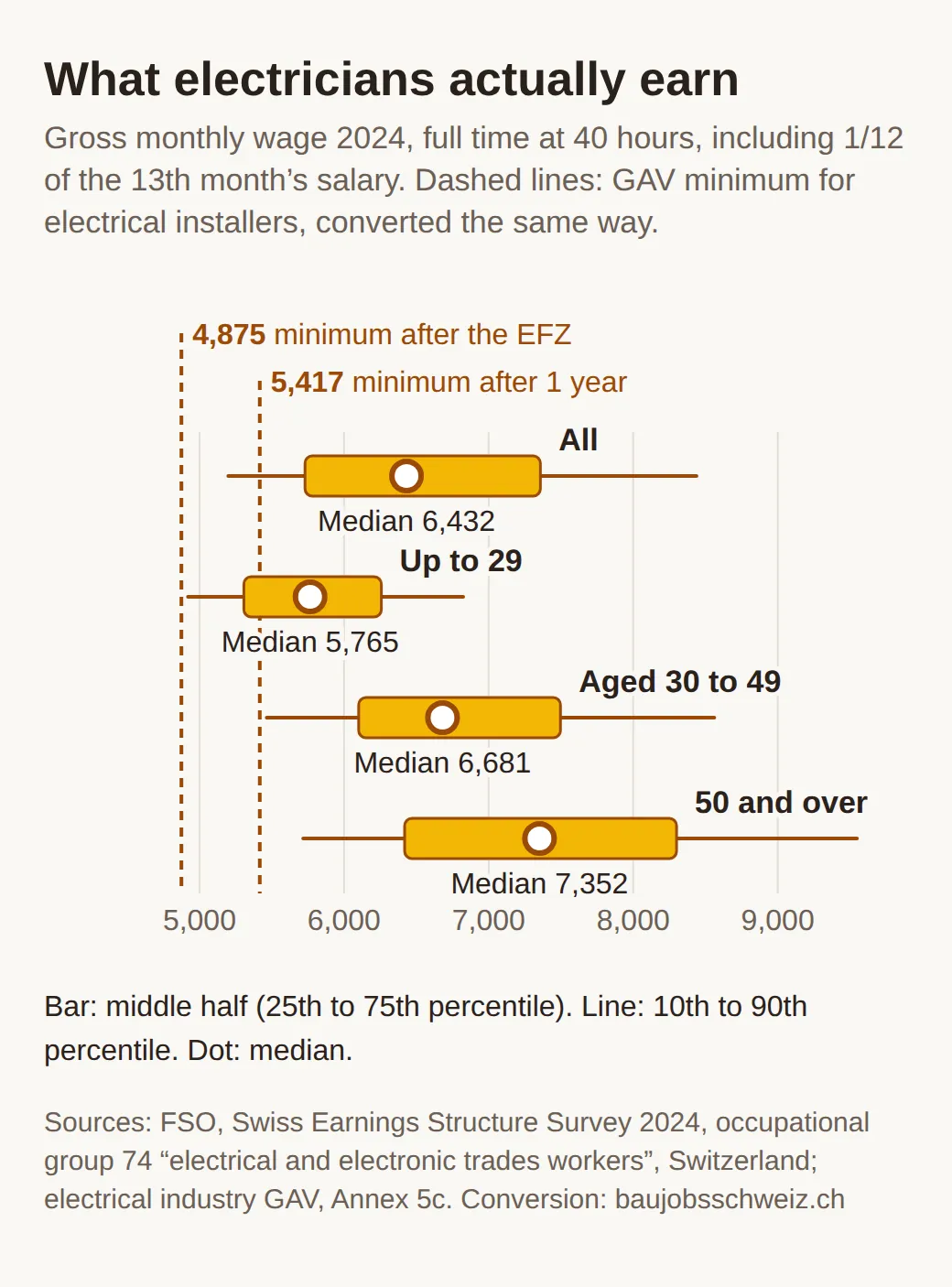
Age makes the biggest difference. Up to 29, the median is CHF 5,765, between 30 and 49 it's 6,681, and from 50 it's CHF 7,352. By region, the median varies less: it was highest in Espace Mittelland, which includes Bern, at CHF 6,645, at 6,459 in Zurich, and lowest in Ticino, at CHF 5,825. Two caveats apply: besides electrical installers, the occupational group also includes electronics technicians and electromechanics, and the figures include shift and night supplements. They still make a useful benchmark when you negotiate your pay.
If your pay isn't right
First check three things on your employment contract and payslip: the qualification your level is based on, the date from which your industry experience counts, and, if you're paid by the hour, the three supplements. If something's wrong, talk to the company first and bring your certificates.
If that doesn't help, you can contact the regional joint commission or the PLK in Bern, which, according to the GAV text, has payroll inspections carried out. If it finds breaches, the company has to pay what it owes and can be ordered to pay a contractual penalty of up to CHF 30,000 per breach, more in serious cases. You can also turn to the unions Unia and Syna, which signed the GAV with EIT.swiss.
Construction jobs in the canton of Bern
When you change jobs, it pays to negotiate with the figures from the earnings survey rather than with the minimum. In the interview, ask whether you'll be paid monthly or hourly, which level you'll be on, and whether the company has set a travel time zone. How wages in the main construction sector work by wage class and zone is shown in our article on bricklayers' pay, and what applies when you work through a temp agency in our article on temp work in construction. You'll find open positions in the city of Basel under trades and construction in Basel.
Common questions
- Does the minimum wage apply if I work as a temp electrician?
- Yes. According to the national joint commission, the minimum wages of the generally binding agreement also apply to staffing agencies. A general pay rise is yours too if you're under contract with the agency when the rise is declared binding, whatever company you're placed with. The exception is a wage agreement that leaves out new hires after a cut-off date.
- Do the minimum wages apply to electricians in Geneva and Valais?
- The national agreement doesn't apply there, because both cantons have their own agreement for the electrical trade. So you can't use the figures in this article for Geneva or Valais. Ask the cantonal joint commission or a union there for the current minimum wages.
- As a cross-border commuter with a German journeyman's certificate (Gesellenbrief), do I get the electrical installer minimum wage?
- Only with a certificate of equivalence from the Federal Inspectorate for Heavy Current Installations (ESTI) or the State Secretariat for Education, Research and Innovation (SERI). Without one, you fall into the level for a foreign electrical qualification: at least CHF 4,300 in 2026, and CHF 4,600 after a full year of experience in Switzerland. According to the joint commission, your employer has to tell you that recognition is possible.
- Does the electrical industry agreement cover electrical planners?
- Usually not. Anyone who mainly plans, designs projects, works out costings or writes quotes is excluded from the generally binding agreement, as are managers and staff who mostly do office work. So there's no GAV minimum wage for electrical planners; their pay is freely negotiated.
- Can my employer pay me less than the minimum wage because of a health condition?
- Only with approval. If a minimum wage can't be paid for reasons to do with the person, such as a health condition, the company has to apply to the national joint commission. The agreement must give its reasons and be signed by you as well.
More posts
All posts
Notice Period in Swiss Construction 2026: What the LMV Says
Notice periods in Swiss construction under the LMV 2026: probation, notice by year of service and from 55, illness and accidents, winter layoffs, RAV and FAR.

Temp work in Swiss construction: pay, expenses, notice 2026
Temping on a Swiss building site: the 2026 minimum wage, holiday pay, 13th month and site allowance, how quickly you can be let go and what happens to FAR.

Accident on a Construction Site: What Suva Pays in 2026
Hurt on a construction site? Who pays the first three days, how Suva works out the 80% daily allowance, and the rules on treatment, pensions and free time.