Notice Period in Swiss Construction 2026: What the LMV Says

What applies on site
During the probation period, you and your employer can end the job with five working days' notice. After that, the main construction sector follows the national collective agreement (Landesmantelvertrag, LMV): one month in the first year of service, two months up to the ninth, three from the tenth, always to the end of a month. From age 55 it's four and six months. And while daily sickness or accident benefits are being paid to you, your employer can't dismiss you.
If you search for Kündigungsfrist Bau, you'll often end up on Austrian rules or on general pages about the Swiss Code of Obligations (CO). They give a one-month probation period with seven days' notice, or they copy the LMV's notice periods wrongly. Hardly anyone mentions the protection during illness, which goes much further in construction than under the CO, or the longer notice from age 55. We pulled it all together from the text of the LMV 2026–2031, the CO and SECO's directives on unemployment insurance, as they stand in October 2026. The LMV, the unemployment insurance laws and SECO's directives are published in German, French and Italian only, so those links lead to German texts; the CO links go to the official English translation.
Who these rules apply to
The LMV applies in every company in the main construction sector, even if the boss isn't a member of the employers' association, because the Federal Council has declared its key parts generally binding. Under Art. 2 of the LMV, the main construction sector means above all building construction, civil engineering, tunnelling and road building, excavation and demolition. It covers the people on site and in ancillary operations: construction workers, bricklayers, foremen, machine operators and drivers.
Under Art. 5 of the LMV, it doesn't cover site foremen and works foremen, managerial, technical and administrative staff, or canteen and cleaning staff. Site foremen have their own agreement; there's more on that in our post on becoming a site foreman. If you're on site through a temp agency, the agency is your employer and the collective agreement for staff leasing (GAV Personalverleih) governs your notice, as explained in Temporary work in construction. Painters, electricians and plumbers have their own collective agreements with their own notice periods. For everyone else, it starts with the probation period.
Probation period: two months, five working days
If you're employed by a company for the first time, the first two months automatically count as probation (Art. 20 LMV). You and your employer can only extend it in writing, and by one month at most. During that time either side can give five working days' notice, on any day, not just to the end of a month. The CO provides for seven days' notice and a one-month probation period (Art. 335b CO), but it expressly allows a collective agreement to set different terms, as long as probation doesn't exceed three months.
Two points often get lost. First, the LMV's wording is "for the first time in the company" (zum ersten Mal im Betrieb). If the same firm takes you on again after a break, say in spring after a winter layoff, there's no new probation period under that wording. Second, if you miss days during probation because of illness or an accident, probation is extended by the days you missed (Art. 335b para. 3 CO). The LMV doesn't say anything different, so the CO applies.
Notice periods after probation
After probation, Art. 21 of the LMV applies: one month in the first year of service, two months from the second up to and including the ninth, three months from the tenth, each to the end of a month. The periods apply "mutually" (gegenseitig), so they're the same whether you resign or your employer dismisses you. A year of service counts from your first working day, and the second one begins on the anniversary of your start date.
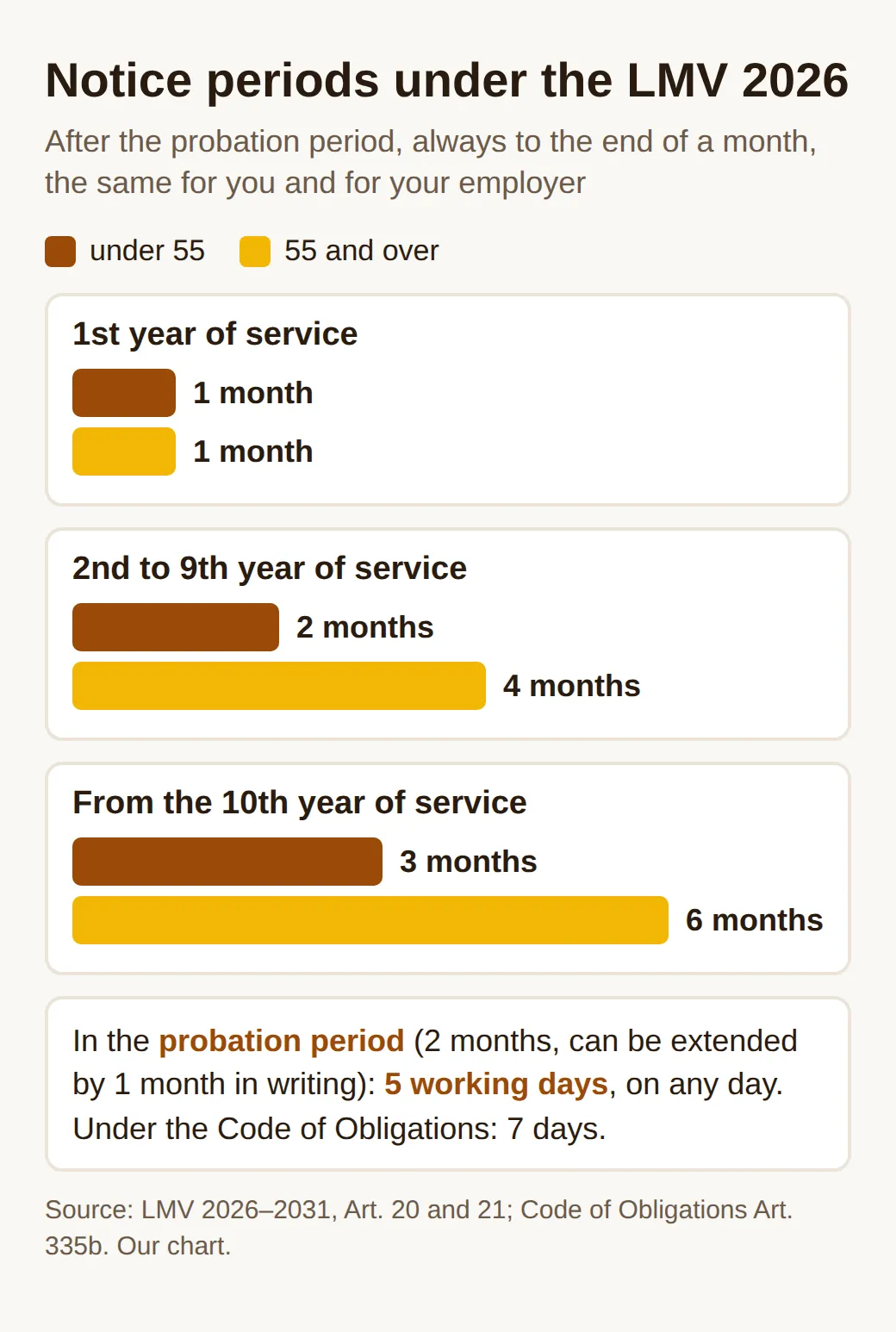
At first glance these are the same numbers as in Art. 335c CO. The difference is in the small print. The CO lets you and your employer change the periods in writing in your employment contract. Art. 21 para. 3 of the LMV forbids shortening them to your disadvantage. If your contract says "one month's notice" in your fifth year of service, that clause doesn't apply and it stays at two months. Longer periods are allowed, but then they must be the same for both sides (Art. 335a CO).
Longer notice from age 55
Once you've turned 55, notice rises to four months after the first year of service and to six months from the tenth year of service. If your employer wants to dismiss you, a meeting must take place first: your manager informs you, hears you out, and together you look for ways to keep the job. In the end, the company decides. The LMV doesn't say what happens if the meeting never takes place.
BGE 132 III 115 shows how the courts protect older employees. A heating installer had worked for the same firm since 1958 and wanted to retire after 45 years of service. Shortly before the end of his 44th year he was dismissed and put on garden leave at once. The Federal Supreme Court ruled the dismissal unlawful, because the company had dismissed him without any business need and without looking for a more socially acceptable solution, and awarded him six months' wages. The case wasn't about the LMV, but that search for a solution is exactly what the LMV requires from age 55.
Seasonal contracts
The LMV has its own rule for seasonal workers. For an open-ended seasonal employment relationship, the total length counts: under twelve months in all, notice is one month; above that, two months, both to the end of a month. Just as important as the length of the notice is when it reaches you.
When the notice has to reach you
Notice always runs to the end of a month, and it counts from the day the notice reaches you, not from the postmark. An example in the fourth year of service, so with two months' notice: if the letter is in your letterbox on 31 October, the job ends on 31 December. If it arrives on 1 November, it only ends on 31 January.
An ordinary letter counts as received once it's in your letterbox and you would normally empty it. For a registered letter the postman couldn't hand over, what counts is the day you can collect it at the counter according to the collection slip, usually the day after, not the last day you have to pick it up. The Federal Supreme Court set this out for deadlines under federal private law in BGE 137 III 208, even though that case was about the termination of a flat lease. Leaving a registered letter at the post office doesn't buy you any time.
The law doesn't require any particular form for notice. But you can ask your employer to give the reasons in writing (Art. 335 CO). If you have a lot of overtime banked when you get notice and can't use it up in the first month of the notice period, you can ask for the notice period to run one month longer (Art. 23 para. 5 LMV). How the hours account works is explained in Working hours in construction.
If you resign yourself, the same notice periods apply. If you leave more than two days early without your employer's agreement, Art. 59 of the LMV says you owe a quarter of a month's basic wage, plus any further damage. So if you agree on an earlier leaving date, put it in writing. In some situations, on the other hand, your employer can't dismiss you at all.
Protection from dismissal during illness and after an accident
This is the biggest difference from the CO. Under the CO, your employer can't dismiss you while you're ill or injured through no fault of your own, but only for a limited time: 30 days in the first year of service, 90 days from the second to the fifth, and 180 days from the sixth (Art. 336c CO). Notice given during that time is void, meaning it has no effect.
The LMV goes much further. After probation, your employer can't dismiss you for as long as the daily sickness allowance insurer or Suva is paying you daily allowances, without the CO's fixed 30, 90 or 180 days. For illness, the insurance pays until the 730th day after the illness began (Art. 56 LMV).
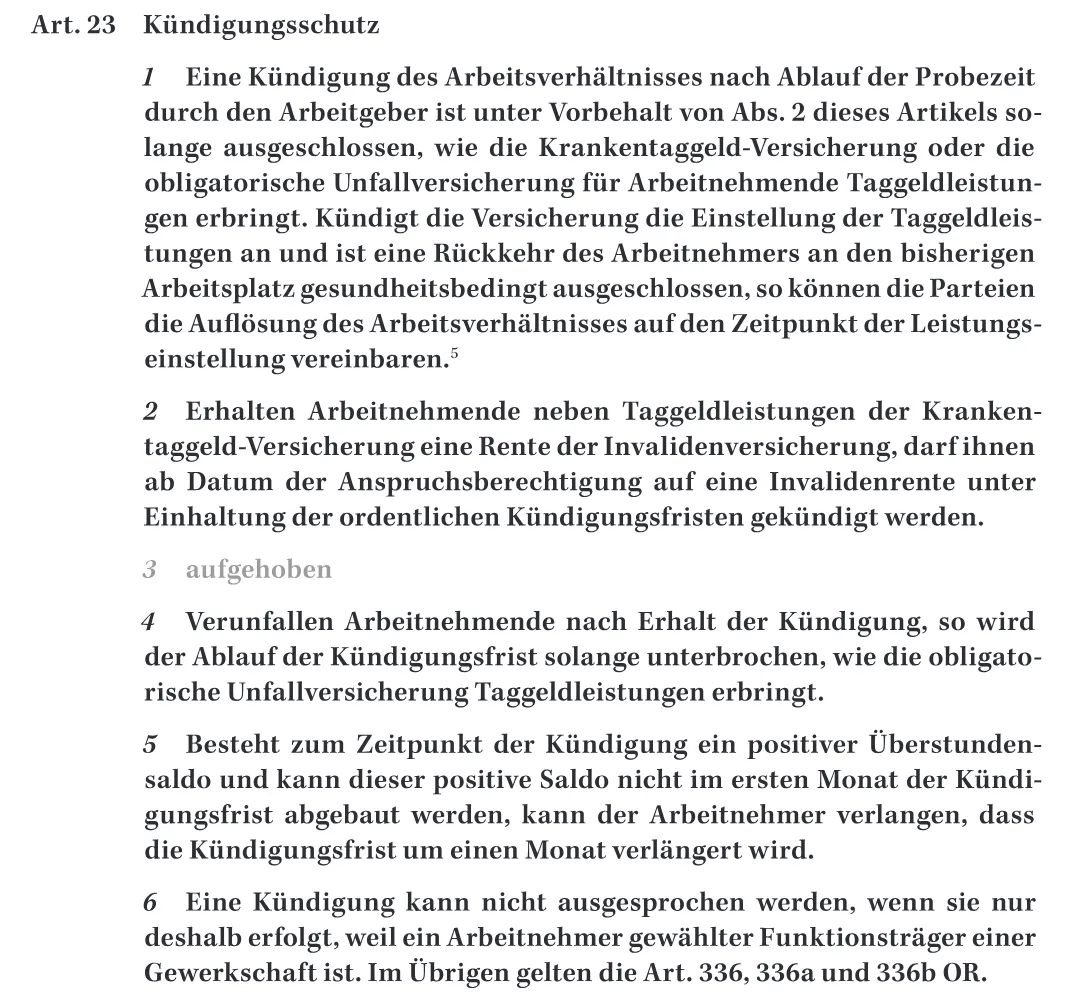
While the daily allowance is being paid, there are only two exceptions. If you get a disability insurance (IV) pension on top of the daily allowance, your employer can dismiss you with normal notice from the date you become entitled to the pension. And if the insurer announces it will stop the daily allowance and you can't return to your job for health reasons, you and your employer can agree that the job ends with the last daily allowance. "Agree" means it can't happen without your signature.
There's a gap at the start of an illness. The LMV allows employers to take out daily allowance insurance that only pays after a waiting period of up to 60 days. During that time the company itself pays 90% of the lost wages (Art. 56 LMV). The LMV ties its protection to the insurer's daily allowance. From the first day of illness, though, you're safely protected under the CO, with its 30, 90 or 180 days. So always report sick straight away and hand in the doctor's certificate. Exactly how the daily allowance insurance pays out is a topic of its own.
A case from Solothurn shows what a void dismissal means. A crane operator whose contract incorporated the LMV was given notice in September 2012, to the end of November, while he was ill. The single judge declared the dismissal void because it fell within the CO's protected period. So the employment continued without valid notice, and during his illness he was entitled to an 80% daily allowance from the insurance under the LMV. That put so much money at stake that a court of three judges should have decided the case. The cantonal High Court sent the case back to that court, and the Federal Supreme Court confirmed this in 4A_488/2014. How it ended has not been published.
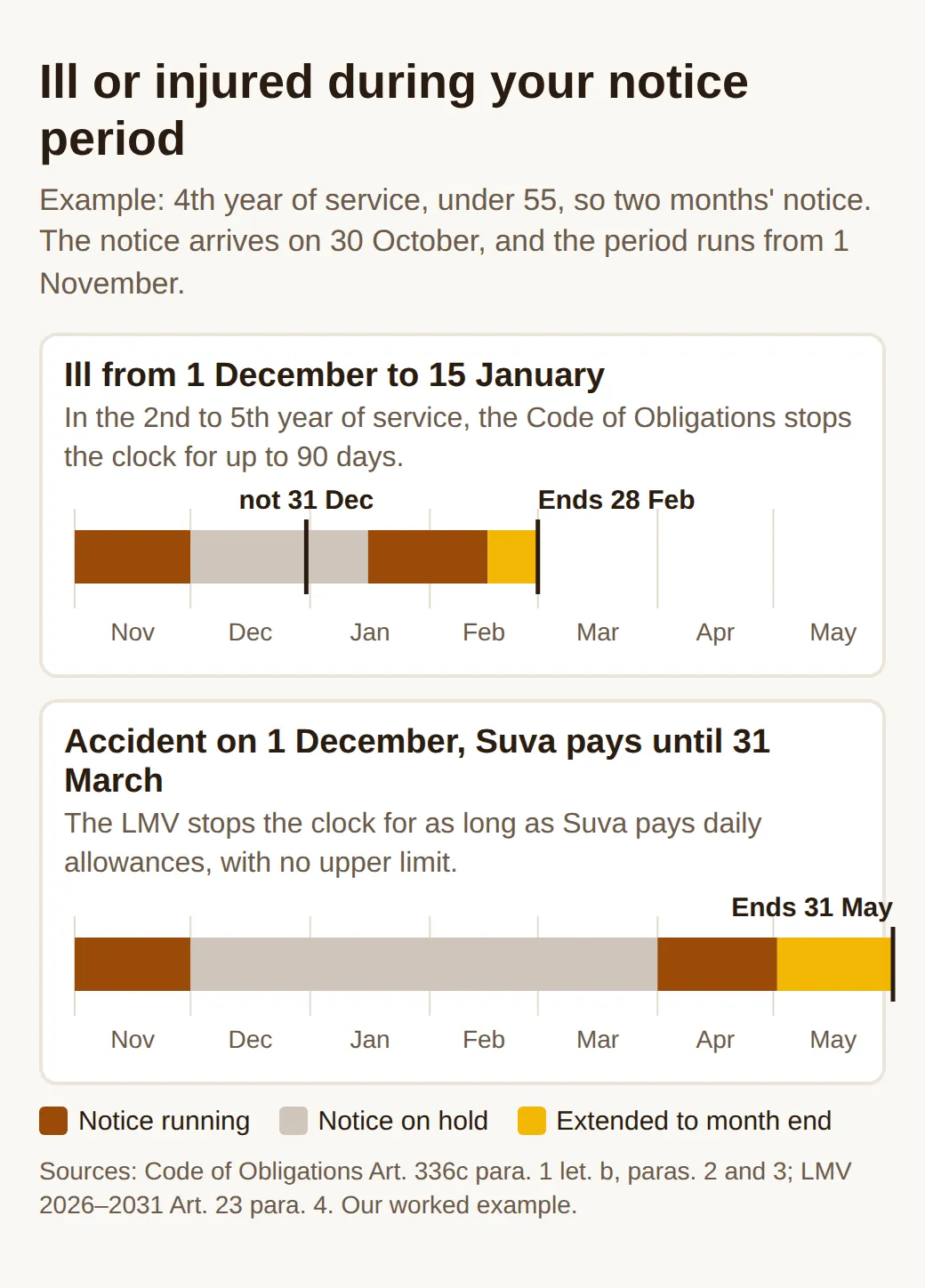
Ill or injured after you've already been given notice
If you only fall ill after receiving notice, the CO puts the notice period on hold for at most 30, 90 or 180 days, depending on your year of service. After that the rest of the period runs on and is extended to the next month end. If you have an accident after receiving notice, the LMV is again more generous: the notice period is on hold for as long as Suva pays daily allowances (Art. 23 para. 4 LMV). The LMV doesn't say whether the rest is then also extended to the end of the month. In the example below, we calculate it the same way as under the CO. What else Suva pays for is in Accidents on the building site.
Bad weather and short-time work don't protect you from dismissal
There's no protected period for bad weather. Your employer can dismiss you in January too, while the site is shut down by snow. But that changes who pays for the lost time. Bad weather compensation carries on during the notice period: under SECO's directive (margin no. B24), employees who have been given notice are entitled to it as well. On days when the weather stops work, you still get 80% of the lost earnings, as described in Bad weather in construction.
Short-time work is the other way round. Anyone whose employment has been terminated has no right to short-time work compensation from the start of the notice period, whoever gave notice (directive on short-time work, margin nos. B27 and B28). If work then dries up for lack of orders, the company bears the cost and owes you your full wage (Art. 324 CO). Often the harder question isn't who pays, but why you were dismissed.
Union work and other reasons that make a dismissal unlawful
Art. 23 para. 6 of the LMV prohibits dismissing you simply because you're an elected union official, and refers to the CO for everything else. Under the CO, a dismissal is unlawful (often called unfair or abusive dismissal) if it's because you are or aren't a union member, or because you carry out lawful union activities. If you're an elected employee representative, your employer even has to prove it had just cause (Art. 336 para. 2 CO). A dismissal is also unlawful if it's because you assert claims in good faith, for example for unpaid overtime or travel time, or because you're doing military or civilian service.
An unlawful dismissal stays valid. You get compensation set by the court, at most six months' wages (Art. 336a CO). The LMV leaves open whether its stricter wording gives union officials any more than this. For the compensation there are two deadlines you mustn't miss: you have to object to the dismissal in writing to your employer by the end of the notice period, and file your claim no later than 180 days after the job ends (Art. 336b CO). An objection can be this short:
Objection to the notice of termination of [date]
I hereby object to the notice of termination of [date] under Art. 336b CO. I consider the dismissal unlawful because [reason, for example: it came two weeks after I was elected to the committee of the union branch]. I am willing to continue working.
[Place, date, signature]
Send it by registered post and keep a copy. If it's not just you but many people at once, further rules apply.
Mass redundancies in construction
Mass redundancies are when a company, within 30 days, dismisses people for reasons that have nothing to do with them personally: at least ten employees in a company with 21 to 99 staff, at least 10% in one with 100 to 299, and at least 30 in one with 300 or more (Art. 335d CO). The company must then consult the workforce beforehand, inform them in writing of the reasons and the numbers, and notify the cantonal employment office. A job terminated this way ends no earlier than 30 days after that notification to the office (Art. 335g CO). If the consultation is skipped, the dismissal is unlawful, but compensation is capped at two months' wages.
Art. 60 of the LMV asks for more. The company has to inform the joint professional committee (paritätische Berufskommission) in good time. When choosing who goes, it should take into account personal circumstances, family and support obligations, length of service and qualifications, and occupational mobility. And it's expected to draw up a written social plan, even if it's below the size at which the CO requires one (250 employees and 30 dismissals). In construction, though, there's one kind of dismissal that comes round every year.
Laid off in autumn, rehired in spring
Some firms in construction and tourism, especially in Valais and Graubünden, lay off their workers at the end of the season and take them back for the next one, with unemployment insurance paying for the months in between. That's how Blick described it in January 2020. Legally, it's an entirely normal dismissal. The full notice periods to the end of a month apply, and so does all the protection from dismissal. If you're ill in November and receiving daily allowances, you can't be dismissed just because winter is coming.
What a promise to take you back in spring is worth depends on exactly what was promised. So get it in writing, with a date and a wage. For the RAV, the regional employment centre, a vague promise changes nothing: under SECO's directive on unemployment benefits, a merely verbal assurance of further work doesn't release you from looking for a job, and neither does a job that's only in prospect. If you only take seasonal jobs and only look for fixed-term work, you're not considered fit for placement and get no daily allowance. You also have to apply for permanent jobs, outside construction if necessary (margin no. B260). If the same firm rehires you in spring, there's no new probation period under Art. 20 of the LMV.
Waiting days at the RAV
Daily allowances start after waiting days, during which you're unemployed and get nothing (Art. 18 AVIG, the Unemployment Insurance Act). As a rule there are five. Without children under 25, there are ten days with insured earnings of CHF 60,001 to 90,000 a year, 15 days up to CHF 125,000 and 20 above that. You have no waiting days with insured earnings of up to CHF 36,000 or, with children under 25, up to CHF 60,000 (Art. 6a AVIV, the Unemployment Insurance Ordinance). You only serve these general waiting days once in the two-year framework period, so not again every winter, as long as the framework period is running.
After seasonal work, there's an additional special waiting day (Art. 6 AVIV). It doesn't apply, among other cases, if the job lasted at least a year without a break or was ended early for economic reasons. You have to register with the RAV no later than the first day you want to be paid for (Art. 17 AVIG), and you have to apply for jobs from the day you received notice. The Federal Supreme Court decided this in ruling 8C_768/2014. If you're a few years away from early retirement, there's more to think about at the RAV.
Dismissed at 55 or older: what it means for FAR and the RAV
From 55 you have the longer notice of four or six months and the meeting before any dismissal. But the biggest worry is usually early retirement at 60 through the FAR foundation. How the pension works is covered in Early retirement in construction. Here it's only about the consequences of a dismissal.
For the full FAR pension, the last seven years before retirement must be spent without a gap in a company covered by FAR. Unemployment during that time is allowed for up to two years at most, but it costs you: the pension is cut by 1/180 for every missing month, unless you make up the time by working or pay the contributions afterwards (Art. 13 and 16 of the FAR regulations). As a rule, only someone registered with the RAV counts as unemployed. A gap of at most six months without RAV registration after your employer dismissed you only counts as unemployment if you then went back to work for a FAR company. So always register with the RAV, even if you expect to find a new job quickly.
For seasonal workers there's an exception few people know about. If you work at least six consecutive months every year between the start of March and the end of November in a FAR company, as a rule over at least three seasons in a row, unemployment in December, January and February doesn't count towards the two years (Art. 17 para. 1ter of the FAR regulations).
At the RAV you get more daily allowances from 55: up to 520 instead of 400, if you can show at least 22 months of contributions (Art. 27 AVIG). If you become unemployed in the last four years before your AHV reference age, you get 120 extra daily allowances, and the framework period runs until your AHV pension starts (Art. 41b AVIV).
Two mistakes cost especially dear at this age. Don't sign a termination agreement that shortens the notice period. The unemployment insurance fund can treat that as unemployment through your own fault (directive on unemployment benefits, margin no. C216) and suspend your benefits for a number of days. If you resign without a new job to go to, that usually counts as serious fault: 31 to 60 suspension days (Art. 45 AVIV). And don't confuse dismissal with a planned exit: if you're entitled to the FAR pension the following year, you and your employer agree on it in writing by the middle of the year before, under Art. 21 para. 5 of the LMV, and the job ends automatically when the pension starts, with no notice needed.
What you can do now
If you've been given notice, first write down the date it arrived. Then count your years of service, check whether you're 55, and work out the end date to the right month end. If the date in the letter is wrong, write to your employer saying which end date you believe is correct. If you were ill or injured when the notice came, have it checked before the notice period runs out. Don't sign anything that shortens the notice period. And register with the RAV as soon as you know you don't have a job to go to.
The notice period is also time to look for work, and the RAV will want to see your applications from that period.
If you're looking in the mountain cantons, also check the canton of Valais and the canton of Graubünden. Ask at the interview whether the company is bound by the LMV and the FAR collective agreement. Your notice periods depend on it and, from your mid-50s, so does your early retirement.
Common questions
- Does a resignation or dismissal in Swiss construction have to be in writing?
- No. Neither the Code of Obligations nor the LMV requires any particular form for ordinary notice; only an extension of the probation period must be in writing. But whoever gives notice has to be able to prove that it arrived and when, so a registered letter is worth it. You can ask your employer to give the reasons in writing.
- Do the LMV notice periods apply to site foremen?
- No, Art. 5 of the LMV excludes site foremen and works foremen. For them, the Swiss Builders' Association, Unia, Syna and Baukader Schweiz signed the collective agreement for construction supervisors: three months' probation with seven days' notice, then one month in the first year of service and three months from the second, four months from age 55 and six months from the tenth year of service. Your employment contract says whether your company is bound by it.
- What notice period applies if I work for a temp agency on a building site?
- Your employer is the temp agency, not the construction company, so Art. 21 of the LMV does not apply. For an open-ended assignment, the federal law on recruitment and staff leasing allows notice of at least two days in the first three months and at least seven days from the fourth to the sixth month. After that, your assignment contract and the collective agreement for staff leasing apply.
- Do I get my 13th month's salary if I leave in the middle of the year?
- Yes, pro rata. Under Art. 45 of the LMV you are entitled to the 13th month's salary from your first working day, and if the job did not last a full calendar year, you get the share for the months you worked. It belongs on your final payslip.
More posts
All posts
Site Foreman (Polier) Training 2026: Path, Cost and Pay
How to become a site foreman (Polier) in Switzerland: from bricklayer to foreman to federal diploma. Duration, cost, federal subsidies and 2026 pay.

Electrician Pay in Switzerland 2026: Minimum Wages to 2029
Electrician salary in Switzerland 2026: GAV minimum wages for electrical installers and installation electricians, apprentice pay and the 2027 rise.

Temp work in Swiss construction: pay, expenses, notice 2026
Temping on a Swiss building site: the 2026 minimum wage, holiday pay, 13th month and site allowance, how quickly you can be let go and what happens to FAR.