Sick Pay in Swiss Construction: What the LMV 2026 Pays
The short answer
If you are off sick on a Swiss building site, your employer's daily sickness benefits insurance pays 80% of the wage you lose, from the second day of illness up to the 730th day after the illness began. You bear the first day yourself. You and your employer each pay half the premium. That is what the national collective agreement for the main construction sector (Landesmantelvertrag, LMV) 2026 says.
You'll often see other figures online. 90% applied under the LMV 2023–2025. "720 days within 900" comes from the LMV of 2000 and from the Health Insurance Act. And the Bern or Zurich scale that many guides use to work out sick pay only matters for you in construction in one special case. Here we follow an illness from day one, based on the text of the LMV 2026 as of 1 April 2026, and show what applies if you are dismissed, work part-time, commute across the border or are close to your FAR early retirement pension. The agreement and most of our sources are published in German, French and Italian only, so most links below lead to German texts.
What the LMV has required since 2026
Every company covered by the LMV must take out daily sickness benefits insurance for its staff. That is in Art. 56 of the national collective agreement 2026–2031. Because the Federal Council has declared the LMV generally binding, this also applies to construction companies that don't belong to any association. Your cover starts on the day you start work or should have started. There's no waiting period for new staff.
The insurance replaces the duty to keep paying wages that the Code of Obligations otherwise places on the employer. If the insurer pays what the LMV requires, Art. 56 para. 11 says that settles every claim under Art. 324a CO. That's why the scales courts otherwise use to set how long an employer must keep paying wages play almost no role in construction. If the insurer pays less than the LMV requires, your employer is liable for the difference.
What's new since 2026 is the amount. The LMV 2023–2025 still required 90% of the wage lost; the new agreement only requires 80%. At the same time, the employer may choose a policy with a deferral period of up to 60 days instead of 30. In its explanatory paper on the LMV 2026, the Swiss joint enforcement commission (SVK) says this brings the terms into line with the usual conditions on the market. For companies that belong to an association, this has applied since 1 January 2026; for all others since 1 April 2026, when the agreement was declared generally binding.
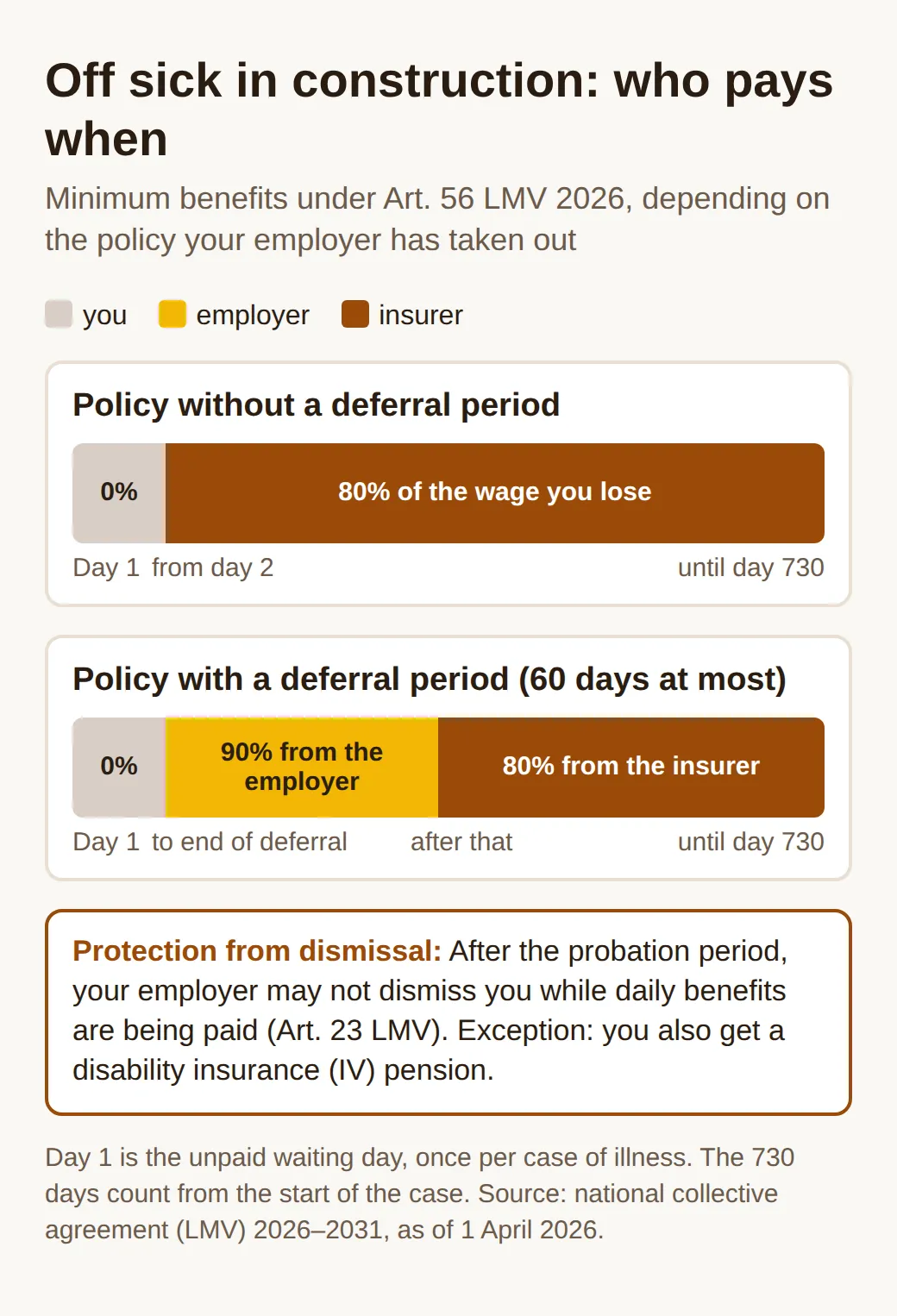
You can see which of the two your employer has in the policy, or ask in the office. For the first day it makes no difference: nobody pays for that one.
Day 1: the waiting day
Each case of illness has at most one unpaid waiting day (Karenztag), and you bear it (Art. 56 para. 3 LMV). A trained bricklayer with a Federal VET Diploma (EFZ) and three years on building sites (wage class Q) earns at least CHF 34 an hour in the red wage zone in 2026. Taking an 8-hour working day, the waiting day costs him CHF 272 gross. Exactly how many hours a day counts for is in your company's working time calendar. Three bouts of flu in a winter mean three waiting days.
There is one exception, for a relapse. If the same illness makes you unfit for work again within 90 calendar days of your return, there's no waiting day. So tell your doctor it's the same illness as before, so that it goes on the certificate.
None of this applies to accidents. Suva pays for those, with its own rules and its own waiting days. Our post on accidents on the building site explains how that works. Here it's only about illness, and from the second day on, about money.
From day 2: 80%, from your employer or the insurer
From the second day, you get at least 80% of the gross wage you lose because of the illness. If your employer has a policy with a deferral period, it pays you 90% itself until that period ends, and then the insurer takes over with 80% (Art. 56 para. 5). In the first few weeks you are better off than with a policy that has no deferral period.
The calculation uses the wage for your normal contractual working hours, as last paid. If LMV wages go up while you are sick, your daily benefit goes up with them. The share of the 13th month's salary must be included in the cover, as Annex 6 of the LMV says. There is an upper limit: you may not get more while sick than you would at work, measured on your net wage.
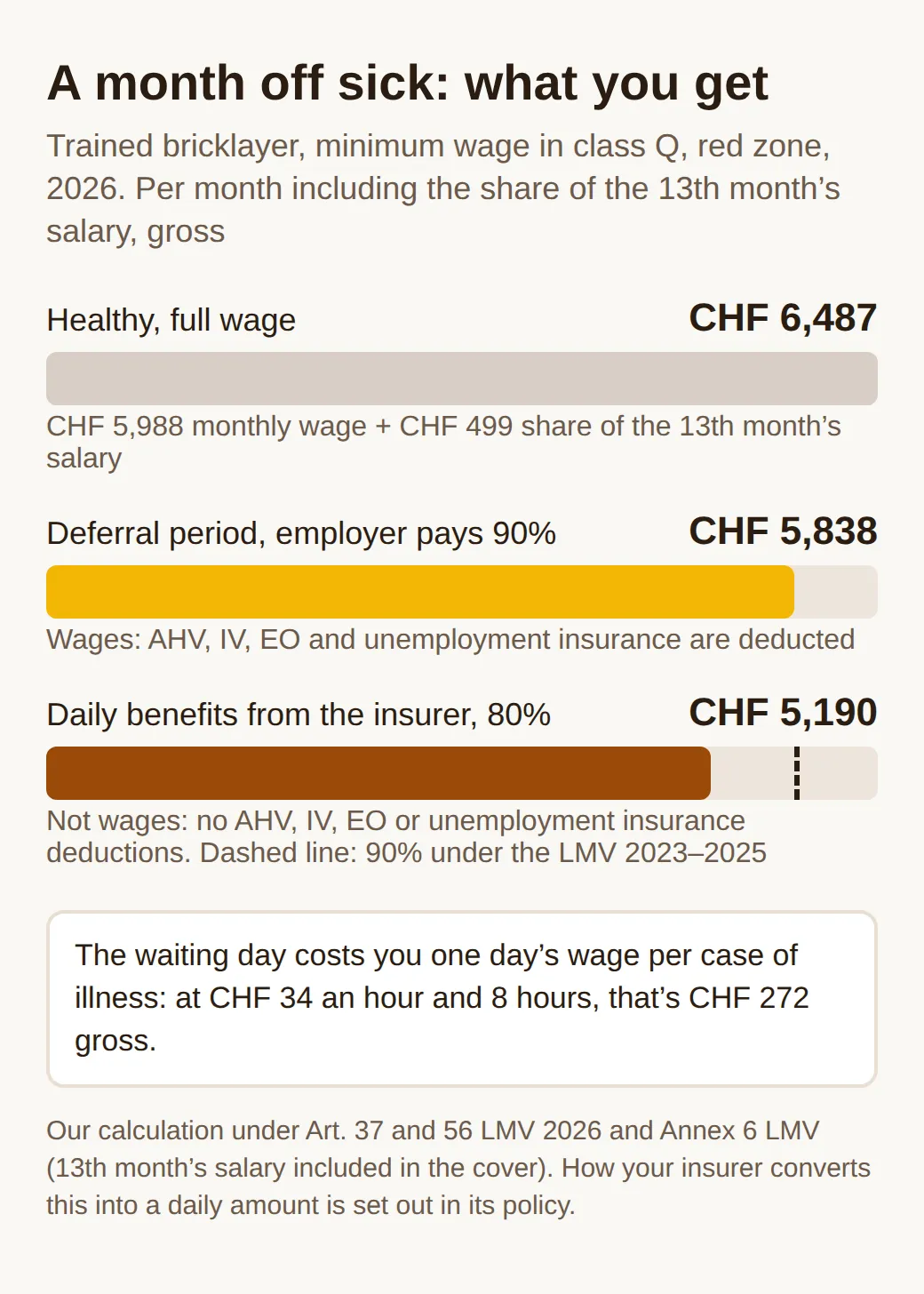
The gap in your wallet isn't quite as big as the bars suggest. Insurance benefits paid for illness don't count as earned income under Art. 6 of the AHV ordinance (in German). So no contributions to AHV, IV, EO (old-age, disability and income compensation insurance) or unemployment insurance come off the daily benefit, and according to the FAR foundation, no FAR contributions either. The 90% your employer pays during the deferral period, on the other hand, counts as wages, with all the usual deductions.
Part-time and partly sick
If you work part-time, it has to be agreed in writing, with your share of the annual working hours. The hours credited to you for days of sickness fall in the same proportion (Art. 25 para. 3 LMV), and the daily benefit is based on the part-time percentage in your contract. At 60%, you get 80% of your 60% wage.
If you are only partly unfit for work, the insurer pays according to the degree of incapacity, as soon as a doctor certifies at least 25%. That's more generous than daily benefits insurance under the Health Insurance Act (KVG), which only has to pay from 50%. If you are 50% sick, you work the other half and get your wage for it, and the daily benefit for the sick half. For that to run smoothly, you need the right papers at the right time.
Calling in sick: what to do and when
The LMV doesn't say by when you must call in sick or from which day you need a doctor's certificate. That's set by the conditions of your employer's policy and the company's own rules. Your employer must tell you about these conditions (Art. 56 para. 11). That's more than a formality: if the insurer refuses benefits because you broke its conditions through your own fault, your employer is not liable, provided it had informed you. Then you bear the loss.
The insurer Helsana's information sheet for employees shows what this looks like in practice. You report the illness to your employer immediately. If you report it late or have no medical certificate, the start of benefits can be postponed or cancelled altogether. If the illness goes on, you send a new certificate every month, and at the end one confirming you are fit for work again. You give the insurer a power of attorney for your medical data and stick to your treatment. After 120 days at the latest, it sends you the form to register for disability insurance (IV), with which it coordinates your case. Helsana usually pays the daily benefit to your employer, who must pass it on to you. Other insurers have similar rules, but not the same ones. Ask the office for your insurer's information sheet and keep a copy of every certificate.
The report itself doesn't have to be complicated. A message to your site foreman or the office is enough, as long as it comes early:
Good morning, this is [name]. I'm sick and can't come to the [place] site today. I'm seeing a doctor today and will send you the medical certificate as soon as I have it.
Things only get tricky when the illness comes back.
Relapse: when a new case begins
Two different time limits apply to a relapse. You've already seen the first: if the same illness comes back within 90 days of your return, you don't pay a new waiting day. The second is about duration. The insurer pays up to the 730th day after the case began. Under Art. 56 para. 4, a new case with a fresh 730 days only begins if you were fit for work without a break for twelve months before the relapse.
An example: you are off with a slipped disc in March, are back at work from June and go off again in November with the same back problem. More than 90 days have passed since your return, so you pay a waiting day again. But you weren't healthy for twelve months, so for the insurer it's the same case. The clock has been running since March, and there's no new deferral period either.
Pre-existing conditions
For serious conditions you were already being treated for before you joined the insurance, the insurer may limit its benefits. How far depends on how long you have been employed without a break by companies covered by the LMV (Art. 56 para. 8):
| Employed without a break | Daily benefits per case, at most |
|---|---|
| up to 6 months | 4 weeks |
| up to 9 months | 6 weeks |
| up to 12 months | 2 months |
| up to 5 years | 4 months |
After five years without a break in the Swiss main construction sector, you get the full benefit. Gaps of less than 90 days don't count as a break, or less than 120 days for seasonal workers and short-term residents. So if you move from one construction company to the next, you don't start from zero. And where the insurer only covers you with an exclusion, your employer must pay your wages itself under Art. 324a CO. Who pays for the insurance is the next question.
Who pays the premium for daily sickness benefits?
You and your employer each pay half the actual premium (Art. 56 para. 5). How much it is depends on the insurer and the company. You see your share as a deduction on your payslip. While you are sick, you pay no premium.
How seriously the courts take these duties is shown by a case the Federal Supreme Court decided in 2001 (BGE 127 III 318, in German). After an accident, and once Suva's benefits ended, a labourer got daily benefits from his construction company's group insurance. From April 1998 he received a disability insurance pension, and the company dismissed him with effect from the end of July 1998. He transferred to individual insurance, which kept paying him daily benefits until November 1999, and said he had paid the premiums for it himself. He sued for CHF 10,635. The Zurich courts dismissed the claim; the Federal Supreme Court found for him in principle. The employer's duty to arrange the premium waiver can apply beyond the end of the job, and an employer that fails to take out the group insurance it promised is liable for the loss. Whether the man had really paid the premiums was left for the cantonal High Court to settle. The case was decided under an LMV from the 1990s, but the premium waiver during illness and the employer's liability for gaps are still in the agreement today.
If your employer has no insurance at all, or one that pays less than the LMV, it owes you the difference itself. Contact your union or the joint trade committee in your region (paritätische Berufskommission), which enforces the LMV. The most money is often at stake when a dismissal comes into play.
Sick during your notice period or in bad weather
After the probation period, your employer may not dismiss you as long as the daily sickness benefits insurance is paying (Art. 23 para. 1 LMV). That can last two years and is far stronger than under the Code of Obligations, where protection ends after 30, 90 or 180 days depending on your years of service. If you get a disability insurance pension alongside the daily benefit, your employer may dismiss you from then on with the normal notice. New since 2026: if the insurer announces the end of its payments and you can't return to your job for health reasons, you and your employer can agree to end the employment on that day. 'Agree' means you don't have to say yes.
It's different if you have already been given notice and only fall sick afterwards. Then the notice period is paused, but only for as long as Art. 336c CO provides: at most 30 days in the first year of service, 90 days in the second to fifth, and 180 days from the sixth. After that, the rest of the notice period runs on, and the end moves to the next end of the month. Notice periods, probation and winter layoffs are covered in our post on dismissal in construction.
For bad weather, the rule is this: unemployment insurance only pays bad weather compensation for work lost solely because of the weather (Unemployment Insurance Act, in German). If you are already signed off sick, you are off because of the illness, and that carries on through the daily sickness benefits. Whether your insurer pays less for days when your healthy colleagues aren't working either is set by its policy. The LMV only says you may not get more while sick than at work. How bad weather compensation itself works is in our post on bad weather in construction. When the job ends, a new question comes up.
When you leave your employer
When your employment ends, so does your cover under the group insurance (Art. 56 para. 9). If you are sick on that day, it keeps paying for that case until you are fully fit for work again, up to the 730-day limit. For a new illness after you leave, it pays nothing more.
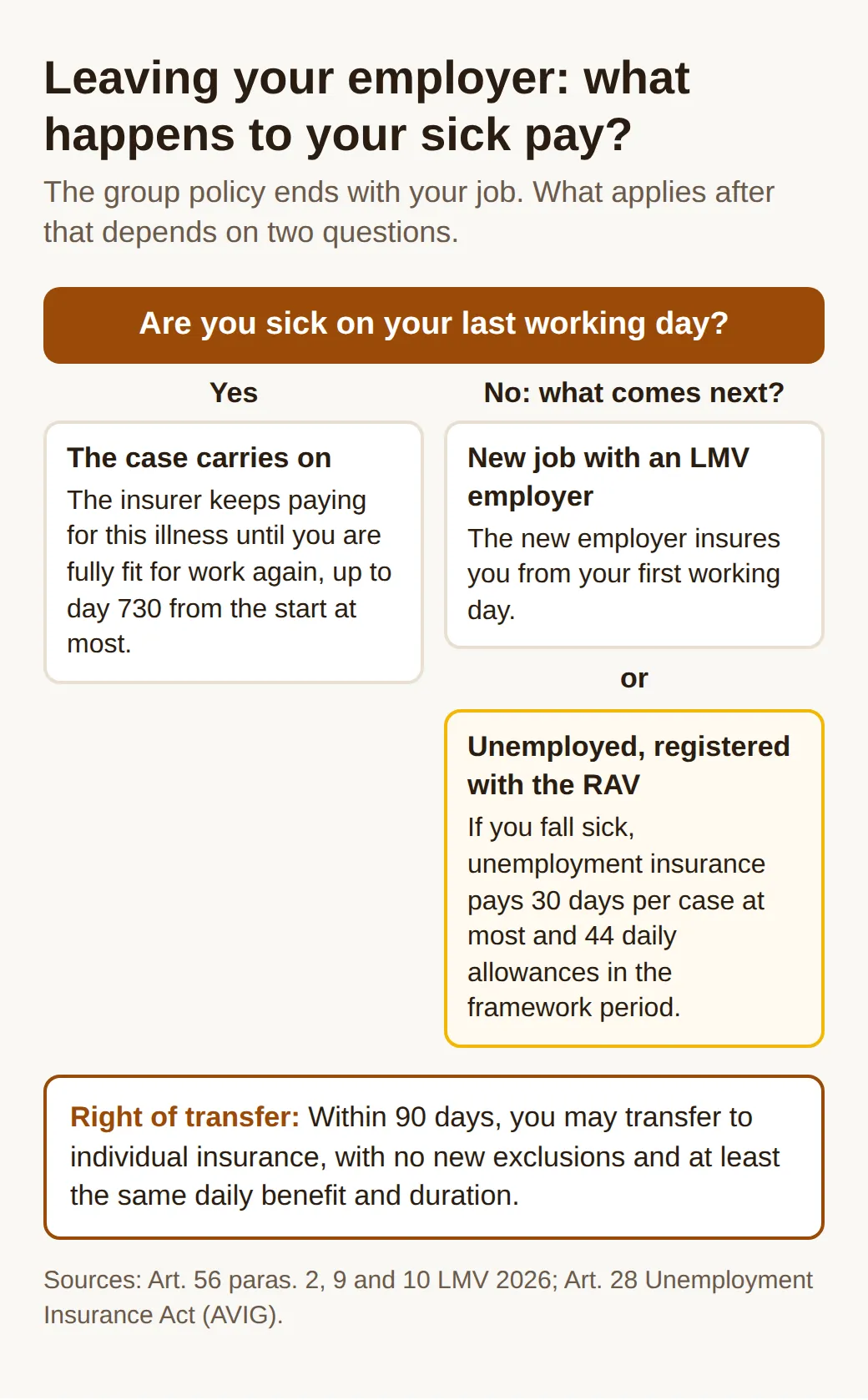
If you start straight away at another construction company, you are insured there from day one. If you become unemployed, the gap is large. If you are sick, unemployment insurance only pays the full daily allowance up to the 30th day of incapacity, and no more than 44 daily allowances in the whole framework period (Art. 28 AVIG, in German). The canton of Bern's unemployment insurance office (in German) works out that 30 calendar days equal 20 to 22 daily allowances, and strongly recommends that unemployed people take out daily sickness benefits insurance.
That is exactly what you have a right to: within 90 days of leaving, you may transfer to the insurer's individual insurance. The insurer may not add new exclusions and must cover at least your previous daily benefit and the previous duration of benefits. Your employer must tell you about this in writing in good time (Art. 56 para. 10). You then pay the premium on your own. If your employer's policy runs under the Health Insurance Act, you even stay in the group insurance until the insurer has informed you in writing (Art. 71 KVG, in German).
Some insurers restrict the right of transfer in their conditions. Helsana, for example, rules it out if you live abroad, join a new group policy, or leave during the probation period and don't register with unemployment insurance. The LMV has no such exceptions. So write early, by registered post:
Transfer to individual insurance: I was employed by [company] until [date] and insured under its group daily sickness benefits insurance (contract [number]). Under Art. 56 para. 10 LMV, I am transferring to individual insurance, with my previous daily benefit, the previous duration of benefits and no new exclusions. Please send the policy and the premium invoice to [address].
Cross-border workers, short-term permits and travel abroad
The insurance applies worldwide, but not without limits (Art. 56 para. 12). If you are abroad for more than three months, it lapses, unless you are in hospital and may not travel back for medical reasons. Liechtenstein doesn't count as abroad. More important in everyday life: if you travel abroad while sick without the insurer's express consent, it only pays again from your return. Helsana asks to be told 14 days before you travel. That includes visiting family in your home country.
If you have neither an annual residence permit nor a settlement permit, for example only a short-term L permit, all benefits end when your permit expires or when you leave Switzerland. The only exception is a medically necessary hospital stay in Switzerland, with the approval of the authority in charge.
The insurer treats cross-border workers like everyone else, as long as they live in the neighbouring border zone and stay reachable for the insurer's checks. If you move for good to another region abroad, it may stop paying. Rights under the agreements with the EU and EFTA are not affected. When transferring to individual insurance, living abroad can become a problem, see above.
Jobs near the border
Depending on where you live across the border, jobs in Basel, Geneva or Ticino are closest. With a new employer, ask which insurer covers the daily sickness benefits and what it requires if you live abroad.
In your late fifties: sick before the FAR pension
For older construction workers, a long illness shortly before 60 can upset early retirement. The LMV protects you from dismissal as long as the daily benefit is being paid, even at 58 or 59. Your FAR pension is postponed if you are fully unfit for work and getting daily benefits when it is due to start. According to the FAR foundation, it only starts once it is higher than the daily benefit, once you are awarded a disability insurance pension, or once the daily benefits run out with no disability insurance decision yet. You still have to apply no later than six months before the date you originally planned, or the pension starts later by the length of the delay. The foundation offsets the daily benefit and any disability insurance pension awarded later against the FAR pension, because FAR only pays after all other social insurance.
If your job ends while you are sick, register with the RAV, the regional employment centre, even if you can't work. The FAR regulations (in German) count people who are unfit for work and whose employment has ended as unemployed if they are registered with the RAV. Up to two years of unemployment in the last seven years before the pension are allowed, with a reduction. Without registering, you risk a gap in the seven years you must have worked in construction without a break. How the FAR pension is calculated, and which gaps remain in AHV and the pension fund, is in our post on early retirement in construction.
What you can do now
Check your next payslip for a deduction for daily sickness benefits. If there isn't one, ask which insurer your employer has insured you with. Get the information sheet or the conditions and look for two things: by when you must hand in a medical certificate, and whether the policy has a deferral period. Then you know who pays you 90% in the first weeks and who pays 80% after that. And if you leave or have to leave, mark the 90-day transfer deadline in your calendar before you walk out of the office for the last time.
If you are looking for a new job
Every construction company covered by the LMV must insure you against illness from your first day. Still, ask about the insurer and the deferral period at the job interview: the answer quickly shows you how well the company knows its obligations.
Common questions
- Do I get sick pay during the probation period in construction?
- Yes. Under Art. 56 LMV, your cover starts on the day you start work or should have started, so the probation period is included. What you don't have during probation is protection from dismissal: your employer may dismiss you even though you are sick, because the ban on dismissal in the LMV and the Code of Obligations only applies once the probation period is over.
- Are apprentices covered by daily sickness benefits insurance?
- Yes. The LMV's annex on the conditions for apprentices expressly lists the daily sickness benefits insurance under Art. 56 among the benefits apprentices receive. The same rules therefore apply: one waiting day per case of illness, then 80% of the apprentice wage you lose.
- Does daily sickness benefits insurance pay during maternity leave?
- Yes. The LMV requires maternity benefits for at least 16 weeks, at least eight of them after the birth. These weeks don't count towards the 730 days for illness. The insurer may offset the state maternity allowance from the income compensation scheme (EO) where it is paid for the same period.
- Do I get public holiday pay if I'm off sick on a public holiday?
- No, not if you are getting daily sickness benefits for that day. The LMV rules out public holiday pay in that case so the day isn't paid twice. The daily benefit itself carries on over the public holiday.
More posts
All posts
Temp work in Swiss construction: pay, expenses, notice 2026
Temping on a Swiss building site: the 2026 minimum wage, holiday pay, 13th month and site allowance, how quickly you can be let go and what happens to FAR.

Notice Period in Swiss Construction 2026: What the LMV Says
Notice periods in Swiss construction under the LMV 2026: probation, notice by year of service and from 55, illness and accidents, winter layoffs, RAV and FAR.

Electrician Pay in Switzerland 2026: Minimum Wages to 2029
Electrician salary in Switzerland 2026: GAV minimum wages for electrical installers and installation electricians, apprentice pay and the 2027 rise.